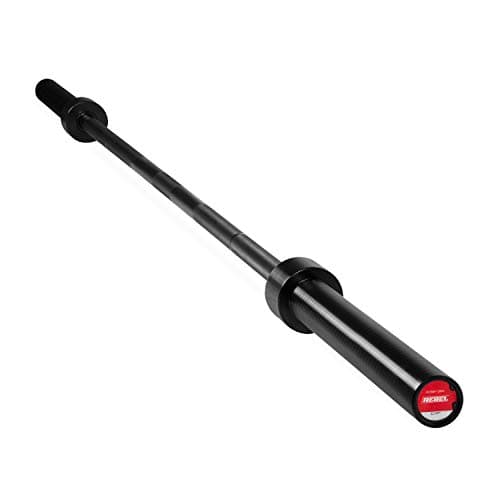
The headline: a 2,000 lb rating at a budget price
The single reason to look at The Rebel is its 2,000 lb capacity, a figure that normally lives on specialist power bars costing several times more. On a budget bar it’s unusual, and it’s the whole value story. The important honesty note is how to read a rating like this: no home lifter loads anywhere near 2,000 lb, so treat it as durability headroom, not a target. A bar rated this high isn’t going to take a permanent set from your squats and pulls, and it gives you the confidence that the shaft has margin to spare for years. Our weight-capacity guideexplains why the number matters as a durability signal rather than a ceiling you’ll ever approach.
It’s worth being precise about what the rating does and doesn’t promise. Capacity tells you the shaft is strong; it says nothing about how the bar feels in the hand, how the sleeves spin, or how sharp the knurl is. Plenty of cheap bars quote a big number and then disappoint on everything else. What makes The Rebel interesting is that the high rating comes attached to a full-length 7 ft shaft and a real Olympic 2" fitment — so you’re getting a genuinely capable bar body, not a big number on a compromised frame.
Length and stiffness: built for heavy, slow lifts
At a full 7 ft, The Rebel racks in a standard power rack and takes the same plates and collars as any Olympic bar. More to the point, a long, high-capacity shaft like this behaves the way a general-strength lifter wants: it stays reasonably stiffunder heavy, slow lifts. That makes it a comfortable fit for squats, presses and deadlifts, where you want the bar to sit still rather than oscillate. It won’t give you the tuned whip of a dedicated Olympic weightlifting bar, but for the powerlifts and general training, a stiff, dependable shaft is exactly the behavior you’re after.
That leaning toward the power end is why we treat The Rebel as a budget high-capacity option for a general or powerlifting gym rather than an Olympic-lifting bar. If your training is squat, bench and deadlift plus general accessory work, the long stiff shaft is a strength; if you’re chasing cleans and snatches, you’d want a bar built for spin and whip instead. Our best powerlifting barbell roundup is the right place to compare it against bars built specifically for the slow, maximal lifts.
Where the budget shows: the knurl
Here’s the honest part. The Rebel’s knurl is moderate, not aggressive — a milder, less defined pattern than you’d get on a specialist power bar. For most training that’s fine, even pleasant, because a moderate knurl is comfortable across reps and doesn’t shred your hands. The trade-off shows up on heavy raw pulls: with a milder grip you’ll reach for chalk sooner than you would on an aggressively knurled bar, and a dedicated max-effort deadlifter will find the bite lacking. It’s a passive-leaning grip that suits general strength work well and hardcore pulling less. If grip aggressiveness is your top priority, that’s the one spec where a purpose-built power bar clearly out-performs this one.
Where the budget shows: finish and sleeve feel
The other place the price shows is the finish and the sleeves. The Rebel uses a black oxide shaft with chrome sleeves, and both do their jobs at this price without feeling premium. Black oxide is a functional, low-cost coating that offers modest corrosion resistance but needs the same basic care as any budget finish — wipe the bar down after sweaty sessions and keep it dry, because black oxide is one of the less rust-resistant options once the thin coating wears. Our barbell finishes guide walks through how black oxide compares to chrome, zinc, Cerakote and bare steel, and why finish is mostly about rust care and feel rather than strength.
The bushing sleevesare the other honest compromise. Bushings give a serviceable, controlled spin that’s perfectly suited to squats, presses and slow pulls, but they don’t deliver the free, silky rotation of a bearing bar — and on a budget bar the sleeve feel and finish are exactly where you’ll notice you paid less. None of this undermines the bar for its intended job; it just means the money went into the shaft and the capacity rating, and came out of the grip and the polish.
The brand advantage: stock, parts and returns
One quiet upside that’s easy to overlook: The Rebel is a CAP bar, which means it’s widely stocked with easy parts and returns. On a budget bar that matters more than it looks. There’s a large base of owner history to read before you buy, the brand isn’t going to vanish, and if something goes wrong you’re dealing with a known quantity rather than a nameless import. If you like the value proposition here, CAP’s cheaper stablemate is worth a look too — our CAP The Beast reviewcovers the lower-capacity, even-cheaper bar in the same family, and comparing the two is the clearest way to decide whether the jump to 2,000 lb is worth it for you.
Who should buy it — and who shouldn’t
Buy The Rebel ifyou want the highest capacity number for the least money, you train general strength and the powerlifts, and you can live with a moderate knurl and a basic finish. It’s the cheapest honest route to a genuinely high-capacity shaft, and for a home gym that will never approach the rating, it buys a lifetime of durability headroom. It anchors the value end of our best budget barbell thinking for exactly that reason: a big, real number at a small price.
Look elsewhere ifyou want an aggressive grip for max deadlifts, a more durable or premium finish, or the free spin of a bearing bar for Olympic lifting. In those cases the money is better spent on a bar built for the specific job — a dedicated power bar for the bite, or a bearing bar for the spin. But if the question is simply “what’s the cheapest bar with a genuinely high capacity that won’t bend on me,” The Rebel is a strong, honest answer. Our how much does a barbell cost guide puts its price bracket in context against the rest of the market.
Bushing spin and daily maintenance
It’s worth spelling out how the bushing sleevesbehave day to day, because wrong expectations are where most budget-bar disappointment comes from. Bushings give a controlled, moderate spin: the sleeves turn freely enough that plates don’t bind on a squat or a press, but they don’t whir the way a bearing bar does. For the powerlifts and general strength training that’s exactly right — you don’t want fast spin under a heavy squat, and controlled rotation is more than enough for slow pulls. Where you’d miss it is the Olympic lifts, where a fast, free-spinning bar lets the plates rotate as you turn your wrists over in a clean or snatch; on a bushing bar that spin simply isn’t there. Match the bar to the job and the bushings are a non-issue.
Maintenance is the other habit to build. A budget bar with a black oxide shaftrewards a little routine care: wipe the shaft down after sweaty sessions, keep a light film of oil on it if your gym is humid, and don’t leave chalk caked in the knurl. Do that and the bar lasts for years; neglect it and the finish is the first thing to show surface rust. The important reassurance is that the coating, not the steel, is what your care routine protects — the 2,000 lb-rated shaft will long outlast a budget finish, so a bit of black oxide wear is cosmetic rather than structural. That’s the right way to think about a high-capacity budget bar: the expensive-to-replace part (the shaft) is over-built, and the cheap-to-maintain part (the finish) is the bit that asks for a rag and some oil.
Sources
- CAP The Rebel 7 ft Olympic barbell — manufacturer product specification (7 ft / 2.13 m length, 2,000 lb capacity, bushing sleeves, black oxide shaft with chrome sleeves, 2" Olympic fitment) as published on the retail listing.
- General barbell spec principles (capacity as durability headroom, shaft stiffness, moderate vs aggressive knurl, black oxide finish and rust care, bushing spin) as covered in our methodology and linked spec guides.