Cost per pound: check it, don’t assume it
Cast iron is traditionally the cheapest way to buy weight — it’s cheaper to make than rubber-coated bumpers, so it has usually won on price per pound. Don’t assume it still does on any given day. At the live prices showing on this site today, this set is not the cheapest per pound on offer — our value bumper set undercuts it. Every price here is live and dated, so divide by the set weight yourself before you buy rather than trusting the old rule of thumb.
What iron reliably buys you is the absence of rubber you don’t need. If your training is squats, presses and deadlifts that you set down under control — not drop from overhead — the drop-safety a bumper pays for is a feature you will never use, and iron gives you the same load in a fraction of the sleeve space. That, not the price tag, is the case for a rack-based strength setup. Our how many plates do I need guide covers building a first loadout.
Thin iron: more weight per sleeve
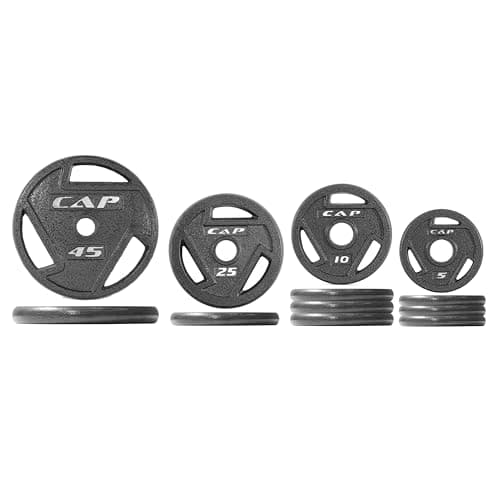
Because these are thin iron plates, they take up far less room on the sleeve than rubber bumpers of the same weight. That matters when you start loading heavy: a bar full of thick bumpers runs out of sleeve space long before a bar loaded with thin iron does. If you deadlift or squat serious weight, the loadability of thin iron is a real, practical advantage. Our weight plate sizes guide explains how thickness and sleeve space interact.
Machined holes, grip cut-outs and 2-inch fitment
The plates are cast iron with a machined center hole and a baked-enamel finish— a machined bore is the small quality marker that separates a decent iron set from a rough-cast one, because it seats cleanly on the sleeve instead of sitting loose. The 2-inch Olympic hole means they load on your existing bar with no adapters, the grip cut-outs make a 45 easier to carry one-handed, and the raised numbers save you squinting at a loaded bar. Store them on a plate tree or rack horns to keep the enamel intact and the floor clear.
The one thing you must never do
Here’s the hard rule: you cannot safely drop a loaded bar on iron. Cast iron has no give, so dropping a loaded bar can crack a plate, damage the bar, and gouge your floor — and it’s dangerous. If your training involves dropping the bar from the hang or overhead — Olympic lifts, snatches, cleans, CrossFit-style metcons — you need rubber bumper plates, not iron. The other minor trade is that bare iron can chip its enamel and surface-rust in a damp garage, so wipe it down and keep it off a wet floor.
Who should buy it — and who shouldn’t
Buy it ifyou train with a controlled set-down — squats, presses, rows and deadlifts — and want maximum loadability without paying for drop-safety you’ll never use. It pairs cleanly with any Olympic barand a rack, and it’s the default plate for a strength-focused home gym.
Look elsewhere ifyou drop the bar — from the hang, overhead, or in metcons. For that, rubber bumpers are non-negotiable; our bumper plate roundup ranks them, and our what are bumper platesguide explains why. Many home gyms end up owning some of each — iron for the heavy static lifts, a few bumpers for anything they drop.
Sources
- CAP Elite 200 lb Olympic cast-iron plate set (ASIN B0CJCPQSWH) — manufacturer product specification (200 lb set weight; 4x5, 4x10, 2x25 and 2x45 lb plates; solid cast iron with a machined hole and baked black enamel finish; 2-inch Olympic center hole; grip holes and raised numbers) as published on the retail listing.
- The CAP Elite 285 lb set previously reviewed on this page (ASIN B0FLN1TY4Q) — Amazon listing availability checked 25 August 2026, returned “Currently unavailable” with no offer price.
- General plate principles (cost-per-pound of iron vs bumpers, thin-iron loadability, drop-safety limits of iron, corrosion of bare iron) as covered in our methodology and linked spec guides.