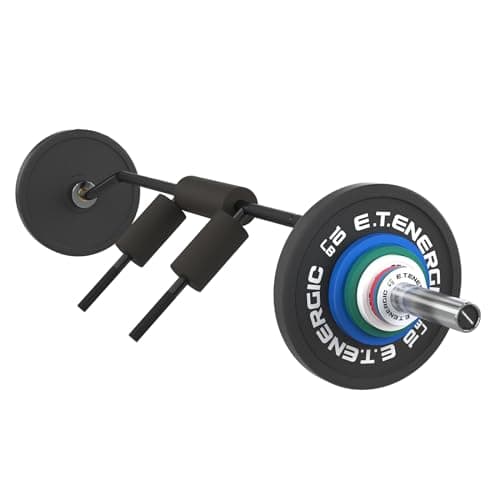
Why a full 7 ft rackable SSB matters
The single most useful thing about this bar is the one that looks least exciting on paper: it’s a full 7 ft (2.13 m) Olympic bar. That length is what lets it rack and un-rack in a standard power rack or squat standexactly like a regular barbell. You walk it out of the same J-hooks, you re-rack it into the same J-hooks, and the sleeves take the same plates and collars you already own. There’s no special cradle, no odd loading ritual, and no fiddling with a bar that doesn’t quite span your uprights.
This sounds obvious until you shop the budget end of the category, where plenty of cheap safety squat bars are short or non-standard and end up sitting awkwardly in a full-size rack — you can’t always rack them cleanly, and loading and unloading becomes a two-hands-on-the-bar balancing act. A full-length bar removes all of that. For a home lifter training alone, being able to bail into your safety pins and re-rack without a spotter is a big part of the safety in “safety squat bar,” and a bar that racks like a normal barbell is what makes that routine dependable. If you want the wider view of how the rackable bars stack up, our best safety squat bar roundup is the place to compare this against the field.
The cambered yoke and the upright squat groove
The reason to own an SSB at all is what the cambered yoke and shoulder pads do to your squat. Instead of resting the bar across your upper back and reaching back to grip it, you load it onto padded shoulders with the weight cambered slightly forward. That forward camber shifts your center of mass and encourages a more upright torso than a straight barbell back squat. In practical terms it feels like a squat that sits somewhere between a high-bar back squat and a front squat: more quad and upper-back demand, a taller chest, and far less strain on the shoulders and elbows.
That last point is the one that sells most home lifters on a safety squat bar. If you have cranky shoulders, limited overhead or external-rotation mobility, or you simply can’t get comfortable wrenching your arms back under a straight bar, the SSB lets you keep squatting heavy without the joint complaint. The neutral, hands-in-front position takes the shoulders out of the equation entirely. It also makes the bar a useful accessory tool even if your main squat is fine — the upright groove hammers the upper back and quads in a way that carries over to your regular squat. If you’re new to the movement, our guide to using a safety squat bar walks through setup, the tendency to fold forward, and how to groove the pattern before you load it heavy.
The honest note here is that E.T.ENERGIC’s pad and camber geometry is its own, and pad firmness and yoke shape are exactly the details that vary bar to bar. We can tell you the bar is a genuine cambered SSB with shoulder pads — we can’t tell you it feels identical to a commercial bar you’ve tried, because we don’t run a test rig and pad feel is subjective. What we can say is that the mechanism is the real thing: a cambered yoke that drives the upright squat, not a straight bar with pads glued on.
700 lb capacity as headroom for raw squatters
The 700 lb rating is the spec people worry about most and need to worry about least. Read it as durability headroom, not a target. The overwhelming majority of raw home squatters will never load a safety squat bar to 700 lb — and remember the SSB is typically a bar you use at a somewhat lower load than your straight-bar squat because the upright, cambered position is less mechanically forgiving. So for most lifters, 700 lb is a comfortable margin that means the bar isn’t going to take a permanent set or flex alarmingly under working weights.
It’s worth being precise about what the number does and doesn’t promise. Capacity tells you the shaft is strong enough to shrug off your training loads for years; it says nothing about pad comfort, camber geometry, or finish. On this bar the 700 lb figure is plenty for its intended buyer — the general-strength or powerlifting home lifter who wants a rackable SSB for squats, good mornings, and upper-back work. The place the ceiling actually bites is at the very top end, which is the honest trade-off we cover next.
The honest trade-offs
Two corners are cut to hit this price, and both are worth stating plainly. The first is brand track record. E.T.ENERGIC doesn’t have the decades of commercial history behind it that a Body-Solid or a specialist strength brand does. That doesn’t make the bar bad — it’s a genuine cambered SSB with the length and fitment it claims — but it does mean there’s less of a long owner-history paper trail to lean on, and less of a guarantee that parts, warranty, and support will be there in the way an established brand offers. On a budget bar that’s part of what you’re accepting for the lower price.
The second is the capacity ceiling. At 700 lb it trails the 1,000–1,500 lbcommercial SSBs built for the strongest lifters and busy commercial floors. For a raw home squatter that gap is academic — you’ll never approach either number. But if you’re a very heavy or advanced lifter who wants the biggest possible margin, or you’re kitting out a gym where lots of people will hammer the bar, the higher-rated bars give you headroom this one doesn’t. Pad durability and finish tend to follow the same budget-versus-commercial line: the mechanism is real, but the polish and the longevity guarantees are where the extra money on a commercial bar goes. None of this undermines the E.T.ENERGIC for its intended job; it just marks the edges of what an entry-price SSB is.
Who the entry rackable SSB suits — and who should step up
Buy the E.T.ENERGIC ifyou want your first safety squat bar, you train in a standard power rack or squat stand, and you want a genuine cambered SSB that racks like a normal barbell without a big outlay. It’s the pick for the home lifter who wants the shoulder-sparing, upright-squat benefits of an SSB and cares more about getting a full-length, rackable bar in the gym than about squeezing out the last of the capacity or brand pedigree. For most raw squatters the 700 lb rating is all the headroom they’ll ever need, and the full 7 ft length is the feature that actually makes the bar pleasant to live with day to day.
Step up ifyou’re a very heavy or advanced lifter who wants a 1,000–1,500 lb ceiling, you’re fitting out a shared or commercial space, or you want the reassurance of a long-established brand’s warranty and parts support. In that case a commercial bar earns its premium — our Body-Solid safety squat bar review covers the higher-capacity, longer-pedigree option and is the clearest comparison for deciding whether the extra spend is worth it for you. If your only question is “what’s the cheapest safety squat bar that racks properly and does the SSB job honestly,” though, the E.T.ENERGIC is a strong answer, and it’s the reason it anchors the value end of our thinking on these bars.
Living with the bar
A couple of practical notes round out the picture. Because it’s a full Olympic bar with standard 2" sleeves, there’s no learning curve to the hardware — your existing plates, collars, and rack all work, and the bar itself weighs and handles like the barbell you know once the pads are on your shoulders. The adjustment period is entirely about the movement, not the gear: the cambered load wants to fold you forward, so the first few sessions are about learning to drive the chest up and brace the upper back, ideally starting lighter than your straight-bar squat while you find the groove.
Maintenance is ordinary barbell care. Keep the sleeves and shaft clean, wipe the bar down after sweaty sessions, and don’t leave it loaded and racked under tension for months. The pads are the part most specific to an SSB — store the bar where the pads aren’t crushed or baking in direct sun, and they’ll keep their shape. Do that and an entry-price SSB earns its keep for years; the mechanism is simple and there’s not much to go wrong. The reassurance is that the expensive-to-replace part — the rated shaft and yoke — is built for loads you’ll never reach, so the bar’s honest job is squarely within its comfort zone.
Sources
- E.T.ENERGIC 7 ft Safety Squat Bar (700 lb) — manufacturer product specification (7 ft / 2.13 m length, 700 lb capacity, Olympic cambered SSB with shoulder pads, 2" Olympic sleeves) as published on the retail listing.
- General safety-squat-bar principles (rackable full-length design, cambered yoke and the upright squat groove, capacity as durability headroom, entry versus commercial trade-offs) as covered in our methodology and linked SSB guides.