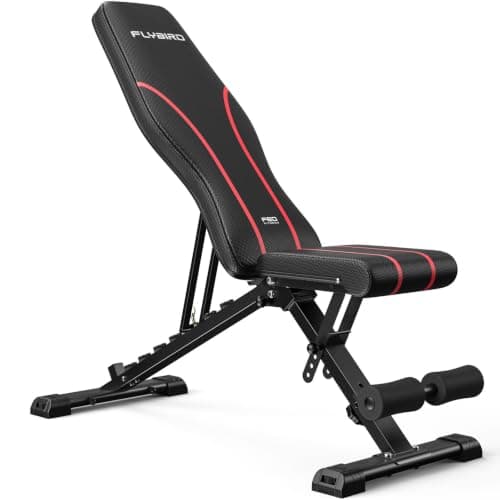
What a utility bench is — and what the WB2 does well
Before judging the WB2, it helps to be clear about the category it lives in. A utility benchis a light, general-purpose bench meant for dumbbell pressing, rows, accessory movements and the odd incline set — not a fortress built to sit under a loaded barbell in a rack. The WB2 is a textbook example: a foldable multi-position bench that adjusts between incline and flat, and that’s designed to be moved, folded and stored rather than left bolted in place. Read that way, most of its “limits” are simply the honest boundaries of the job it was built for.
What the WB2 does well is the everyday work that fills most home-gym sessions. It gives you a stable, adjustable surface for dumbbell presses, incline presses, shoulder work, supported rows, chest- supported movements and any number of accessory exercises. For a lifter who trains primarily with dumbbells, that covers the large majority of what a bench is ever asked to do. The value story is simple and genuinely rare: this is about the lowest price for a bench that isn’t junk. Plenty of benches undercut it, but they wobble, sag or feel unsafe; the WB2 clears the bar of being a real, usable training tool at the entry price, which is exactly why it anchors the cheap end of the field.
Foldability and footprint: built for apartments
The single most underrated feature of the WB2 is that it folds flat. In an apartment or a shared room, storage is often the real constraint on owning gear at all — not budget, not motivation, but where the thing lives when you’re not using it. A bench that folds down and slides into a closet, behind a door or under a bed changes that calculation entirely. You train, you fold, it disappears, and the room goes back to being a room.
That portability is part of the same package. The WB2 is light, so moving it out for a session and away afterward isn’t a chore, and it’s easy to reposition against a wall or into better light mid-workout. For renters and small-space lifters this is the whole appeal: a real adjustable bench that doesn’t demand a dedicated corner of the home. The trade for that lightness shows up under heavy load — a bench you can pick up with one hand is never going to feel as planted as a heavy, welded fixed bench — but for its intended dumbbell work the footprint-to-capability ratio is exactly what an apartment gym needs.
Incline and flat positions for dumbbell pressing
The WB2’s adjustability is what separates it from a plain flat bench and makes it a genuine utility piece. Moving between incline and flat lets you hit the chest from more than one angle, run seated shoulder presses on the steeper settings, and set a comfortable back angle for supported dumbbell rows and other accessory work. If you want to understand why those settings matter and what each angle actually trains, our weight bench angles explained guide walks through how the incline changes the movement.
Paired with a set of dumbbells, that adjustability covers a huge amount of productive training. Flat and incline dumbbell presses build the chest and shoulders; the same positions support rows, flyes, pullovers, curls and triceps work. This is the WB2’s home turf, and it does the job without drama. The honest caveat is the backrest: it’s shorter than the WB5 and WB7, so taller lifters may find their head and shoulders reaching the end of the pad on a flat press more than they would on a longer bench. It’s a comfort-and-support difference rather than a safety failure for dumbbell work, but it’s a real one — and it’s the first place you feel that this is the smallest, cheapest bench in the line.
The honest limits: capacity and a shorter backrest
Here’s the part that keeps the WB2 honest. It carries a lower capacitythan FLYBIRD’s bigger benches, and that single fact defines what you should and shouldn’t do on it. It is not built for maximal barbell benching. A heavy barbell bench press puts your bodyweight plus a loaded bar onto the pad, and it does so with the specific demand that the bench stay rock-solid while a max effort grinds — sometimes with the bar dumped or racked hard. That is a job for a heavy, high-capacity flat or adjustable bench used inside a rack with safeties, not for a light foldable utility bench. Loading the WB2 the way you’d load a dedicated barbell bench is asking it to do something it was never rated for.
The shorter backrestcompounds that. A longer pad gives your torso and head full support and gives the whole bench a longer, more stable base; the WB2’s shorter pad is fine for dumbbell work but is another reason it isn’t the platform for heavy barbell pressing. None of this is a knock — it’s the difference between a utility bench and a barbell bench, and the WB2 is honestly the former. The mistake to avoid is buying the cheapest bench in the line and then asking it to be the most capable one. Match the tool to the task and the limits are a non-issue; push past them and you’ll be disappointed, and rightly so.
Where to step up — and who genuinely needs more
If you read the limits above and thought “but I do want to barbell bench,” that’s your answer to look further up the range. The most natural step up is within the same family: our FLYBIRD WB5 bench review covers the bigger, longer-backrest, higher-capacity sibling that handles more serious pressing while keeping the adjustable, foldable character. Beyond FLYBIRD, our best adjustable benchroundup is the right place to compare heavier, higher-capacity benches built to sit under a loaded barbell in a rack, if that’s the training you’re planning for.
Whether you actually need that upgrade comes down to how you train, and two guides settle it quickly. If you’re not sure a bench belongs in your setup at all yet, our do I need a weight benchguide is the honest starting point — for a lot of dumbbell-first lifters, a light utility bench like the WB2 is genuinely all they need. And if you’re weighing whether a flat bench would do or whether the incline settings earn their keep, our flat vs adjustable bench comparison lays out the trade. The rule of thumb: if your training is dumbbell-led and space-limited, the WB2 is the right amount of bench; if you’re committed to heavy barbell benching, buy the heavier bench from the start rather than out-growing this one.
Who should buy it — and who shouldn’t
Buy the WB2 ifyou train mostly with dumbbells, you’re short on space, and you want a real adjustable bench at about the lowest honest price. For an apartment lifter or a beginner building a first setup, it does the everyday work — incline and flat pressing, rows, accessory movements — and then folds away when you’re done. As the utility benchit’s designed to be, it’s a strong, honest pick and the cheapest way into the category that doesn’t feel like a compromise on safety.
Look elsewhere ifyour training centers on heavy barbell bench pressing, you’re a taller lifter who wants full head-to-hips support on a long pad, or you want a bench that lives bolted in a rack rather than folded in a closet. In those cases the money is better spent a rung up the ladder — the WB5 or a heavier bench from the adjustable roundup — where the extra capacity and longer backrest are the whole point. But if the question is simply “what’s the cheapest adjustable bench that’s actually good enough for dumbbell work in a small space,” the WB2 is a clear, honest answer.
Stability and daily use in a small space
It’s worth spelling out how the WB2 behaves day to day, because wrong expectations are where most cheap-bench disappointment comes from. For dumbbell pressing, rows and accessory work at sensible loads, it gives you a steady, usable platform — the kind of stability a utility bench is supposed to provide. Where a light foldable bench will always feel different from a heavy welded one is at the edges: near the top of its capacity, on aggressive setups, and on the hard barbell work it isn’t rated for. Keep it inside the dumbbell-and-accessory lane and the stability is a non-issue; drive it toward maximal barbell benching and the lightness and shorter backrest are exactly what you’ll feel.
The practical habits are simple. Set the bench on a flat, hard surface rather than a soft rug so the base sits square; check that the incline pin or lock is fully seated before every set; and fold and store it dry so the mechanism and pad stay in good shape. Do that and a well-treated utility bench gives you years of the everyday training it was built for. The right way to think about the WB2 is as a specialist, not a compromise: it does light, adjustable, foldable dumbbell work at the entry price better than almost anything else, and it leaves the heavy barbell benching to the heavier benches that were built for it.
Sources
- FLYBIRD WB2 Utility Bench — manufacturer product specification (foldable multi-position bench, incline / flat positions, folds flat for storage, dumbbell / accessory use, lowest-priced bench in the FLYBIRD line) as published on the retail listing.
- General weight-bench principles (utility vs barbell bench roles, capacity and backrest length as load and support signals, incline angles, foldability and footprint for small spaces) as covered in our methodology and linked bench guides.