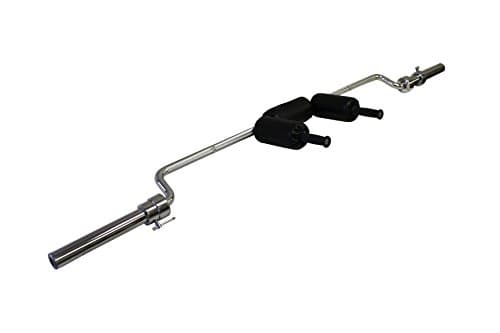
The cambered yoke design and why the forward lean changes the squat
The heart of any safety squat bar is the cambered yoke, and the Ader’s is the classic version of it. The sleeves sit below and forward of the shoulder pads, so the load hangs out in front of your center of mass rather than sitting square on your traps. That forward offset is the whole point: it creates a constant tipping-forward torque that you have to fight by staying upright and driving your upper back hard into the pad. Where a straight barbell lets you fold at the hips and turn a squat into a good-morning, the SSB actively punishes that and rewards a tall, quad-driven squat. The padded yoke also wraps your shoulders instead of asking them to externally rotate under a straight bar, which is why lifters with cranky shoulders or elbows can often squat pain-free on an SSB when a back squat is off the table.
It’s worth being honest that this changed groove is a feature and a cost at the same time. The forward lean means the SSB carries less absolute load than your back squat — the bar is working you harder at the same weight, so the number on the sleeves will be lower and that is normal, not a weakness. If you want a side-by-side of how the two tools differ in groove, muscle emphasis and loading, our safety squat bar vs barbellcomparison lays it out. The short version is that the Ader isn’t trying to replace your barbell; it’s a specialist that adds an upright, shoulder-friendly squat variation to the gym, and the fixed camber here delivers that variation in the simplest, most durable way possible.
The 1,000 lb rating: durability headroom for any home squatter
The Ader is rated to 1,000 lb, and the right way to read that number is as durability headroomrather than a target you’ll ever chase. Because the cambered yoke makes the bar feel heavier than a straight bar at the same weight, real working loads on an SSB are lower than most people’s back squat to begin with. Stack that against a four-figure rating and the maths is reassuring: no home lifter is going to approach 1,000 lb of loaded SSB, so the capacity exists to guarantee the welded yoke won’t take a permanent set, flex or fatigue under a lifetime of ordinary training. It’s a signal that the frame has margin to spare, not an invitation to load it to the ceiling.
That matters more on a specialty bar than on a standard barbell, because a safety squat bar is a welded yoke rather than a single straight shaft. You want confidence that the joints and the camber are over-built for the loads a garage gym will ever put through them, and a 1,000 lb rating buys exactly that. For any home squatter — beginner or advanced — the practical takeaway is that capacity is not the thing to worry about here. The Ader has enough headroom that you’ll never think about it again after you buy it, which is precisely how a durability number should behave.
The shoulder yoke pad: functional, not plush
The pad is where the Ader’s honest, no-frills character shows most clearly. It uses a shoulder yoke padthat does its job — it spreads the load across your traps and shoulders and keeps the yoke seated where it should be — but the padding and finish are functional rather than plush. This is a firm, get-on-with-it pad, not the thick, contoured memory-foam harness you’ll find marketed on some of the pricier, more heavily branded bars. Under a heavy set you’ll feel the load, which is arguably how an SSB should feel anyway, but if your priority is the softest possible shoulder interface, this isn’t the bar that leads on comfort.
The upside of that plainness is durability and predictability. A simpler pad has less to compress, crack or peel over years of use, and it behaves the same on rep one as it does on rep one thousand. It’s the same philosophy that runs through the whole bar: fewer soft, wear-prone parts means fewer things that degrade or fail. If plush padding and a premium finish are near the top of your list, weigh that honestly before buying — the Ader trades a little comfort and polish for a build that simply keeps working.
The value of a long owner-history model
The quietest advantage the Ader has is time. This is a long-running modelthat has been sold for years, which means there is a real base of owner history to read before you spend a cent. On a specialty bar that matters more than it looks. Newer imports flood the market with attractive spec sheets and no track record — you’re trusting that the welds hold and the pad lasts because the listing says so. With the Ader you can find lifters who have squatted on the same bar for years and read how the yoke, pad and sleeves actually age. Buying a proven design is a form of risk reduction that a brand-new SKU simply can’t offer.
That track record pairs with the design’s deliberate simplicity. There are no fragile moving parts— no adjustable camber mechanism, no hinges, nothing that can develop play or seize up. A fixed, welded yoke is about as low-risk as a specialty bar gets, and when you combine “nothing to break” with “years of people proving it doesn’t,” you get a bar you can buy with unusual confidence. The honest counterweight, covered below, is that this proven design is priced near the commercial bars without carrying the big brand-name support and marketing that some buyers expect at that price.
How heavy an SSB is, and the loading-math implications
One thing every SSB buyer should sort out before the first session is that the bar itself is not 17.5 kg like an Olympic barbell. Safety squat bars are heavier — the yoke, the camber and the pad all add steel — and the bar’s own weight is a meaningful chunk of your first working set. That changes your loading maths: your true working weight is the plates plus a bar that weighs far more than a standard barbell, so a “light” SSB set is heavier than the plate count suggests. Our guide on how much a safety squat bar weighs walks through the typical range and how to account for it when you program.
The practical implication is twofold. First, start lighter than you think on your first SSB session and add plates from there, because the combination of a heavy bar and the harder forward-lean groove makes the same number feel a good deal tougher than a back squat. Second, when you compare your SSB numbers week to week, be consistent about whether you count the bar — the Ader’s heft is a fixed constant, so once you know it you can log honestly and progress the way you would on any lift. None of this is a knock on the bar; it’s just the reality of the tool, and knowing it up front keeps your programming honest.
Where it sits versus cheaper and pricier SSBs
The Ader lives in the middle of the safety squat bar market, and that position is the key to deciding whether it’s right for you. Below it sit the true budget bars — if your priority is the lowest possible entry price and you can accept a shorter, thinner track record, our best budget safety squat bar pick is the place to start, and the VEVOR 1,500 lb SSB is a good example of a cheaper import that quotes a big capacity number for less money. The Ader costs more than those, and the extra spend buys the proven design and the long owner history rather than a bigger spec.
Above it sit the premium, heavily branded bars. The Bells of Steel SSB 4.0 is the natural comparison here: a more polished, better-supported bar with a plusher pad and a stronger brand presence, and the Ader is priced near those commercial bars without the big brand-name supportto match. That’s the honest tension in the value story — you’re paying a near-premium price for a proven, plain bar rather than a premium-feeling one. Whether that trade makes sense depends on what you value; our best safety squat bar roundup sets the Ader against the whole field so you can see exactly where a proven middle option beats both the budget and the premium ends.
Sources
- Ader Safety Squat Olympic Bar (1,000 lb) — manufacturer product specification (cambered yoke SSB, 1,000 lb capacity, shoulder yoke pad, 2" Olympic sleeves) as published on the retail listing.
- General safety squat bar principles (cambered yoke and forward-lean mechanics, capacity as durability headroom, bar weight and loading maths, pad and finish trade-offs) as covered in our methodology and linked SSB guides.