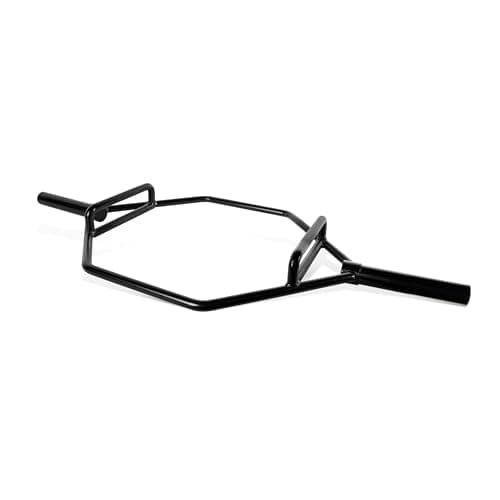
The value default hex bar
The reason this bar exists in most people’s carts is simple: it’s cheap enough to add to any collection and it does the core trap-bar jobs without fuss. A hex (trap) barlets you stand inside the weight instead of behind it, which shifts the load closer to your center of mass and makes for a more upright, back-friendly deadlift than a straight bar — the single most common reason home lifters buy one. The CAP delivers exactly that at the low end of the price range, which is why it’s the bar we point value-first buyers toward before they consider spending up. Our trap bar vs barbell deadlift guide explains the movement difference in full.
Dual-height combo handles: high and low in one bar
The combo grip is the feature that lifts this above a bare-bones hex bar. It gives you high handles and low handlesin the same frame, so you can pick the height that suits the lift and your body. The raised handles shorten the range of motion and start you more upright — friendlier for taller lifters, tight hips or ankles, and for shrugs and carries; the low handles give you the full range and a deeper pull that trains more like a conventional deadlift. Being able to flip the bar and choose is genuinely useful, and it’s the kind of versatility that used to cost more. Our high vs low trap-bar handles guide walks exactly when to use each.
Full 2-inch Olympic sleeves: your plates fit
The bar runs full 2-inch Olympic sleeves, so it takes the plates you already ownwith no adapters — iron or bumpers, whatever’s on your rack. That matters more than it sounds: some cheaper novelty bars come with short or standard sleeves that limit how much you can load or force you to buy different plates, and this one doesn’t. Standard Olympic sleeves also mean the bar behaves predictably in your setup and loads to a genuinely heavy deadlift or shrug rather than topping out early. It’s the fitment you want, and it’s the reason the bar slots straight into an existing home gym.
Deadlifts, shrugs and carries
In use, the CAP covers the three things people buy a hex bar for. Deadliftsare the headline — the neutral-grip, centered-load position is easier on the lower back and lets many lifters pull more comfortably than with a straight bar. Shrugs are excellent in a hex bar because the weight hangs at your sides instead of in front, so you can load them heavy without the bar dragging up your thighs. And loaded carries— farmer’s walks, in effect — are natural in a trap bar, with the high handles making it easy to pick the weight up and go. For a home gym, that’s a lot of useful training from one cheap bar.
Where the price shows: the closed frame
Now the honest trade-offs. The first is the closed frame. This is a traditional fully enclosed hexagon, which means you step into and out of the middleof the bar to use it — slightly more awkward than an opentrap bar, which has one end cut away so you can walk straight in and out. The closed frame is fine once you’re set, but it’s a small daily friction, and it makes the bar harder to store flat against a wall. If easy in-and-out access matters to you, the open-frame option in our Synergee open trap bar review solves exactly that, and our open vs closed trap bar guide weighs the two designs.
Where the price shows: the smooth grip
The second trade is the grip. On a budget hex bar, some handle areas are smooth or only lightly knurledrather than carrying an aggressive, biting pattern, so on a heavy deadlift the bar can feel slick and you’ll want to chalk up to hold it. For most training loads that’s a non-issue, but a heavy puller chasing every last rep will notice the grip isn’t as secure as a well-knurled specialist bar. It’s the classic budget-bar compromise — the structure and fitment are genuine, and the grip feel is where the corner is cut. Chalk and honest expectations cover most of it.
Sizing the bar to your gym and rack
Before you buy any trap bar, think about the space it lives in. A closed-frame hex bar is a fixed hexagon, so it needs floor room to load and a spot to store — it doesn’t lie flat against a wall as easily as a straight bar, and you step into the middle to use it, so you want clear space around it. Check that the bar’s outside width clears whatever you’re pulling next to, and that you’ve got room to walk in and set up. For most home gyms this is a non-issue, but in a tight garage it’s worth a moment’s thought, because the frame’s footprint is one of the practical differences between a hex bar and a straight one. Our trap bar weight guidealso reminds you to confirm the bar’s own weight before you program loads.
Working around the smooth grip
Since the grip is the main compromise, it’s worth knowing how easily you can manage it. On a heavy deadlift, a light coat of chalktransforms a smooth or lightly knurled handle — it’s the cheapest fix there is and covers most of the gap. For your heaviest pulls, strapstake grip out of the equation entirely, which is common practice for trap-bar work anyway. So while a sharper knurl would be nicer to own, the smooth grip is a soft limit rather than a hard one: chalk handles day-to-day pulling, and straps handle the top-end sets. It’s a very different situation from a structural flaw you can’t work around.
Where the hex bar fits among your bars
It also helps to place the hex bar in the wider specialty-bar picture. Against a straight barbell, the hex bar trades some specificity for a more upright, back-friendly pull and easier loaded carries; against a safety squat bar it’s a pulling-and-carrying tool rather than a squatting one. Most home lifters who own a rack and a straight bar find the trap bar is the specialty bar that adds the most new training for the least money — which is exactly the case our is a trap bar worth it guide makes. At this price, the CAP is the low-risk way to add that movement and find out how much you use it before deciding whether a fancier bar is ever worth it.
Finish and upkeep
The plain black finishis functional rather than fancy, and it wants the same basic care as any coated bar: wipe it down after chalky or sweaty sessions and keep it off a damp floor so the coating and sleeves don’t surface-rust. There’s nothing special to maintain here — it’s a cheap bar finished to a cheap-bar standard — but a minute of upkeep keeps it looking and loading right for years. Store it where the sleeves aren’t sitting in moisture and it’ll hold up fine.
Who should buy it — and who shouldn’t
Buy it ifyou want a dependable hex bar for trap-bar deadlifts, shrugs and carries at the lowest sensible price, you value the dual-height handles, and you don’t mind stepping into a closed frame and chalking up for a milder grip. As a first trap bar or a cheap addition to a collection, it’s the honest value default. If you’re comparing CAP’s trap-bar options, our other CAP trap bar review covers the alternative in the line.
Look elsewhere if you want easy walk-in access (an open trap bar), a sharper, more secure knurl for heavy pulls, or a more refined frame overall. The picks in our best trap bar roundupcover the step-ups — you pay more, but you buy the open frame, the grip and the finish with it.
Sources
- CAP Olympic hex / trap bar (combo grip) — manufacturer product specification (dual-height combo handles, 2-inch Olympic sleeves, closed hexagonal frame, black finish, deadlift/shrug/carry use) as published on the retail listing.
- General trap-bar principles (neutral-grip centered-load deadlift, high vs low handles, open vs closed frame, Olympic sleeve fitment, knurl and grip feel) as covered in our methodology and linked specialty-bar guides.