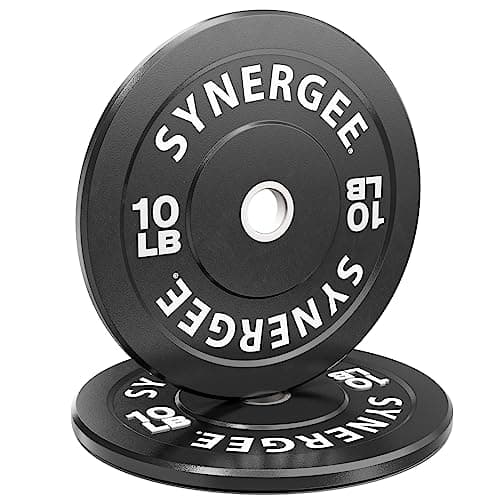
The steel insert hub — the spec that actually decides a bumper
Strip a bumper plate down and it’s two parts: a disc of rubber and a metal collar at the center that the bar passes through. That collar is the insert, and it does all the hard work. It’s what the sleeve of the bar bears against, what absorbs the shock every time you drop a loaded bar, and what holds the plate’s shape at the one point where all the force concentrates. If you read one number on a bumper spec sheet, read what the insert is made of. Our explainer on what bumper plates are walks through the anatomy, but the short version is that the rubber is the part you see and the hub is the part that fails.
Synergee’s bumpers use a steel insert. That matters because the failure mode of a cheap bumper is almost always the hub, not the rubber. A thin or poorly bonded metal collar can pull loose from the rubber after enough drops, so the insert starts to spin independently of the plate or slides on the bar; a molded-in hub with too little metal can ovalize so the plate no longer sits square on the sleeve. A proper steel insert resists all of that. It gives the bar something hard and dimensionally stable to ride on, it keeps the 2" Olympic fitmenttrue so the plate doesn’t rattle or bind, and it takes the repeated impact of dropping without deforming. It is, in the most literal sense, the part you’re paying for.
This is also the spec that most cleanly separates a dedicated strength brandfrom a generic import. Two bumpers can look identical — same black rubber, same 450 mmface, same printed weight — and behave completely differently at the hub, where you can’t see the difference until it fails. Synergee is a strength-equipment brand rather than a nameless drop-ship listing, which is worth something on a part that lives or dies at a spec you can’t inspect through the plastic wrap. When you’re comparing options, the insert is the first thing to check; our guide to choosing bumper plates puts it at the top of the list for exactly this reason.
Low bounce — what it protects and why you care
Synergee’s bumpers are a low-bouncerubber. “Bounce” sounds like a footnote until you’ve chased a dropped bar across a garage. A bumper is designed to be dropped — that’s the whole point of rubber over iron — but a plate that rebounds hard sends the bar leaping back up off the floor, which is unpredictable, hard on the bar, and genuinely dangerous in a tight home space. A softer, low-bounce compound absorbs more of the drop and gives it back as a small, controlled hop instead of a launch.
Three things benefit from that. Your platform and floor take a gentler, more spread-out impact instead of a sharp spike. Your bar sees less of the whipping, snapping rebound that stresses the sleeves and the collars over time. And your neighbours— or the family upstairs, or the walls of a shared building — hear a dull thud rather than a ringing bounce. For a home gym, where the platform is often plywood over a concrete slab or, worse, a floor with a room underneath it, low bounce is one of the most practical properties a bumper can have. It doesn’t show up in a headline number the way a weight or a diameter does, but it’s the difference between a plate you can train with early in the morning and one you can’t.
One honest note on expectations: low bounce is a rubber property, not magic. Any bumper dropped from overhead onto a hard floor will still make noise and still need a platform or mats underneath it — the low-bounce compound reduces the rebound and the harshness, it doesn’t make a loaded barbell silent. Match it with a proper drop surface and it does its job; expect it to cancel the drop entirely and you’ll be disappointed. That’s true of every bumper on the market, not a Synergee limitation.
Fitment and sizing — standard where it needs to be
There are no surprises here, which is what you want. Synergee’s bumpers use the standard 2" Olympichole, so they slide onto any Olympic barbell and take any Olympic collar — the same fitment as every plate and bar in a normal home gym. And like essentially all competition-style bumpers they run to the 450 mmdiameter that’s become the de-facto standard, so the loaded height off the floor matches other bumpers and a bar loaded with them sits at the right pull height for deadlifts and cleans. That standardization is the quiet advantage of buying by the pair: because the fitment and diameter are universal, a Synergee pair sits cleanly alongside whatever bumpers you already own. The steel hub keeps that fitment true over time, so the pairs you add this year still slide on smoothly next to the ones you buy later.
Pairs vs a set — the honest per-pound trade
Now the part where buying by the pair costs you. Per pound, pairs are more expensive than a bulk set.That is the core trade and there’s no way around it: a manufacturer that boxes and ships a fixed 150 or 260 lb spread in one carton spreads the packaging, shipping and handling across all that weight and passes some of the saving on. Buy the same total weight one pair at a time and you pay a premium for the flexibility. It’s the same logic as buying groceries in bulk versus by the item — convenience and precision cost a little more per unit.
The related warning is that building a full loadout pair by pair adds up. If you’re starting a gym from zero and you need a bit of everything — 10s, 25s, 45s — assembling that entire spread as individual pairs will very likely cost more than one boxed set of the same weights, and it’s slower and fiddlier to order too. If that’s your situation, a set is the smarter buy. Our CAP 260 lb bumper set reviewcovers a complete boxed spread that’s built for exactly the from-scratch case, and the best budget weight plates roundup is the right place to see how the per-pound maths shakes out across the value end of the market.
So when are pairs the smart buy? When you already own a base and you’re topping up. The classic case is a lifter who bought a starter set, got stronger, and now needs another pair or two of 45sto keep loading the bar — buying a second full set to get those 45s would mean paying again for a stack of 10s and 25s you don’t need. Buying a pair of 45s solves the exact problem for the least total spend, even though the per-pound number is higher. The same is true when a set left you one denomination short, or when you want to add a light pair for technique work. In every one of those cases the flexibility of a pair is worth its premium, because the alternative — a whole extra set — is far more expensive for the weight you actually need. Buy pairs to fill gaps; buy a set to build a base.
Do you even need bumpers?
Worth asking before you spend anything, because bumpers aren’t automatically the right plate. You need bumpers if you drop the bar from height— Olympic lifts, or missed reps you have to bail on — because that’s the impact iron plates and floors can’t take. You need them if you train on a floor that can’t survive dropped iron. And their uniform 450 mm diameter, regardless of weight, means even a light bar sits at full pull height, which matters for deadlift and clean setup. But if you only squat, bench, press and deadlift-under-control and you set the bar down rather than dropping it, iron plates are cheaper per pound and take up less space on the bar. Bumpers are a tool for a specific job, not an upgrade for its own sake. Our guide to whether you need bumper platesworks through the cases in detail; read it first if you’re not already sure the answer is yes, because it’s a cheaper decision to get right before you buy than after.
Where Synergee’s pairs sit in the field
Put it all together and Synergee’s bumpers occupy a clear, useful slot: a durable, low-bounce, steel-hubbed bumper from a real strength brand, sold in the increment you actually run short of. That’s a genuinely different value proposition from a boxed set, and the two aren’t really competing — one builds a base, the other fills the gaps in a base you already own. The knock against the pairs is purely the per-pound premium and the cost of assembling a full loadout piecemeal; the case for them is the steel insert, the controlled bounce, and the precision of buying exactly the weights you need.
Buy Synergee by the pair ifyou already own most of a loadout and need to top up a denomination — almost always more 45s — or if you want to add a light pair without paying for a whole set to get it. Look at a set instead ifyou’re starting from zero, where the bulk per-pound saving wins. Either way, the right move before you commit is to see how these stack up against the whole field: our best bumper platesroundup ranks the sets and pairs side by side so you can decide whether topping up beats replacing, and where Synergee’s pairs land against the competition.
Sources
- Synergee Bumper Plates (pairs) — manufacturer product specification (sold by the pair and as singles, low-bounce rubber, steel insert hub, 2" Olympic fitment) as published on the retail listing.
- General bumper-plate principles (steel insert hub as the durability spec, low-bounce compound behavior, the standard 450 mm diameter and 2-inch Olympic fitment, and the per-pound trade between pairs and bulk sets) as covered in our methodology and linked bumper-plate guides.