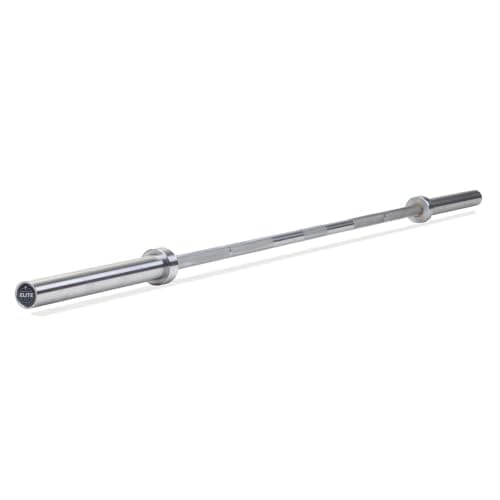
The shaft: a stiff 29mm power spec
The Elite runs a 29mm hard-chrome shaft— the diameter that defines a power bar. That extra millimeter over a 28mm Olympic bar does two things: it fills the hand a little more, which some lifters grip more confidently on a max deadlift, and it makes the bar noticeably stiffer. Stiffness is the point here. On a heavy squat or bench you want the bar dead in your hands, not storing and returning energy, because whip that helps an Olympic lifter just makes a heavy single feel unstable. If the idea of shaft flex is new to you, our whip guide explains why a power bar is built to have almost none of it.
Aggressive mountain knurl: the reason to buy it
Grip is where this bar earns its place. It carries an aggressive mountain knurl — a deep, sharp diamond pattern that locks into your palms and holds a heavy raw deadlift without slipping. That bite is exactly what a dedicated power lifter wants: it means less chalk, fewer grip failures, and more confidence on a max pull. Our aggressive vs passive knurling guide explains the trade-off in full, because bite always cuts both ways. The honest flip side: a sharp knurl tearssoft hands on high-rep work. If you do sets of ten touch-and-go reps, this knurl will shred you long before it helps. It’s built for low reps at heavy load, and it is unapologetic about it.
The center knurl: a real power feature, and a caveat
The Elite has a center knurl— a strip of grip in the middle of the shaft that stops the bar sliding down your back on a low-bar squat. It’s a genuine power-bar feature and one of the clearest signals that a bar is built for the powerlifts rather than mixed training. The caveat is equally honest: a center knurl can scrape your neckon high-bar squats and gets in the way on cleans, which is precisely why Olympic bars leave it off. If you don’t low-bar squat, you may find you never want it. Our center knurl guidecovers who should and shouldn’t care.
Brass bushings and a 2,000 lb rating
The sleeves ride on brass bushings, which give the modest, controlled spin a power bar wants — enough that plates don’t torque your wrists, but nothing like the free rotation of a bearing bar, which you’d never use on a slow grind anyway. Brass bushings on a sub-$300 bar are a boutique-grade detail; most bars this cheap use cheaper sintered bushings. The 2,000 lb ratingis far beyond what any raw home lifter will load, so read it as durability headroom rather than a target — our weight-capacity guide explains why the headline number matters less than the steel behind it, and why bars bend from bad drops onto rack safeties, not from the weight you lift.
Finish and value
The hard-chrome finish is a sensible, durable choice for a training bar — more rust-resistant than bare steel or thin decorative chrome, and low-maintenance with a weekly brush and light oil. It sits below stainless and a good Cerakote on outright corrosion resistance, but it is exactly what you want at this price. Taken together — 29mm stiff shaft, aggressive knurl, center knurl, brass bushings, 2,000 lb rating — this is a competition-shaped spec sheet for the money, which is why it tops our power-bar list.
Who should buy it — and who shouldn’t
Buy it if you train the powerlifts almost exclusively and want the hardest, most confident grip you can get without paying boutique money. The bite, the stiffness and the center knurl are all things a dedicated squat-bench-deadlift lifter actively wants, and it pairs cleanly with a set of iron plates loaded in a cage.
Look elsewhere ifyou clean, snatch, do CrossFit-style metcons, or train the big lifts for high reps. The aggressive knurl will chew your hands and the stiff shaft and center knurl do nothing for you — start with our Olympic roundup or the value bearing bar in our CrossFit roundupinstead. If you want one bar that does a bit of everything, this isn’t it, and that’s by design.
Sources
- Titan Fitness Elite Series power barbell — manufacturer product specification (shaft diameter, capacity, sleeve/bushing type, knurl aggressiveness, center knurl, hard-chrome finish) as published on the retail listing.
- General power-bar spec principles (shaft stiffness and diameter, knurl bite, center knurl, bushing rotation, finish and corrosion) as covered in our methodology and linked spec guides.