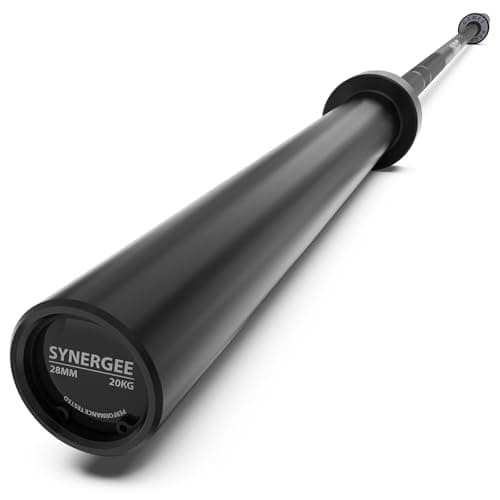
The shaft: a 28mm ceramic-coated all-rounder
The Games bar runs a 28mm shaft— the diameter most home lifters want. It’s thin enough to sit comfortably in a hook grip for the Olympic lifts and to feel lively under the bar, but not so thin it feels like a noodle under a heavy squat. That leans it toward Olympic and mixed training rather than maximal, dead-stiff powerlifting, which is exactly what a fast-spinning bar should do. If you want to understand how a millimeter of diameter changes the feel, our whip guide covers it.
The ceramic coatingis the quiet standout. Ceramic resists rust noticeably better than bare steel or plain chrome, so it holds up in a garage without the constant oiling a bare bar demands. It sits below stainless and a good Cerakote on outright corrosion resistance, but well above the budget field — a strong showing at this price. Our finishes guide ranks every coating on grip and rust resistance.
Composite bearings: the reason to buy this bar
Sleeve rotation is where this bar earns its place. It runs composite bearings, not the bushings you’ll find on almost every bar near its price. The difference matters in exactly one situation: the catch phase of a clean or snatch, where the bar has to spin freely in your hands as you drop under it. A bearing bar rotates fast and smooth there, sparing your wrists; a bushing bar spins “enough” but not freely. If the Olympic lifts or fast metcons are your training, this is the single spec that should decide your bar. Our bushing vs bearing guide explains the trade-off in full.
The flip side is the honest one: if you neverclean or snatch, that lively spin does nothing for you. A squat, bench and deadlift don’t ask the bar to rotate, so a bushing bar of the same capacity would serve you identically for less money. That’s not a knock on the Games bar — it’s the reason we don’t recommend it to dedicated powerlifters, who are better served by our power-bar roundup.
Knurl and marks: dual-marked and medium
The knurl is a medium pattern with dual marks— both the Olympic and powerlifting rings. Medium is the right call on a bar built for higher-rep and Olympic work: it grips confidently without the sharp bite of an aggressive power-bar knurl that would tear your hands on a set of touch-and-go cleans. The dual marks let you index a snatch grip and a bench grip on the same bar, which is exactly what a do-everything bar needs. If the marks are new to you, our knurling guide explains them.
Capacity: 1,500 lb of headroom
The 1,500 lb rating is far beyond what any raw home lifter loads, so read it as durability headroom rather than a target. Where a high rating genuinely helps is repeated heavy dropping onto rack safeties or from the top of a clean, which is more common in the exact metcon-style training this bar is built for. Our weight-capacity guide explains why the headline number matters less than the tensile strength behind it.
Who should buy it — and who shouldn’t
Buy it if the Olympic lifts, CrossFit-style metcons, or a genuine mix of everything are your training. The bearing spin, ceramic finish and dual marks make it the value benchmark for that lifter, and it pairs cleanly with a set of bumper plates you can actually drop.
Look elsewhere ifyou only train the powerlifts. If you never clean or snatch, a stiff 29mm power bar with an aggressive knurl fits you better and costs less than paying for bearings you won’t use — start with our power-bar roundup. And if you want one do-everything bar without the bearing premium, the bushing all-rounders in our Olympic roundup are the smarter spend.
Sources
- Synergee Games 20kg barbell — manufacturer product specification (shaft diameter, capacity, sleeve type, knurl marks, ceramic coating) as published on the retail listing.
- General barbell-spec principles (shaft diameter and feel, bushing vs bearing rotation, knurl aggressiveness, finish and corrosion) as covered in our methodology and linked spec guides.