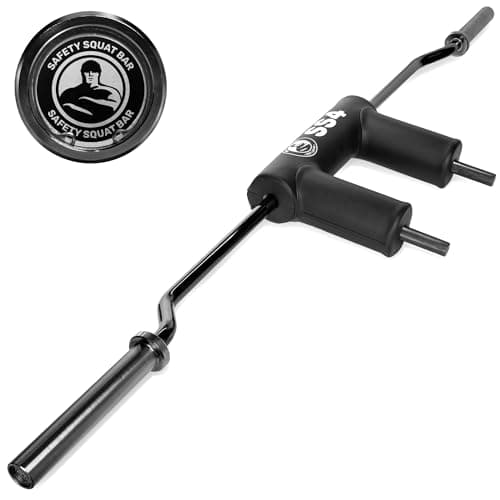
What a safety squat bar is for
First, the point of the tool. A safety squat barhas a cambered shaft with a padded yoke that sits on your shoulders and forward handles you hold in front of you. That does two things a straight bar can’t: it frees your shoulders (no wrenching your arms back into a low-bar rack position, a gift if your shoulders or elbows are cranky), and its forward camber shifts the load so you have to fight to stay upright, which builds the back and the squat. Our safety squat bar guide and SSB vs barbell comparison explain who benefits most. The 4.0 is a premium execution of that tool.
Capacity and bar weight: true specialty-bar numbers
The 1,500 lb rating and roughly 45.6 lb bar weightput the 4.0 firmly in serious-bar territory. The budget SSBs typically rate 700–1,000 lb and run lighter; a 1,500 lb rating is durability headroom well beyond any raw squatter’s working weight, and the substantial bar weight signals a heavy, rigid build rather than thin tubing. If you want to know your exact starting load, note that an SSB is heavier than a 20kg straight bar — our how much does an SSB weigh guide explains why and how to check.
The titanized coating: durability over paint
The 4.0’s black titanized coatingis a genuine upgrade over the painted finishes on budget bars. Paint chips where plates and rack hooks contact the bar and where the yoke meets your shoulders; a titanized coating resists that wear far better, so the bar still looks and functions like new years in. On a specialty bar you buy once and keep, finish durability is worth paying for — it’s the difference between a bar that ages well and one that looks beaten within a season.
The padded yoke: comfort where it counts
The premium padded yokeis where you feel the price on every rep. The yoke is the part that bears on your shoulders and neck, and cheap, thin padding compresses over time and digs in under a heavy load. A thicker, better-made pad spreads the load and stays comfortable set after set, which matters more on an SSB than almost any other bar because the whole point is to keep squatting when a straight bar hurts. Good padding is not a luxury here; it’s central to the bar doing its job.
The honest cost
Two caveats, both about the premium build. It’s the most expensive SSBon our list by a clear margin — if your budget is tight, a budget SSB gives you most of the training benefit for a fraction of the price, and our roundup ranks those honestly. And the heavier bar plus thick padding make it a two-hands job to move around; it’s not a bar you casually reposition. Neither is a flaw so much as the natural cost of a bar built to last.
Who should buy it — and who shouldn’t
Buy it ifyou’ve decided the SSB is a staple of your training and you want the best-built version — the titanized coating, premium pad and 1,500 lb rating are exactly what a lifter who buys once and keeps forever should want. It needs a rack with enough width and clearance, so check the fit.
Look elsewhere ifyou’re trying the SSB for the first time or your budget is tight. A budget bar from our SSB rounduplets you find out whether you love the tool before committing to the premium one — and if you do, the 4.0 is the upgrade to grow into.
Sources
- Bells of Steel Safety Squat Bar 4.0 — manufacturer product specification (weight capacity, bar weight, titanized coating, padded yoke) as published on the retail listing.
- General safety-squat-bar principles (camber and load position, yoke padding, coating durability, bar weight vs a straight bar, rack fitment) as covered in our methodology and linked specialty-bar guides.