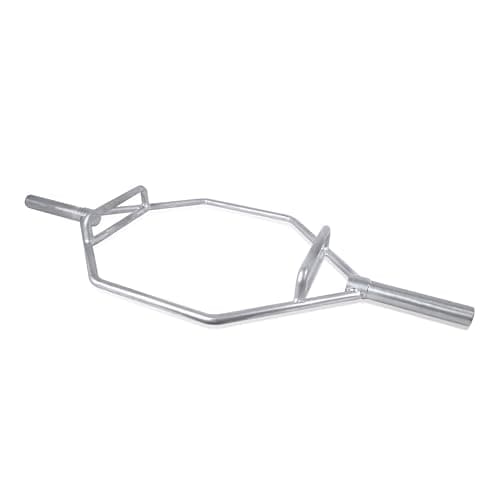
The 750 lb rating: headroom, not a target
The headline number here is the 750 lb capacity, and it’s the clearest reason to pick this bar over the cheaper black hex bars that typically stop lower. The important honesty note is how to read a rating like this: almost no home lifter loads a trap bar anywhere near 750 lb, so treat the figure as durability headroom, not a target you’re meant to chase. A hex bar rated this high isn’t going to take a permanent set or flex worryingly under your heaviest pulls, and it gives you the reassurance that the frame has years of margin to spare. The value of a big number isn’t that you’ll ever approach it — it’s that you never have to think about it.
It’s worth being precise about what the rating does and doesn’t tell you. Capacity says the frame is strong; it says nothing about how the handles feel, how square the welds are, or how the finish holds up over time. Plenty of trap bars quote a healthy number and then disappoint on the details. What makes the chrome CAP interesting is that the higher rating comes attached to real combo grips and a proper 2" Olympic fitment, so you’re getting a genuinely more capable frame, not just a bigger figure printed on the same entry-level bar. For most trainees the practical payoff is simple: load the bar with whatever you own, add plates for years, and never wonder whether the hex frame is the weak link.
Combo handles: what the high and low grips are for
The combo gripsare the feature that earns this bar its keep in day-to-day training. A combo hex bar gives you two handle heights — a raised high handle and a flush low handle— and each one changes the lift in a useful way. The high handles sit the load up off the floor, shortening the range of motion. That’s friendlier to lifters with limited hip or ankle mobility, it lets you pull heavier for the same effort, and it keeps a taller lifter out of a deep, cramped start position. The low handles drop you into a longer pull that looks and feels closer to a conventional deadlift, with more range and more work through the posterior chain.
Having both on one bar means you don’t have to choose up front, and that flexibility is exactly why combo bars are the sensible default for a home gym that serves more than one person or more than one goal. Start on the high handles while you build the movement, drop to the low handles as your mobility and confidence grow, or program both to hit slightly different ranges across a training block. Our guide to trap bar high vs low handlesbreaks down which height suits which lifter and which goal, and it’s the right read before you settle on how you’ll use this bar.
Chrome finish vs plain black: what you actually gain
The second upgrade over the entry hex bars is the chrome finish, and it’s a genuine, if modest, improvement. Chrome is harder-wearing than the plain black coatings on the cheapest trap bars — it resists the everyday scuffing and surface corrosion that make a budget black bar look tired within a season or two, and it wipes down easily after a sweaty session. If you care about a bar that stays presentable and holds up in a humid garage, chrome is the more durable surface, and on a bar you’ll own for years that longevity is worth something.
Here’s the honest counterpoint, though: chrome shows scuffs where the plates load. The sleeves are exactly where steel plates slide on and off and settle under load, and on a bright chrome finish those contact points mark up faster and more visibly than they would on a matte black bar that hides everything. It’s cosmetic, not structural — the scuffing doesn’t weaken the frame or affect a single rep — but if a pristine, showroom look matters to you, know going in that the sleeves will pick up plate marks. The trade is a finish that resists wear better overall but wears more visiblyat the loading points. For most lifters that’s an easy trade; for anyone precious about appearance, it’s the one place chrome bites back.
The closed frame: no loaded carries
This is the limitation to be clear-eyed about. The chrome CAP is a closed hex frame, which means you step in, load, and lift — and you cannot walk out of it with the bar. That rules out loaded carries, the farmer’s-walk-style work that open, walk-in trap bars are built to allow. If carries are a core part of your training, a closed frame simply can’t do that job; you’d step out of the ends of the bar as you moved. It’s not a flaw in this bar so much as a category boundary — closed hex bars deadlift, shrug and press beautifully, but they stay planted.
If loaded carries are on your list, the honest answer is to look at an open bar instead. Our review of the Synergee open trap barcovers a walk-in design built specifically for carries, and it’s the natural contrast to a closed frame like this one. The two designs solve different problems, and the choice comes down to whether you deadlift and press from a fixed spot — where the closed CAP is excellent — or want a bar you can pick up and walk with. Don’t buy the chrome CAP expecting to do carries with it; buy it because you want a rock-solid, high-capacity pulling and pressing hex bar.
Chrome high-capacity CAP vs the cheaper black CAP
The most useful comparison for most buyers isn’t against a rival brand — it’s against CAP’s own cheaper black combo hex bar, which we cover in our CAP trap bar review. The two are close cousins: both are closed combo hex bars from the same brand with the same basic geometry and grip layout. The chrome model steps up in two specific ways — the higher 750 lb capacity rating and the more wear-resistant chrome finish — for a bit more money. Everything else you’re paying for is those two upgrades.
So the decision is refreshingly simple. Buy the chrome high-capacity CAP ifyou want the extra durability headroom for peace of mind, you’d rather have a finish that stays presentable over years of use, and you’re happy to pay a little more for both. It’s the “buy once, forget about it” version of CAP’s hex bar. Save your money on the black CAP ifyou’re a lighter or newer lifter who will never approach even a lower capacity rating, you don’t care whether the sleeves scuff, and the lowest sensible price is the priority. Neither is wrong — they’re the same honest bar at two points on the spend curve, and the chrome model simply buys you headroom and finish. Both share the same closed-frame limitation, so if carries are the deciding factor, neither CAP is your bar.
Who this bar is for
Put it together and the chrome CAP has a clear lane. It’s for the home lifter who deadlifts, shrugs and presses from a fixed spot, wants a combo bar so more than one person or goal is covered, and would rather over-buy on capacity and finish once than replace a tired budget bar later. The 750 lb rating means the frame will outlast your pulling career, the combo grips keep the bar useful across mobility levels and training blocks, and the chrome holds up better than plain black everywhere except the plate-contact points. Those are real, specific strengths, and they’re why it sits at the high-capacity end of the CAP hex family.
It’s not for you if loaded carries are non-negotiable — the closed frame can’t do them, full stop — or if you want the absolute lowest price and don’t value the capacity and finish upgrades, in which case the cheaper black CAP does the same core job. And if you’re still deciding whether a hex bar belongs in your gym at all, or which type suits you, start with the fundamentals before you spend: our guide on how to choose a trap bar walks through capacity, handle style and frame type so you can match the bar to how you actually train. Get those basics right and the chrome CAP is an easy, honest pick for anyone who wants headroom and a clean finish from a closed combo hex bar.
Sources
- CAP Olympic Trap Bar (chrome) — manufacturer product specification (750 lb capacity, combo high and low handles, chrome finish, 2" Olympic fitment, closed hex frame) as published on the retail listing.
- General trap-bar spec principles (capacity as durability headroom, high vs low combo handles, chrome vs black finish and plate-contact wear, closed vs open frames and loaded carries) as covered in our methodology and linked trap-bar guides.