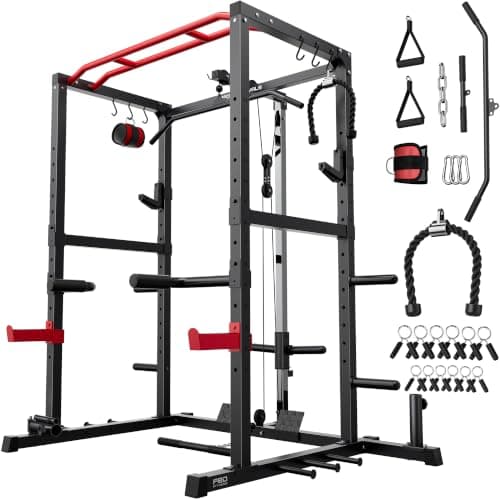
The cage: a full four-post base
Underneath the cables, this is a proper full four-post cage— the format that fully surrounds you so you can bench and squat to safeties with confidence, which our power rack vs squat rack guide explains is the safest way to train alone. It ships with J-hooks and takes standard 2-inch Olympic plates, so your existing plates and bar load straight onto it. The base rack does the core job of any cage: hold the bar, catch a failed rep, and anchor your work.
Integrated cables: the reason to buy it
The defining feature is the built-in LAT pulldown and low-row pulley. A bare cage leaves a gap: it’s excellent for pressing, squatting and pulling off the floor, but it does nothing for lat pulldowns, cable rows and the vertical/horizontal pulling that rounds out a program. This rack closes that gap in the same footprint, which is exactly what you want if the room can’t fit both a cage and a separate cable machine. Combined with the dip handles and multi-grip pull-up bar, it covers a genuinely broad range of movements from one station — the closest a single affordable purchase gets to a whole gym.
The honest limit: plate-loaded, not a weight stack
Here is the trade-off. The cables are plate-loaded— you hang your own plates on the carriage — not a selectorized weight stack. That has two real consequences. First, the pull is less smooththan a commercial stack machine; a plate-loaded pulley has a slightly different feel and you’ll notice it if you’ve trained on gym cable machines. Second, changing weight is slowerthan moving a pin. Neither is a dealbreaker for home training — the movements are the same and the resistance is real — but if buttery cable feel and instant weight changes matter to you, a dedicated weight-stack machine does that better, at the cost of a second footprint and far more money.
Assembly and setup
A cage with an integrated pulley system is more to assemblethan a plain cage, simply because there are more parts — the tower, the carriage, the cable runs. Budget the time, follow the sequence, and check bolt torque after your first few sessions, which is good practice on any rack (our assembly guidewalks the general process). As with any home rack, plan to bolt it down or confirm it’s stable under load; our anchoring guide covers the options.
Who should buy it — and who shouldn’t
Buy it ifyou want cable pulling built into your rack and you have one space to do it all. The integrated LAT and row genuinely expand what you can train, and doing it in one footprint is the whole appeal — pair it with a bench and you have most of a gym in a corner.
Look elsewhere ifyou don’t care about cable work or you want the smoothest possible cable feel. If cables aren’t a priority, a simpler cage from our power rack roundup costs less and assembles faster; if buttery cable feel is the point, budget for a separate stack machine. And if space is the hard constraint, our small-space roundup has more compact answers.
Sources
- SPORTSROYALS power rack with LAT pulldown — manufacturer product specification (four-post cage format, integrated LAT pulldown and low-row pulley, dip handles, pull-up bar, 2-inch plate fitment) as published on the retail listing.
- General rack and cable-system principles (full cage safety, plate-loaded vs weight-stack pulleys, attachment ecosystems, assembly and anchoring) as covered in our methodology and linked rack guides.