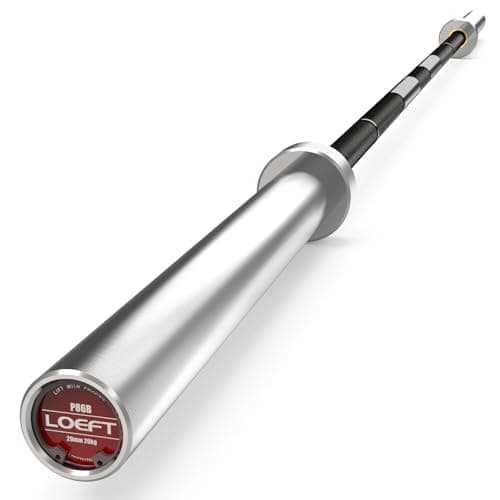
What a “205K PSI power bar” actually claims
Strip the marketing off and the P86B is making three claims that matter to a strength lifter: a high published tensile strength, a very high load rating, and an aggressive, center-knurled grip. Those are exactly the three levers a dedicated power bar pulls, and they’re the levers a general-purpose or budget Olympic bar deliberately softens. So the honest framing is not “is this a good barbell?” but “is this a good powerbar?” — because that’s the only job its spec sheet is built for. If you want the wider context on how power bars differ from all-rounders, our Olympic vs powerlifting barbell guide lays out why the two are almost opposite tools despite looking identical on a rack.
The 205,000 PSI tensile figure, read honestly
Tensile strengthis the headline number here, and it’s worth understanding rather than just trusting. Tensile is the stress a bar’s steel can take before it fails, measured in PSI, and higher figures generally track with a bar that resists permanent bending and holds its shape over years of heavy loading. A published 205,000 PSIfigure sits in genuine competition-grade territory — the kind of number you normally see quoted on specialist bars that cost several times more. That is the P86B’s single most compelling line, and it’s the reason the bar earns a review at all.
The caveat we always give: a tensile number is a manufacturer-published figure, not something we verified in a lab, and the way brands test and report it isn’t perfectly standardized. So we read 205K PSI as a strong claim that the shaft is made from good steel, not as a certified guarantee. Even taken conservatively, it points to a bar with real headroom rather than a soft import that takes a set after a few heavy sessions. Our barbell tensile strength guideexplains how to read these figures, why higher isn’t automatically “better feel,” and how tensile relates to the whip and stiffness you actually notice under the bar.
The 2,000 lb capacity and a dead-stiff shaft
The 2,000 lb capacityis the second big number, and like most high ratings it’s best read as durability headroom rather than a target — no raw lifter is loading anywhere near it. What the rating and the high tensile figure combine to produce is the trait a powerlifter actually cares about: a stiff shaft. A power bar is supposed to feel dead. When you unrack a heavy squat you don’t want the bar oscillating on your back, and when you grind a max bench you don’t want energy bleeding into whip. The P86B is built to sit still under load, which is exactly right for the slow, maximal lifts and exactly wrong for anything explosive.
That stiffness is a feature and a limitation in the same breath. It keeps the bar predictable under a heavy single, but it also means the bar has no forgiving flex for cleans, snatches, or speed pulls where a little whip helps the bar leave the floor. If you want a bar that does a bit of everything, the stiffness works against you; if you only ever squat, bench and deadlift heavy and slow, it’s precisely the behavior you’re paying for.
The aggressive knurl and the center knurl
Grip is where the P86B most obviously declares its intentions. The knurl is aggressive— a sharp, well-defined pattern that digs into the hand and refuses to slip on a heavy, sweaty deadlift. For a raw puller chasing a max, that bite is the whole point: an aggressive knurl means you rely less on chalk and straps and more on the bar simply locking to your hand. Our aggressive vs passive knurlingguide walks through why the sharpest bars feel “grippy” to a powerlifter and “painful” to everyone else — the same texture reads completely differently depending on what you do with the bar.
The P86B also carries a center knurl, and that one detail tells you almost everything about who the bar is for. A center knurl is a band of texture in the middle of the shaft that grips your shirt and skin during a back squat so the bar doesn’t slide down your back. It’s standard on power bars and deliberately absent from most Olympic and general-purpose bars, because it chews at your neck and collarbones during front squats, cleans and high-rep pressing. Our center knurl explained guide covers this trade-off in full — but the short version is that a center knurl is a love-it-or-hate-it feature that quietly marks a bar as a specialist tool.
Where the budget price shows — and the honest cons
No bar this cheap is free of compromise, and the P86B’s cons come straight from the same traits that make it good. First, the aggressive knurl will tear soft hands on high volume. If you do a lot of repetitions, touch-and-go sets, or Olympic pulls, a sharp knurl shreds calluses fast, and no amount of “toughening up” makes 20 reps on a competition-sharp bar pleasant. This is not a flaw so much as a mismatch: the same bite that a one-rep-max lover praises is the reason a CrossFit or bodybuilding lifter should look elsewhere.
Second, the center knurl and stiffness make it single-purpose. Between the sharp grip, the dead shaft and the center band, this is a power-lifts-only bar. It will do the job of a squat, bench and deadlift bar superbly and the job of an all-rounder poorly. That’s the honest ceiling on the value story: the P86B is a bargain ifa dedicated power bar is what you were shopping for, and a false economy if you actually needed one bar to cover everything. If you’re in the second camp, a hybrid or general Olympic bar will serve you far better than a cheap specialist.
Who it’s for — and who should skip it
Buy the P86B ifyou’re a dedicated powerlifter or a strength lifter whose training is squat, bench and deadlift, you want a genuinely aggressive grip and a dead-stiff shaft, and you don’t want to pay boutique money for a competition-style spec sheet. On those terms it’s one of the strongest value picks in the category, which is why it earns a place in our best powerlifting barbell roundup rather than sitting on the sidelines. If you want to see how it stacks up against a more established specialist, the Titan Elite Power Baris the obvious comparison — a known-brand power bar with its own following.
Skip the P86B ifyou train the Olympic lifts, do high-rep or CrossFit-style volume, have hands that don’t tolerate a sharp knurl, or want a single do-everything bar for a general home gym. The center knurl, the aggressive bite and the stiff shaft that make it a great power bar are exactly the traits that make it a frustrating all-rounder. In that case the honest move is to buy a softer, more versatile bar and treat the P86B as the second bar you add once your training narrows to pure strength.
6 ft or 7 ft: picking the right length
The P86B is offered in 6 and 7 ft options, and the choice is mostly about your rack and your lifts. A 7 ft baris the standard full length — it spans a normal power rack’s uprights, gives you the usual sleeve length for loading plenty of plates, and is what most people should default to for squat, bench and deadlift. A 6 ft baris shorter and easier to handle, which can suit a tight space or a narrow rack, but you have to confirm it actually fits your rack’s width before you buy — a bar that’s too short won’t seat properly in standard J-hooks. For a dedicated powerlifting setup in a normal rack, the 7 ft is the safe default; only reach for the 6 ft if space genuinely forces the issue. Either way the fitment stays a standard 2", so your plates and collars carry straight over.
Living with an aggressive knurl
Owning a sharply knurled bar changes your habits, and it’s worth knowing that going in. Chalk becomes less about grip and more about managing skin — the bite is already there, so you use chalk to stop the knurl grabbing and tearing on your heaviest sets. Lifters who run an aggressive bar tend to keep their hand care tighter: filing down calluses, avoiding high-rep work on the sharp bar, and saving it for the low-rep lifts it’s built for. None of that is a flaw in the P86B; it’s simply the reality of a competition-style grip, and it reinforces why this is a specialist’s bar rather than the one a beginner should start on. If that sounds like friction you’d rather not deal with, that’s the clearest sign a softer, more versatile bar suits you better.
Sources
- P86B Powerlifting Barbell (205K PSI) — manufacturer product specification (205,000 PSI published tensile strength, 2,000 lb capacity, aggressive knurl with center knurl, 2" plate fitment, 6/7 ft length options) as published on the retail listing.
- General power-bar spec principles (tensile strength interpretation, capacity as durability headroom, shaft stiffness, aggressive vs passive knurl, center knurl trade-offs) as covered in our methodology and linked spec guides.