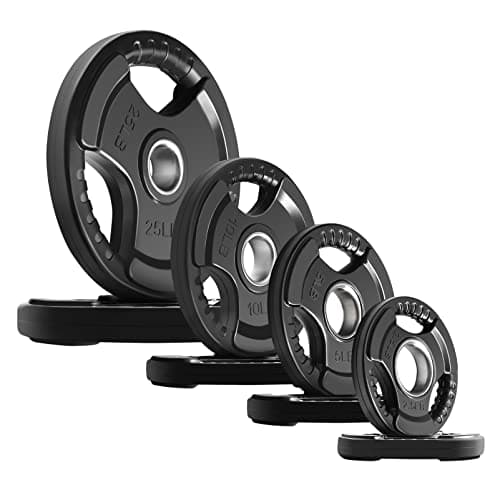
What a grip plate is — and what it isn’t
A grip plate is a standard plate with cut-out handlesmolded into the body — usually three, hence “tri-grip.” The handles do one job well: they make the plate easy to pick up, carry and use on its own, which turns each plate into a piece of loadable equipment rather than something that only lives on a bar. That’s the whole design idea, and it’s worth being clear-eyed about it up front, because a grip plate is optimized for handling, not for maximum weight-per-dollar or for dropping. Understand what it’s for and it’s an easy plate to like; expect it to do a bumper’s job and it will disappoint.
The cut-out handles: carry and loaded raises
The handles are the reason to buy these. They make plates genuinely easy to carry around a garage gym — loading and unloading a bar, moving a stack, hauling a plate to a corner for accessory work — without pinching the rim or dropping it on your toes. They also open up loaded, dumbbell-style movements: plate front raises, plate presses, around-the-worlds, loaded carries, Russian twists and the rest of the accessory catalog that’s awkward with a bare, handle-less plate. If a chunk of your training is single-plate accessory work or you just move plates around a lot, that convenience is a real, everyday benefit that a plain iron plate doesn’t give you.
Rubber-encased: quieter and floor-friendly
The rubber encasement is the other selling point. Rubber-coated plates are far quieterthan bare cast iron — no metallic clang when they knock together on the sleeve or touch down — which matters in a shared house, an apartment, or a garage next to a bedroom wall. The coating also protects your floorand equipment: it’s more forgiving on the bar, the rack and the ground than bare iron, so an accidental knock is less likely to chip a plate, gouge the floor or mark the bar. For a home gym where the equipment and the room have to coexist, that quieter, gentler behavior is worth a lot even before you use the handles.
The honest limit: these are NOT bumper plates
Here’s the line to underline: a rubber coat is not the same as a bumper. True bumper platesare built from dense rubber all the way through and are engineered to be dropped from overhead again and again. Rubber-encased grip plates have a metal or metal-and-filler core wearing a rubber jacket — the coating quiets them and protects surfaces, but it is notdesigned to absorb the impact of a loaded bar slammed to the floor. Do not drop a loaded bar on grip plates: you risk cracking the coating, splitting the plate, damaging the bar and hurting yourself. If your training involves dropping the bar — Olympic lifts, cleans, snatches, CrossFit-style metcons — you need real bumpers, not these. Our bumper plates vs iron plates guide explains exactly where that line sits and why it matters.
Thicker than bare iron: fewer per sleeve
The second honest trade is thickness. Because of the rubber jacket, grip plates are thicker than bare cast iron of the same weight, so fewer fit on a sleeve. That’s rarely an issue for the accessory and moderate-load work these are best at, but if you deadlift or squat heavy and want to pack the most weight onto the bar, thin machined iron loads far more before you run out of sleeve. If maximum loadability and the lowest cost-per-pound are your priorities, our cast-iron plate reviewis the plate to read instead — iron is cheaper and thinner, and you give up the handles and the quiet in return.
Fitment and pairing
The 2-inch Olympic openings mean these load on your existing Olympic barwith no adapters, so they drop straight into a standard home setup. Many gyms end up owning a mix: thin iron for the heavy static lifts, a few bumpers for anything they drop, and a pair or two of grip plates for the carrying and accessory work they make easy. If you’re still deciding what your first full set should be, our how to choose weight plates guide walks the whole decision.
Grip plates in a mixed loadout
The smart way to think about grip plates isn’t as your whole set but as one useful layer in a mixed loadout. A lot of home gyms end up owning three kinds of plate for three jobs: thin cast iron for the heavy static lifts where cost-per-pound and loadability matter most, a few true bumpers for anything they drop, and a pair or two of grip plates for the carrying and single-plate accessory work these do best. Bought that way, the RitFit plates earn their place without you having to pretend they’re something they’re not. If you’re building your first set from scratch and trying to decide the split, our how to choose weight plates guide walks the whole decision, and our weight plates roundup ranks the options for each role.
Concrete uses: the accessory catalog
It’s worth being specific about what the handles unlock, because “accessory work” is vague. With a handled plate you can do plate front raises and around-the-worlds for the shoulders, plate presses and chest-loaded work, loaded carries and suitcase holds for the grip and trunk, Russian twists and weighted sit-ups for the core, goblet-style squats, and plate-loaded rows — all movements that are fiddly or uncomfortable to grip on a bare, handle-less plate. If a meaningful slice of your training is this kind of single-implement work, or you do a lot of it away from the bar, the convenience compounds over every session. It’s the difference between a plate you can only load and a plate you can actually train with in your hands.
Coating durability and care
On the coating itself: the rubber encasement is what keeps these quiet and floor-friendly, and looking after it keeps them that way. Rubber-encased plates hold up well to normal loading and carrying, but the coating isn’t indestructible — sharp knocks against a hard edge, or the impact of dropping them, can nick or split the jacket, which is one more reason not to treat them like bumpers. Store them somewhere they’re not banging into metal, wipe them down if they pick up chalk or grime, and they’ll stay quiet and intact for years. Treated as the handling-and-quiet plates they are, rather than the drop plates they aren’t, they’re low-maintenance and long-lived.
Fitment and loading a mixed bar
Two quick practical points. First, these load on 2-inch Olympicsleeves, so they mix freely on the bar with your existing iron or bumpers — there’s no separate standard to manage. Second, because grip plates are thicker than bare iron, keep an eye on how much sleeve you’ve got left when you combine them with other plates on a heavy bar; if you’re loading near the collar, put your thinnest plates (iron) on first and any grip plates toward the outside. It’s a small loading habit that keeps a mixed bar tidy and the collars seated. For most accessory and moderate-load work you’ll never bump into the limit, but it’s worth knowing when you do go heavy.
Who should buy them — and who shouldn’t
Buy them ifyou want quiet, floor-friendly plates that are easy to carry and great for single-plate accessory and dumbbell-style movements, and you train in a shared or noise-sensitive space. As a handy supplement to a main set — or a moderate-load plate for a room where clang and floor damage are a problem — they’re a genuinely nice thing to own.
Look elsewhere if you drop the bar (you need bumpers, full stop) or if your priority is the most weight per dollar and the most weight per sleeve for heavy static lifts (that’s thin cast iron). Match the plate to the job: grip plates are handling and quiet, not dropping and density.
Sources
- RitFit Olympic rubber grip weight plates — manufacturer product specification (tri-grip cut-out handles, rubber-encased coating, 2-inch Olympic fitment, grip/handle-plate design) as published on the retail listing.
- General plate principles (grip-plate handling use, rubber coating vs true bumper construction, drop-safety limits, plate thickness and sleeve loadability, 2-inch fitment) as covered in our methodology and linked spec guides.