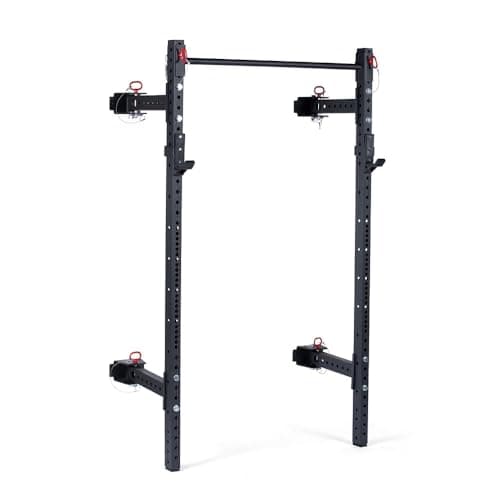
The steel: real 11-gauge, not thin import stock
The headline spec is the tubing. The T-3 uses 2x3-inch uprights in 11-gauge steel— about an eighth of an inch thick, the commercial standard. This is the single biggest reason to buy it over a cheap compact rack: most space-saving racks cut cost with thin box steel that flexes under a heavy squat, and the T-3 doesn’t. Our 11-gauge vs 14-gauge guideexplains how much stiffer the thicker tube is and why it matters when you rack a heavy bar. In a space-saving format, getting real steel is rare and it’s the T-3’s whole pitch.
The fold: how it reclaims the room
The rack mounts to the wall and folds flat, sitting roughly five inches from the wall when stowed. In use you swing the uprights out; when you’re done, you fold them back and the floor is yours again for parking, kids, or anything else. That is the entire reason this format exists, and the T-3 does it with heavier steel than the compact freestanding racks it competes with. If your constraint is that the room has another job when you’re not lifting, nothing else in our roundups solves it as cleanly. Before you buy, read our rack-sizing guide to confirm your ceiling height clears the pull-up bar and the folded depth suits your room.
Attachments and the Titan ecosystem
The rack ships with J-hooks and a pull-up bar, and because it’s part of Titan’s T-3 line it plugs into a large ecosystem of attachments— safeties, spotter arms and more sized to the same 2x3 hole pattern. That expandability is a genuine advantage over one-off compact racks: you can start minimal and add the pieces you need. It also means you’re not locked into a dead-end product; the T-3 platform has been around long enough that parts and accessories are easy to find.
The trade-off: no back uprights
Here is the honest cost of the folding format. A wall-mounted rack has no rear uprights, so it isn’t a full enclosure the way a four-post cage is. You rely on spotter armsto catch a failed rep rather than being fully surrounded by safeties, which changes how you set up to bench and squat alone. It’s completely usable and safe when set correctly — and far safer than no rack — but if you want the total confidence of being boxed in on all four sides, a cage is the format for you. Our power rack vs squat rack guide and spotter arms vs safety straps guide walk the difference.
Mounting: the one hard requirement
A folding rack transfers real load into your wall, so it must bolt into solid structure— studs on a framed wall, or masonry anchors on concrete or block. This is the T-3’s one non-negotiable: if you can’t mount it into something structural, it isn’t the rack for you, and a freestanding compact cage or squat stand is the answer instead. Our anchoring guide covers mounting to concrete, wood and rental floors. Get the mount right and the rack is rock-solid; get it wrong and no steel gauge saves you.
Who should buy it — and who shouldn’t
Buy it iffloor space is your hard constraint, you have a solid wall to mount to, and you want commercial-grade 11-gauge steel rather than a flimsy compact rack. It’s the cleanest way to have a serious rack and a usable room, and it pairs with a stiff bar and bumper plates for heavy work.
Look elsewhere ifyou have the floor space for a full cage, want to be fully enclosed by safeties, or can’t mount into structure. In those cases a four-post cage from our power rack roundup or a squat stand is the better call.
Sources
- Titan T-3 wall-mounted folding rack — manufacturer product specification (upright size and steel gauge, wall-mounted folding design, folded depth, included J-hooks and pull-up bar) as published on the retail listing.
- General rack-design principles (steel gauge and tube size, full cage vs wall-mounted format, safeties vs spotter arms, anchoring) as covered in our methodology and linked rack guides.