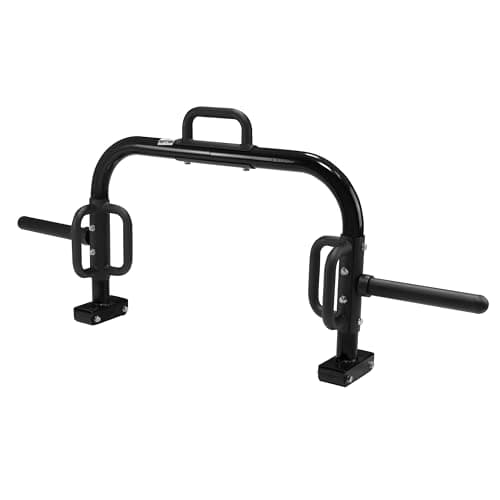
Open vs closed frame: why the walk-in matters
The defining feature here is the open frame. A conventional hex or diamond trap bar surrounds you completely: you stand inside a closed loop of steel, which is fine for a deadlift where you never move your feet, but it physically fences you in the moment you try to walk. The CAP Deluxe leaves one end of that loop open, so you can step straight out the frontof the bar. That’s the whole reason the open format exists, and it changes what the tool can do rather than just how it looks. Our open vs closed trap bar guide walks through the trade-offs in full, but the headline is simple: an open bar is a deadlift bar that can also go for a walk.
In practice that means loaded carriesbecome a first-class movement. With a closed hex you’re stuck doing static holds; with the open CAP you can load the bar, stand up and walk it forward for farmer-style carries with the weight hanging at your sides in a natural, balanced position. The same geometry opens up walking lungesand step-through work, because your lead leg has somewhere to go. If the appeal of a trap bar for you is that neutral-grip, weight-at-your-sides feel, the open frame extends that same feel into movement patterns a closed bar locks you out of. The honest caveat is that removing one end of the frame changes the balance slightly compared to a fully symmetric hex — the load sits a touch differently — but for deadlifts, shrugs and carries that difference is minor and easy to adjust to within a session.
Dual high and low handles: what each height suits
The CAP Deluxe carries two sets of handles, high and low, exactly like a standard dual-grip trap bar. Flip the bar one way and you deadlift from the raised handles; flip it over and you pull from the low handles. This isn’t a gimmick — the two heights genuinely suit different lifters and different goals, and having both on one bar is a large part of the trap bar’s appeal.
The high handlesraise the bar off the floor by a couple of inches, which shortens the range of motion and lets you start from a more upright, less-folded position. That’s the friendlier setting for taller lifters, anyone with limited hip or hamstring mobility, and beginners still learning to brace — you can move meaningful weight without having to reach all the way to the deck. The low handles put the load closer to a conventional deadlift height, giving you the full range of motion and the greater posterior-chain demand that comes with it. Because the two heights change how much weight feels manageable, it helps to know roughly where a trap bar sits before you start plate math; our how heavy is a trap bar guidecovers typical bare-bar weights so you can plan your loading around whichever handle you’re using. Most owners settle on one height for their main pulls and keep the other for variation, deload work or a training partner of a different build — and the fact that both live on one bar is real value at this price.
2" Olympic fitment: it takes the plates you already own
The sleeves are standard 2" Olympic, which is the boring-but-important part of the spec. It means the CAP Deluxe takes the exact same plates and collars as your barbell — any Olympic-hole plate, bumper or iron, slides straight on. There’s no adapter, no proprietary collar and no separate plate set to buy. If you already have a home gym built around a 7 ft Olympic bar, this bar drops into that ecosystem with zero friction, and it’ll rack and store alongside the rest of your gear without any special handling. For a budget purchase that compatibility matters: the whole point of a value bar is that it earns its place without forcing you to spend anywhere else to use it, and standard Olympic fitment is what makes that true here.
The honest budget compromises: welds, finish and loading
Here’s where the price shows, and it shows in two specific places. First, the finish and the welds are budget-tier. This is a CAP bar at a CAP price, and the coating and the weld quality reflect that — expect a functional finish rather than a premium one, and welds that do their job without the clean, confidence-inspiring look of a specialist bar. None of that undermines the bar for deadlifts, shrugs and carries, but if you run your hand along it expecting the fit and finish of a dedicated strength brand, you’ll feel where the money was saved. Treat the finish like any budget coating: wipe the bar down after sweaty sessions and keep it dry so surface rust doesn’t get a foothold.
The second compromise is a genuine convenience gap. The CAP Deluxe doesn’t stand upright on its ownfor loading. A stand-up open bar sits vertically so you can slide plates on at a comfortable height; the CAP lies flat, so you load it the old-fashioned way — bending down, or tipping and steadying it yourself. On a heavily loaded bar that’s a small but real daily annoyance. It’s worth knowing that this is currently a theoretical trade rather than a live one: the stand-up bar we used to rank against it, the Synergee stand-up open trap bar, is no longer buyable, so every open bar you can actually order today loads off the floor. If you’re happy to do that, the CAP gives you the open geometry for less than anything else in the format.
Trap-bar deadlift benefits: why the format is worth owning
Step back from the open-vs-closed question for a moment, because the underlying reason to buy any version of this tool is the trap-bar deadlift itself. Pulling from inside the bar with a neutral gripand the load lined up through your center of mass shifts the lift toward a more upright torso and a more quad-driven pattern than a straight-bar deadlift. For a lot of home lifters that means a movement that’s easier on the lower back, simpler to learn and more forgiving of imperfect mobility — while still letting you load heavy and build real strength. Our trap bar vs barbell deadlift guide breaks down exactly how the mechanics differ and when each one is the better choice.
That’s also why the trap bar earns its footprint for so many people: it’s one of the most versatile single purchases in a home gym, covering deadlifts, shrugs, carries and — on this open model — lunges too. If you’re still weighing whether the tool belongs in your setup at all, our is a trap bar worth it guidemakes the case for and against, so you can decide before you spend. For most enthusiasts building out a well-rounded gym, the answer is that it’s one of the highest-value specialty bars you can own, and the CAP Deluxe is a low-cost way to find that out for yourself.
Who should buy it — and who should look at the closed hex
Buy the CAP Deluxe if you specifically want the open, walk-in format — you want carries and lunges as well as deadlifts — and you want the cheapest honest way into it. You’re accepting a budget finish and floor-loading in exchange for open geometry, dual grips and CAP’s easy availability and returns. For a lot of home lifters that’s a smart trade: the open format is the whole reason you’re here, and this bar delivers it for less than the specialist alternatives.
Look at a closed hex instead ifyou mostly deadlift and shrug and don’t care about carries or lunges, because a symmetric closed bar can be cheaper still and its balanced frame is arguably nicer for pure pulling. CAP’s own closed model is the natural comparison — our CAP Olympic Hex Trap Bar reviewcovers the closed-frame bar in the same family, and if your training never leaves the deadlift-and-shrug lane, it may be the better-value pick. Either way, it’s worth seeing the whole field before you commit: our best trap bar roundup lines up the open and closed options at every price so you can match the format and the budget to how you actually train.
Sources
- CAP Deluxe Open Trap Bar — manufacturer product specification (open dual-grip frame, high and low handles, 2" Olympic sleeves, intended for deadlifts, shrugs and loaded carries) as published on the retail listing.
- General specialty-bar principles (open vs closed trap-bar geometry, dual high/low handle heights, 2" Olympic fitment, neutral-grip trap-bar deadlift mechanics, and budget finish and weld trade-offs) as covered in our methodology and linked trap-bar guides.