The 2% tolerance: why accuracy matters
The headline spec is the published 2% weight tolerance. Cheap economy iron can drift several percent from its stated weight, which sounds trivial until you’re chasing a small PR or trying to keep left and right sides balanced — a “45” that’s really 47 on one side and 43 on the other quietly makes your loading a guess. A tighter,publishedtolerance means your working weights are honest and your two sides match. It’s the same reason serious lifters value calibrated plates — this set brings a slice of that consistency at an iron-plate price. Our plate sizes guide explains why tolerance sits alongside diameter and hole size as a real spec.
Powder coat: cleaner and more durable than bare iron
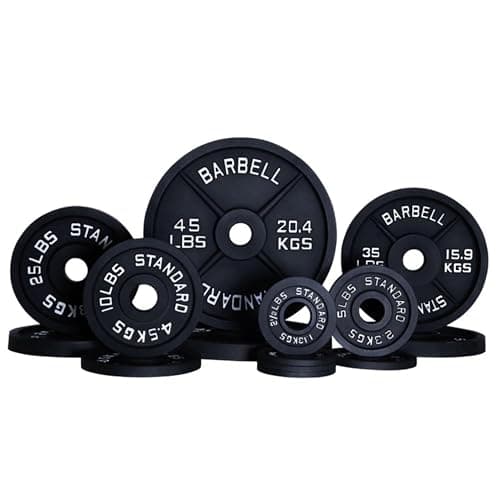
The powder coatis a genuine upgrade over bare cast iron. It resists the surface rust bare iron develops in a damp garage and the chipping that raw plates pick up from loading and stacking, so the set stays looking and reading clean for longer. It’s also simply nicer to handle — less of the metallic residue bare iron leaves on your hands. Our plate storage guide covers keeping any iron plate off a damp floor, but a coated plate is the more forgiving starting point.
A graduated set: no hunting for denominations
Buying a graduated 250 lb setis usually the cheapest and simplest route to a working loadout — you get a spread of denominations in one purchase rather than hunting single pairs. 250 lb plus the bar covers most beginners’ and many intermediates’ working sets across pressing, rowing and moderate squats and pulls. When you outgrow it, the plate everyone runs short of first is the 45, which you can add by the pair — our how many plates do I need guide maps a loadout by strength level.
The honest limit: not drop-safe
The key caveat, stated plainly: these are iron plates, not bumpers— you cannot safely drop a loaded bar on them. Dropping iron risks cracking a plate and your floor. That makes this set ideal for controlled lifting inside a rack with safeties, where a missed rep lands on the pins rather than the deck — but wrong for anyone who deadlifts to the floor and drops, or does Olympic lifting. If that’s you, you want bumper plates, and our bumper vs ironguide walks the decision. The other honest note is price: a coated, tighter-tolerance set costs more than a bare cast-iron set of the same weight, which is exactly what you’re paying for.
Loadability: thin iron fits more per sleeve
One practical upside of iron over bumpers: it’s thinner, so far more weight fits per sleeve before you run out of room. A lifter loading heavy squats and pulls on a standard 2-inch bar will get more plates on with iron than with wide rubber bumpers, which is a real advantage as your numbers climb. Pair the set with a 2-inch Olympic bar and lock it with good collars.
Who should buy it — and who shouldn’t
Buy it ifyou want accurate, consistent, rust-resistant weight for controlled lifting, you value a published tolerance and a durable coat, and you rack your heavy work rather than dropping it. It’s the accuracy-first pick, and a clean, long-lasting base loadout.
Look elsewhere ifyou deadlift to the floor and drop the bar, or do any Olympic lifting — you need drop-safe bumpers— or if outright cost per pound is all that matters, where a bare cast-iron set is cheaper. Our plate cost guide lays out the per-pound math.
Sources
- Barbell Standard 250 lb powder-coated Olympic plate set — manufacturer product specification (set weight, powder-coated finish, published 2% weight tolerance, 2" Olympic fitment) as published on the retail listing.
- General weight-plate principles (weight tolerance and accuracy, coated vs bare iron durability, drop-safety limits of iron, thickness and loadability) as covered in our methodology and linked plate guides.