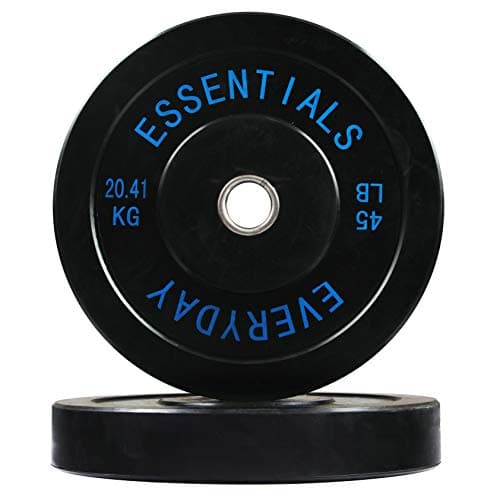
Why the 45 is the plate you run out of first
Ask anyone who has loaded a barbell for a year and they’ll tell you the same thing: you never have enough 45s. The 45 lb plate is the workhorse of every heavy lift — it’s the biggest common bumper, the one you stack to build a working weight, and the first plate your bar asks for once you’re past warm-ups. A set that comes with a single pair of 45s feels balanced on paper and then runs short the moment your squat or deadlift climbs, because you burn through the big plates fastest and the little ones sit unused in a corner. That’s the whole reason this product exists: it sells the exact plate the market always undersupplies, on its own, so you can fix the shortage without buying a second full set. Our guide to how many plates you need walks through why the big plates always run out first and how to budget your loadout around that.
The math is unforgiving. A single pair of 45s puts 90 lb of plate on the bar; add the bar itself and you’re around 135 lb, a working weight for plenty of lifters but a warm-up for plenty of others. To load 225 you need two pairs of 45s; to load 315 you need three. Every step up in strength is another pair of 45s, and lighter plates do nothing to help — you can’t substitute a stack of 10s for the reach and clearance of a proper 45. That’s why the 45 is the one plate almost every home lifter ends up buying more than once, and why a stand-alone pair is such a sensible thing to keep on the shelf.
Buying by the pair vs buying a graduated set
The right way to think about this pair is as a top-up, not a starter kit. A graduated bumper plate setis what you buy when you have nothing: it gives you a spread of weights — 10s, 25s, 35s, 45s — so you can build the small jumps a training program lives on. A pair of 45s does the opposite job. It assumes you already own the light plates and simply need more of the heavy one, which is the situation most lifters land in after their first year of getting stronger. Buying that heavy pair on its own is cheaper than buying a second graduated set, because you’re not paying again for the 10s and 25s you already have sitting idle.
That’s the honest limit of this product, and it’s worth stating plainly: a pair of 45s is only useful once you already have lighter plates.On its own it can’t make the fine adjustments a beginner needs — you can’t go from 135 to 155 with nothing but 45s, and micro-loading is impossible. So if this is your very first plate purchase, it’s the wrong one; you want a graduated set that covers the small increments first, and BalanceFrom’s own full kit is the natural place to start there. Our review of the full BalanceFrom set covers that graduated option, and it’s the piece to read if you’re building a loadout from zero rather than topping one up.
The decision, then, is simple. If you own a set and keep hitting a ceiling because you’ve run out of big plates, buy the pair. If you own nothing, buy the set. Our guide on how to choose bumper plates lays out that set-versus-pair logic in more detail, along with the diameter and insert questions that matter more than brand.
Steel hub and color coding, carried over from the full set
The reassuring part of buying the pair is that you’re not getting a stripped-down version of the plate. These 45s carry the same steel insert hub and the same color codingas the plates in BalanceFrom’s graduated set, so if you already own that set the pair drops straight in and matches. The steel hub is the spec that matters most here. A metal insert around the 2" collar opening is far more durable than a bare rubber center — it resists the wallowing and tearing that cheap all-rubber bumpers suffer where the plate meets the sleeve, and it holds the fit tight over years of loading and unloading. It’s the difference between a plate that stays true on the bar and one that gets sloppy. Our bumper plates explainer covers why the hub material is the durability question worth caring about on a bumper.
The color coding is a smaller but genuinely nice touch on a heavy plate. Being able to read the weight at a glance matters most on the plates you handle constantly, and the 45 is exactly that plate. It also means the pair sits visually alongside a color-coded set instead of clashing with it, which keeps a rack looking coherent. None of this is exotic — steel hubs and color coding are what you’d expect on a competent modern bumper — but the point is that the stand-alone pair gives you the same build quality as the set, not a downgrade to justify the lower entry price.
Standard thickness and the sleeve-space trade-off
Here’s the honest con, and it’s the one thing to weigh before you buy several pairs. These are standard-thickness bumpers, not the thin, high-density competition plates built to pack more weight into less width. That means each 45 takes up more room on the bar’s loadable sleeve than a comp plate of the same weight would, and the difference compounds fast when you stack them. Load three or four pairs of standard 45s per side for a heavy pull and you can start crowding the collar, running out of usable sleeve before you run out of strength. A lifter chasing very heavy loads — or anyone with a shorter loadable sleeve — will feel that limit sooner with standard plates than with thin competition ones.
For most home lifters this is a trade-off, not a dealbreaker. Standard thickness is the norm for training bumpers precisely because it’s cheaper, and comp-spec thinness carries a real price premium you don’t need unless you’re loading near the top of the sleeve. The point is to go in with eyes open: if you expect to stack a lot of 45s, count your sleeve space first and know that standard plates eat it faster. If you’re loading two pairs a side and not chasing a competition total, you’ll likely never notice. Where thin plates genuinely earn their keep, our Synergee bumper reviewis the comparison to read — those are the plates people reach for when sleeve space, not price, is the constraint.
How the pair fits into building a bumper loadout
The smart way to use this product is as one line in a plan, not a purchase on its own. A sensible home bumper loadout usually starts with a graduated set for the light and mid plates, then grows by adding pairs of 45s as you get stronger — because, again, the 45 is the plate you keep running out of. Bought this way, the stand-alone pair is the most cost-efficient upgrade you can make: every time your working weight climbs a plate, you buy exactly the plate you need and nothing else. Over a few years that’s a much cheaper path to a heavy setup than repeatedly buying whole sets and piling up 10s you never touch.
If you’re still deciding whether bumpers are even the right plate for you, that question comes before this one. Bumpers earn their keep if you drop the bar from overhead or deadlift on a floor you want to protect; if you never drop the bar, iron plates are cheaper and thinner. Our guides on what bumper plates are and whether you actually need bumper platessettle that before you spend on any of them. And once the plates are in the gym, keeping the big 45s off the floor and on a proper tree or peg is what saves your back and your hubs — our guide on how to store weight plates covers the storage side that a growing stack of 45s makes non-optional.
Set against the alternatives, the BalanceFrom 45 pair is an easy thing to recommend for the narrow job it does. It’s the same competent, steel-hub, color-coded plate you’d get in a full set, sold in the one weight you’re most likely to want more of, at a lower entry cost than buying another whole kit. Just remember what it is: a top-up, not a starting point. Buy it when you already own light plates and keep bottoming out on the heavy end — and count your sleeve space first if you plan to stack a lot of them.
Sources
- BalanceFrom 45 lb bumper plates (pair) — manufacturer product specification (45 lb pair, steel insert hub, color-coded, 2" Olympic fitment) as published on the retail listing.
- General bumper-plate principles (why 45s run short first, set-versus-pair loadout logic, steel-hub durability, standard versus competition thickness and sleeve-space trade-offs) as covered in our methodology and linked plate guides.