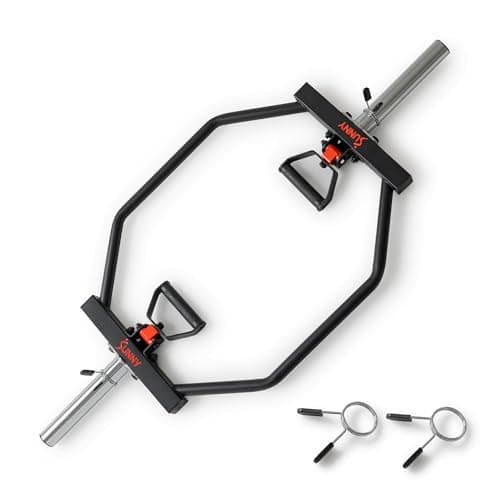
Why a closed hex is a great first trap bar
The Sunny is a textbook closed hexbar: a six-sided frame you stand inside, with handles built into the sides. A closed hex has no moving parts, no adjustments to get wrong and no learning curve beyond the lift itself — you load it, step in and pull. For a first trap bar that simplicity is the point, not a shortcoming. There is nothing to set up, nothing to break and nothing to think about except your own setup and brace. The bar gets out of the way and lets you learn the movement.
And the movement it teaches is the forgiving one. Because the handles sit at your sides, the load stays centered on you instead of hanging out in front, so it’s much easier to keep a tall, neutral spine as the bar leaves the floor. If you’ve ever been nervous about rounding your back on a straight-bar deadlift, the trap bar removes most of that worry. Our trap bar versus barbell deadlift guide walks through the mechanical differences in full, but the short version is that the trap-bar deadlift is the more back-friendly pattern to learn on, and a plain closed hex like this one is the cleanest way to learn it.
Swivel handles, and the high/low choice this bar doesn’t give you
This is the spec people most often get wrong about the Sunny, so it’s worth stating plainly: it does not have the high/low handle pair you flip the bar over to switch between. It has 360° swivel handles at a single height, diamond-knurled, that rotate freely in their mounts. You can hold them in the usual across-the-body orientation or let them turn to a more neutral angle, and they follow your wrists through the pull rather than fixing them in one position. For anyone whose wrists or elbows complain on a rigid handle, that’s a genuine comfort win, and it costs nothing to use.
What you give up is the built-in progression a dual-height bar offers. On a high/low bar you start on the raised handles, which shorten the reach and make it easier to set a flat back before the bar moves, then flip to the low set for a longer pull as mobility improves. On the Sunny there is one start height and that’s the one you get — fine for most beginners, since the fixed height is already a comfortable one, but worth knowing if you specifically wanted the two-heights-in-one-bar feature. Our trap bar high vs low handles guide explains what that choice actually buys, and the CAP Olympic hex trap bar is the combo-grip bar here that does offer both.
A 2" Olympic fitment that takes your plates
The Sunny uses a standard 2" Olympic sleeve, the same fitment as almost every full-size barbell and plate set sold today. In practice that means the plates you already own — or the ones you’d buy for any Olympic bar — slide straight on, and standard spring collars or lock jaws hold them in place. There’s no adapter to hunt down and no oddball plate size to worry about, which is one less thing to get wrong on a first purchase.
That matters more than it sounds for a beginner. A trap bar with the wrong hole size is a frustrating surprise, and the whole appeal of the Sunny is that there are no surprises. If you’re building a home gym around a standard Olympic bar and 2" plates, this hex drops straight into that ecosystem — load it exactly the way you load your barbell, seat the plates with a spring collar or lock jaw, and pull.
The honest limits: a closed frame and lighter-duty capacity
Here’s where the honesty comes in, because a beginner bar earns its place by being clear about what it won’t do. The first limit is the closed frameitself. Because the hex is fully enclosed, you cannot walk with it loaded — there’s no open end to step through, so loaded carries and farmer-style walks are off the table on this bar. If carries are a movement you already know you want, an open trap bar is the design to look at instead, and our open vs closed trap barguide lays out exactly what the open end buys you and what it costs. For a first trap bar bought to learn the deadlift, the closed frame is a fair trade — just go in knowing carries aren’t part of the deal.
The second limit is capacity. The Sunny is rated to 400 lb, which is the lowest figure on our trap-bar list — the chrome CAP bar rates 750 lb. In practice 400 lb still sits far above what most new lifters will pull for a long time, so it rarely bites early — but it’s a real reason this is a starter bar rather than a lifetime one. If you already know you’re chasing big numbers, the sturdier CAP hex is the natural step up, and our CAP Olympic hex trap bar review covers that heavier-duty option. For most people starting out, though, the capacity is plenty; it simply isn’t where you spend money if maximal loading is the goal.
How heavy the bar itself is, and why it matters
One number every trap-bar owner should know is the weight of the empty bar, because it’s part of your loading math every single session. Unlike a standard barbell, which is a familiar 45 lb (20 kg), trap bars vary quite a bit from model to model depending on their size and build — so the bar you pull is not the same starting weight as your barbell, and you can’t assume it’s 45 lb. When you add up a working set, the bar’s own weight counts toward the total on the floor, and guessing it throws off your numbers.
The practical habit is simple: find the Sunny’s listed empty weight on the product spec, write it down, and add it to your plates every time you log a lift. That way your training log reflects what you actually pulled, not just the plates you hung on the ends. Because trap bars differ so much, we keep a full explainer on this — our how heavy is a trap barguide walks through the typical range and how to fold the bar’s weight into your totals so your progress numbers stay honest.
Who should buy it — and who should step up
Buy the Sunny Hex Trap Bar ifyou’re new to pulling heavy and you want a simple, familiar bar from a brand you’ve probably already seen, with no setup and nothing to get wrong. It does the core job — a safe, back-friendly first deadlift — and it does it without asking you to learn anything about the equipment. For a first trap bar in a home gym built on standard 2" plates, that no-surprises simplicity is exactly the right starting point, and it’s why it earns its spot for beginners in our best trap bar roundup.
Step up instead ifyou already know you want loaded carries, heavier loading, or a bar you won’t outgrow. In that case the money is better spent once on a sturdier bar: our CAP trap bar reviewcovers a more heavily built option, and the open-frame, higher-capacity bars in the roundup are worth the extra outlay once you’re past the beginner stage. But if the question is simply “what’s the easiest, safest bar to learn the trap-bar deadlift on,” the Sunny is an honest, uncomplicated answer.
Sources
- Sunny Health & Fitness Hex Trap Bar (model OB-TRAP) — manufacturer product specification (closed hex frame, 360° swivel diamond-knurled handles, 400 lb capacity, 2" Olympic fitment with 11" loadable sleeves) as published on the manufacturer’s product page and the retail listing, re-checked 16 September 2026.
- General specialty-bar principles (the back-friendly trap-bar deadlift position, high vs low handle selection, closed vs open frames and loaded carries, and folding the bar’s own weight into your loading math) as covered in our methodology and linked guides.