Skip to content
Knurl Knock

01

The Best Flat Benches, Measured Against the Competition Spec (2026)

A flat bench has one job, which means there is nowhere for a bad one to hide. We rank the flat benches actually sold on Amazon against the competition bench envelope — 17-inch height, 12-inch pad, 48-inch length — then on frame steel and how much the bench itself weighs.

By Stephen V., Strength-gear enthusiastLast updated September 30, 2026How we pick
Affiliate disclosure: Knurl Knock earns a commission when you buy through our links, at no extra cost to you. We accept no free products and no sponsored placements — we only earn if you buy, never for recommending. How this works.

An adjustable bench is a compromise machine. A flat bench is not: it has one job, one surface and nowhere to hide. That makes it the easiest piece of equipment in a home gym to evaluate honestly — and the easiest to get wrong, because most buyers shop on capacity stickers and price when the specs that actually change your bench press are three measurements of the pad.

Powerlifting settled those measurements decades ago. The IPF Technical Rulebook requires a competition bench to be not less than 1.22 m (48 in) long, 29 to 32 cm (about 11.5 to 12.5 in) wide, and 42 to 45 cm (16.5 to 17.7 in) high, measured from the floor to the top of the pad before it is compressed. You do not have to compete for those numbers to matter. They exist because that envelope is what lets a lifter plant both feet, retract the shoulder blades and drive without the bench getting in the way. Buy outside it and you are quietly training a different movement.

So that is how this list is ranked: geometry first, then frame steel, then the bench’s own weight — because mass is what keeps a bench from skating across the floor when you drive off it. Load rating comes last, not first. Almost every bench below is rated for far more than you will ever put on it, and a 1,200 lb sticker on a 19-inch-tall bench is still the wrong bench. Where a manufacturer publishes a dimension we use it and cite it; where a manufacturer stays quiet, we say so rather than fill the gap in with a guess.

If you are still deciding whether a flat bench is the right buy at all, our flat vs adjustable bench guide makes the honest case for each, and the best adjustable bench roundup covers the FID field if you want incline and decline out of one footprint. Everything below is a fixed flat bench, currently sold, with a live price so you can weigh geometry against budget for your own gym.

02

The picks, ranked

Best flat weight benches — ranked

#ProductBest forScorePrice
1
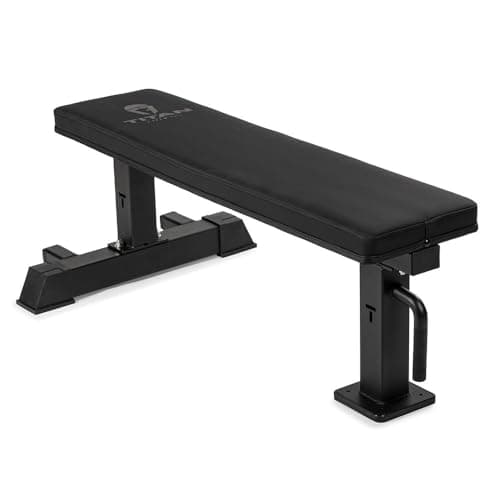
Titan Fitness Elite Series Single Post Flat Bench

The only bench here that lands all three competition dimensions at once — 17 inches tall, a 12-inch pad, 48 inches long — on 11-gauge steel, with a single post that leaves the floor under your feet completely clear.

Best overall9.0
$189.97 · View on Amazon

#ad · Price as of September 30, 2026 · Affiliate disclosure

2
Titan Fitness TITAN Series Single Post Flat Bench

A 76 lb, 1,200 lb-rated bench on 3x3-inch 11-gauge steel with a 50-inch pad — the most planted flat bench on this list, as long as you don't need a competition-legal pad width.

Best for heavy pressing8.7
$299.99 · View on Amazon

#ad · Price as of September 30, 2026 · Affiliate disclosure

3
REP Fitness FB-3000 Flat Weight Bench

11-gauge steel, a 12-inch grippy pad built on a plywood substrate rather than particle board, and a real strength brand behind it — the sensible middle of this list.

Best from a strength brand8.6
$149.99 · View on Amazon

$174.99 14% off

#ad · Price as of September 30, 2026 · Affiliate disclosure

4
FLYBIRD Foldable Flat Weight Bench

A 1,000 lb-rated flat bench that arrives fully assembled and folds flat with a twist of a knob — the answer when the bench has to disappear between sessions.

Best folding flat bench8.0
$119.99 · View on Amazon

#ad · Price as of September 30, 2026 · Affiliate disclosure

5
PROIRON Flat Weight Bench (1,200 lb)

A 1,200 lb static rating, an 11.8-inch pad inside the competition width band, and legs splayed 8 degrees outward on adjustable feet — a lot of considered geometry for budget money.

Best budget7.8
$79.99 · View on Amazon

#ad · Price as of September 30, 2026 · Affiliate disclosure

6
CAP Flat Weight Bench (Color Series)

The cheapest bench here that still publishes a load rating — a fixed 500 lb platform for dumbbell work, hip thrusts and core training rather than a heavy barbell press.

Cheapest with a published rating7.2
$49.99 · View on Amazon

#ad · Price as of September 30, 2026 · Affiliate disclosure

03

Every pick, reviewed

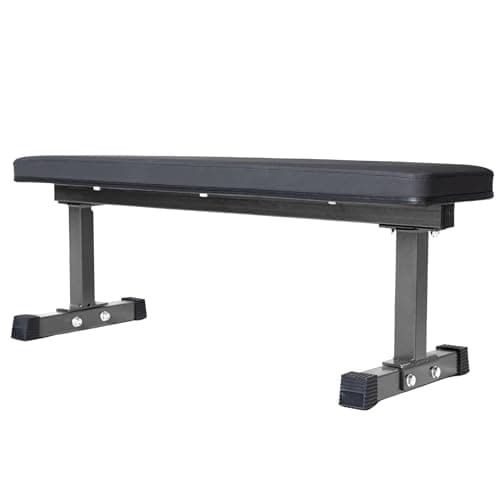
Titan Fitness Elite Series Single Post Flat Bench
01
Best overall

Titan Fitness Elite Series Single Post Flat Bench

Titan Fitness

9.0

The only bench here that lands all three competition dimensions at once — 17 inches tall, a 12-inch pad, 48 inches long — on 11-gauge steel, with a single post that leaves the floor under your feet completely clear.

Capacity
1,000 lb
Height
17" (IPF range)
Pad
48" x 12", 2.5" thick
Frame
11-ga, 2x3" + 3x3" tube
Bench weight
56 lb
Extras
Rear wheels, knurled handle

What we like

  • 17" pad height sits inside the IPF's 42-45 cm window, so your feet reach the floor the way they do on a competition bench
  • 12" pad is in the legal 29-32 cm band — wide enough to support you, narrow enough to let your shoulder blades pin back
  • Single-post design means there is no center leg between your feet when you drive
  • 56 lb of 11-gauge steel, with rear wheels and upright storage so the weight isn't a burden

Trade-offs

  • The 48" pad lands exactly on the 1.22 m minimum with no margin — fine for the rule, tight for very tall lifters
  • 2.5" pad is firm and thin by design; if you want a plush surface the TITAN Series doubles it
  • Roughly four times the price of the cheapest bench here
Value
8
Stability
9
Pad
8
Geometry
10
$189.97 · View on Amazon

#ad · Price as of September 30, 2026 · Affiliate disclosure

Titan Fitness TITAN Series Single Post Flat Bench
02
Best for heavy pressing

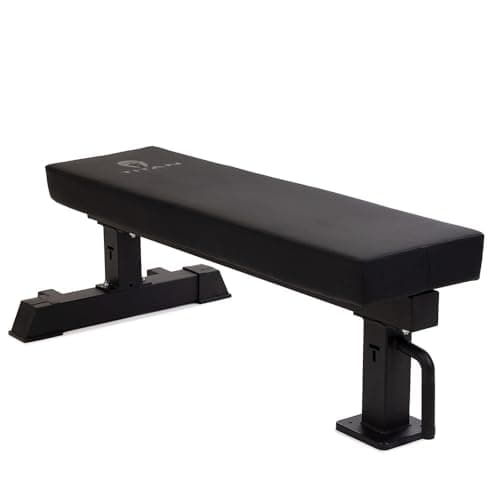
Titan Fitness TITAN Series Single Post Flat Bench

Titan Fitness

8.7

A 76 lb, 1,200 lb-rated bench on 3x3-inch 11-gauge steel with a 50-inch pad — the most planted flat bench on this list, as long as you don't need a competition-legal pad width.

Capacity
1,200 lb
Height
17"
Pad
50" x 14", 4" thick
Frame
3x3" 11-ga steel
Bench weight
76 lb
Extras
Rear wheels, knurled handle

What we like

  • 1,200 lb on 3x3-inch 11-gauge tube is the heaviest-rated frame here
  • 76 lb of bench simply does not move when you unrack and drive
  • 50" pad supports tall lifters head to hips with room left over
  • The 4" HeftyGrip pad is the most comfortable surface on the list for long sessions

Trade-offs

  • The 14" pad is about 35.6 cm — wider than the IPF's 32 cm ceiling, so it is not competition-legal and it can crowd your shoulder blades
  • 4" of foam compresses more under a heavy load than a 2.5" pad, which quietly changes your press height
  • The most expensive bench here by a wide margin
  • 76 lb is a real lift to reposition, even with the rear wheels
Value
7
Stability
10
Pad
9
Geometry
7
$299.99 · View on Amazon

#ad · Price as of September 30, 2026 · Affiliate disclosure

REP Fitness FB-3000 Flat Weight Bench
03
Best from a strength brand

REP Fitness FB-3000 Flat Weight Bench

REP Fitness

8.6

11-gauge steel, a 12-inch grippy pad built on a plywood substrate rather than particle board, and a real strength brand behind it — the sensible middle of this list.

Capacity
700-750 lb (see trade-offs)
Height
17.5-18" to top of pad
Pad
12" wide, 2.5" thick
Frame
11-gauge steel
Bench weight
40-45 lb
Pad build
Plywood base, dense foam

What we like

  • 11-gauge steel and a plywood pad substrate — REP specifies it is not particle board, which is what sags first on cheap benches
  • 12" pad width sits inside the competition band, and the grippy cover keeps your back set when you sweat
  • 40-45 lb is light enough to slide in and out of a rack without a fuss
  • A Denver-based strength company you can actually reach for a replacement pad

Trade-offs

  • Lowest load rating here — and REP's own spec table says 700 lb where the Amazon listing says 750 lb
  • Those two sources also disagree on height (18" vs 17.5"), pad width (11.8" vs 12") and bench weight (40 lb vs 45 lb); either figure puts the height at or just over the IPF's 45 cm ceiling
  • At about 47" the pad is fractionally under the 1.22 m competition minimum
Value
9
Stability
8
Pad
9
Geometry
8
$149.99 · View on Amazon

$174.99 14% off

#ad · Price as of September 30, 2026 · Affiliate disclosure

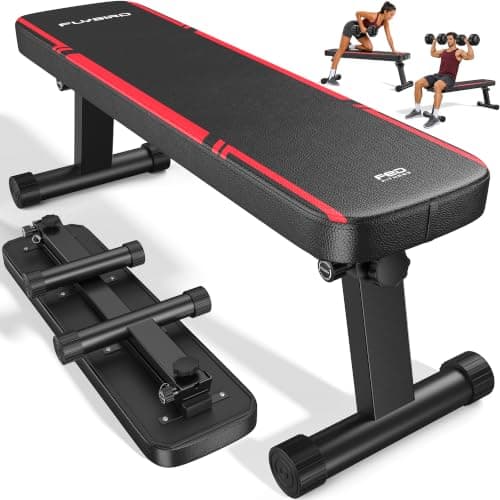
FLYBIRD Foldable Flat Weight Bench
04
Best folding flat bench

FLYBIRD Foldable Flat Weight Bench

FLYBIRD

8.0

A 1,000 lb-rated flat bench that arrives fully assembled and folds flat with a twist of a knob — the answer when the bench has to disappear between sessions.

Capacity
1,000 lb
Pad
45.3" long, 3" thick
Base
Flared trapezoid
Locking
Spring knob + pin
Assembly
Ships pre-assembled
Listed weight
About 19 lb

What we like

  • Folds and unfolds with a pull-and-twist knob — no tools, no disassembly, stores under a bed or against a wall
  • Ships 100% pre-assembled, which is rare in this price class
  • 1,000 lb rating with a two-stage lock: spring knob first, then a removable pin
  • 3" sweat-resistant textured pad, and a flared base that widens the footprint against side-to-side rock

Trade-offs

  • FLYBIRD publishes no pad height and no pad width — the two numbers that decide whether you can set up and drive properly
  • At roughly 19 lb it is the lightest bench here, so it will shift if your setup is aggressive
  • The fold hinge and locking pin are moving parts to check before every heavy set — a fixed bench has none
  • The 45.3" pad is under the 1.22 m competition minimum
Value
9
Stability
6
Pad
8
Geometry
6
$119.99 · View on Amazon

#ad · Price as of September 30, 2026 · Affiliate disclosure

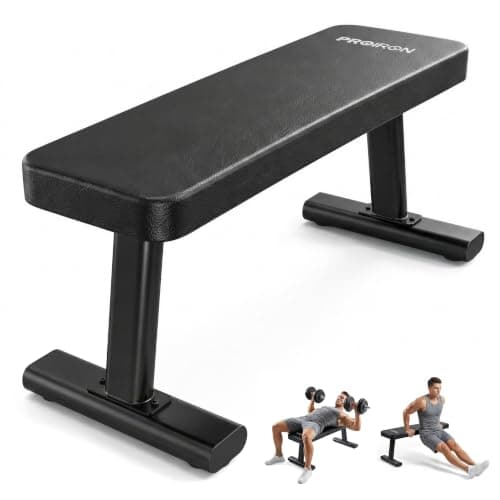
PROIRON Flat Weight Bench (1,200 lb)
05
Best budget

PROIRON Flat Weight Bench (1,200 lb)

PROIRON

7.8

A 1,200 lb static rating, an 11.8-inch pad inside the competition width band, and legs splayed 8 degrees outward on adjustable feet — a lot of considered geometry for budget money.

Capacity
1,200 lb static
Overall
42.5" x 18" x 19"
Pad
42.5" x 11.8", 2" thick
Frame
Reinforced ladder steel
Feet
8-degree splay, adjustable
Upholstery
High-density PVC

What we like

  • 1,200 lb static rating for budget money — on paper it matches the priciest bench here
  • 11.8" pad width is inside the 29-32 cm competition band, which the priciest bench on this list misses
  • Legs splay 8 degrees outward and the feet adjust, so it levels on an uneven garage slab

Trade-offs

  • 19" overall height is well above the IPF's 45 cm ceiling — shorter lifters will lose the floor and with it their leg drive
  • The 42.5" pad is about 5.5" short of the competition minimum; taller lifters will hang off one end
  • 2" pad is thin, and PVC is less grippy than the textured vinyl on the Titan and REP benches
  • PROIRON publishes no bench weight, and a light bench is a bench that moves
Value
10
Stability
7
Pad
6
Geometry
6
$79.99 · View on Amazon

#ad · Price as of September 30, 2026 · Affiliate disclosure

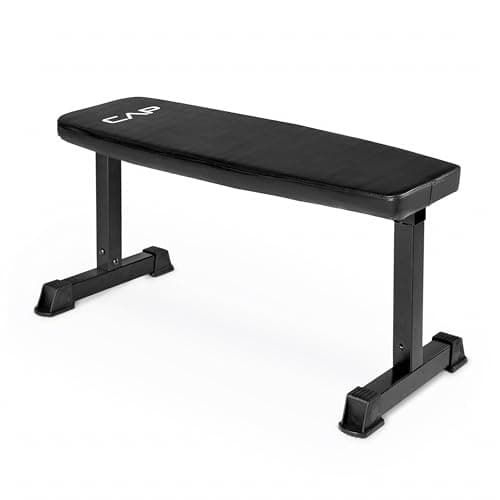
CAP Flat Weight Bench (Color Series)
06
Cheapest with a published rating

CAP Flat Weight Bench (Color Series)

CAP Barbell

7.2

The cheapest bench here that still publishes a load rating — a fixed 500 lb platform for dumbbell work, hip thrusts and core training rather than a heavy barbell press.

Capacity
500 lb
Overall
46.5" L x 18" W x 19" H
Pad
Box-stitched upholstery
Frame
Powder-coated alloy steel
Listed weight
18 lb
Warranty
30 days

What we like

  • Publishes a real 500 lb rating at a price where plenty of benches publish nothing at all
  • 46.5" is a genuinely long platform for the money — longer than the PROIRON or the folding FLYBIRD
  • 18 lb is trivially easy to move, stand on end or carry outside
  • A familiar Amazon strength brand rather than an anonymous import

Trade-offs

  • 500 lb is the lowest rating on the list; a 200 lb lifter pressing 315 lb already puts about 515 lb on the bench
  • 19" height is the tallest here and well outside the IPF window, so leg drive suffers
  • CAP publishes no pad width and no pad thickness for this bench
  • The 30-day manufacturer warranty is the shortest on the list
  • At 18 lb there is no mass to keep it planted — treat it as a dumbbell and accessory bench
Value
9
Stability
6
Pad
6
Geometry
5
$49.99 · View on Amazon

#ad · Price as of September 30, 2026 · Affiliate disclosure

04

How to choose

How to choose a flat bench

Height is the spec almost nobody checks

Pad height decides whether your legs are part of the lift. The competition window is 42 to 45 cm — 16.5 to 17.7 inches— and a 17-inch bench is dead center. Go up to 19 inches, as two of the cheaper benches here do, and a lifter of average height starts reaching for the floor with their toes instead of pushing through their heels. You lose leg drive, you lose a stable base, and you compensate by lifting your feet onto the bench, which is the least safe way to press. Height is also the spec most listings bury, so look for “floor to top of pad” rather than an overall box dimension, and remember that a thick soft pad sinks under load: a 4-inch foam pad measured at 17 inches uncompressed is not 17 inches once you are lying on it with a loaded bar.

Width: wide pads feel generous and press badly

The legal band is 29 to 32 cm, roughly 11.5 to 12.5 inches, and there is a reason it has a ceiling. A pad that is too wide props your shoulder blades apart and stops you pinning them down and back, which is the position that protects your shoulders and shortens the press. A 14-inch pad looks like more bench for your money and is, functionally, less. Our bench pad thickness and width guide walks through why 12 inches keeps coming up and what happens either side of it. Too narrow is a real problem too — below about 10 inches a broad-backed lifter has nothing under the outer edge of the shoulder — but on Amazon the common failure is a pad that is too wide, not too narrow.

Length: 48 inches, and check it if you are tall

The IPF minimum of 1.22 m (48 in) exists so a lifter’s head and hips both stay supported. Several benches here are 42 to 47 inches long, which is fine for a 5’7” lifter doing dumbbell work and genuinely annoying for a 6’3” lifter benching heavy, whose head hangs past the end of the pad exactly when they need a fixed point to press against. Longer is not automatically better — a 50-inch pad claims more floor and is harder to fit inside a rack — but 48 inches is the number to beat if you are tall or you plan to compete.

Steel gauge and the bench’s own weight

After geometry, two specs separate a bench that disappears under you from one that talks back. The first is tube wall thickness: 11-gauge steel is the home-gym standard for a reason, and it is the same principle that separates a thick-walled power rack from a thin one. The second is simply how much the bench weighs. An 18 lb bench with a 500 lb sticker will slide when you drive hard off it; a 76 lb bench will not move at all. That is why our how heavy is a weight bench guide treats bench mass as a stability spec rather than a shipping detail. The trade-off is honest and unavoidable: the benches that stay planted are the benches that are a nuisance to move, which is why the better ones add rear wheels.

Leg layout: where the posts are matters

Flat benches come in two broad layouts. A conventional four-leg bench puts a leg at each corner, which is simple and stable but can put steel exactly where you want to place a foot. A single-post bench carries the pad on one central column with a wide base fore and aft, leaving the area under your feet completely clear. For pressing with real leg drive the single-post layout is the better geometry, and it is why both Titan benches on this list use it. Check the base is genuinely wide before you trust a single post — the whole design depends on the footprint, not the column.

Pad firmness beats pad thickness

A thicker pad is more comfortable to sit on and worse to press from, up to a point. Foam that compresses under a heavy load moves your shoulders, changes your effective bench height and costs you the tight connection to the surface that makes a press feel solid. A dense 2 to 2.5 inch pad with a grippy textured cover is a better pressing surface than 4 inches of soft foam, and the cover matters more than most buyers expect: the upholstery on a bench is what stops your back sliding once you are sweating. What is underneath the foam counts too — a plywood substrate holds its shape where particle board eventually dishes.

Read the load rating last

Capacity is the number every listing leads with and the least useful one on the page. Your bodyweight plus the loaded bar is the real load: a 200 lb lifter pressing 315 lb puts about 515 lb on the bench. That clears every rating here except, uncomfortably, the 500 lb bench at the bottom of the list. Treat the rating as a proxy for build quality — higher-rated benches generally use thicker tube and better welds — and read our bench capacity guide for what the figure does and does not promise. Note too that “static” ratings, like the PROIRON’s 1,200 lb, describe a still load rather than a dynamic one.

Press where it is safe

No flat bench includes safeties. A failed bench press is the most dangerous miss in lifting, so press inside a power rack with the safety bars set just below your chest or with a spotter; our bench press without a spotter guide covers the setups that work and the one to avoid. If you are pressing heavy enough to care about the specs above, pair the bench with a stiff power bar and you have a complete pressing station.

Sources

  • Competition bench dimensions (length not less than 1.22 m; width 29 to 32 cm; height 42 to 45 cm measured floor to top of the uncompressed pad) — IPF Technical Rulebook 2026, effective 1 March 2026.
  • Titan Fitness Elite Series and TITAN Series Single Post Flat Bench — capacity, overall height, pad length, pad width, pad thickness, frame tube and gauge, product weight, and feature list, from Titan’s own published spec tables at titan.fitness.
  • REP Fitness FB-3000 — capacity, pad width and thickness, height to the top of the pad, base width, steel gauge, pad substrate and bench weight, from the published Amazon listing specifications and REP’s own FB-3000 spec table at repfitness.com. The two disagree on four figures; both are quoted above rather than averaged.
  • FLYBIRD Foldable Flat Weight Bench, PROIRON Flat Weight Bench and CAP Flat Weight Bench (Color Series) — capacity, published dimensions, pad and frame details, locking mechanism, warranty and listed item weight, from each product’s Amazon listing specifications, read 30 September 2026.
  • How these picks are ranked on published specifications and computed comparisons rather than hands-on lab testing — our methodology.
05

Common questions

What height should a flat bench be?

Between 16.5 and 17.7 inches from the floor to the top of the uncompressed pad — that is the 42 to 45 cm window the IPF allows for competition. A 17-inch bench is the safe target. Taller benches, and 19 inches is common on budget models, leave shorter lifters reaching for the floor, which costs leg drive and makes the whole setup less stable.

Is a 12-inch bench pad too narrow?

No — 12 inches is the standard, and it is deliberate. Competition rules allow 29 to 32 cm, which is roughly 11.5 to 12.5 inches, because a pad in that range supports your torso while still letting your shoulder blades pin down and back. A wider 14-inch pad feels more generous and actually works against that retraction, and it is outside the legal band.

Is a flat bench better than an adjustable bench?

For pressing, usually yes: a fixed bench has no pivots to flex, no seat-to-back gap and often better geometry, at a lower price. For a single-bench home gym an adjustable FID bench is more useful overall because it adds incline and decline work. Buy a flat bench if you press heavy, already own a rack, or want the most rigid surface per dollar.

What weight capacity does a flat bench need?

Add your bodyweight to your loaded bar and that is the real number — a 200 lb lifter pressing 315 lb loads the bench with about 515 lb. Any bench rated 700 lb and up has comfortable headroom. Treat the rating mainly as a proxy for build quality: higher-rated benches tend to use thicker tube and better welds, which is what you actually feel.

Does a thicker bench pad help?

Only up to about 2.5 inches. Past that the foam compresses under a heavy load, which moves your shoulders, changes your effective bench height and loosens your connection to the surface. A dense 2 to 2.5 inch pad with a grippy cover presses better than 4 inches of soft foam, even though the thick pad is nicer to sit on between sets.

Should I get a folding flat bench?

Only if the bench genuinely has to disappear between sessions. Folding adds a hinge and a locking pin to a piece of equipment whose entire advantage is having no moving parts, and folding benches are lighter, so they shift more under an aggressive setup. If storage is the priority it is a fair trade; if it is not, buy the fixed bench.

Read next

Ready to pick a flat bench?

The list runs from the bench that matches the competition envelope outright to the cheapest one that still publishes a rating, each with a live price so you can weigh geometry against budget.