The rating and the range: the value story
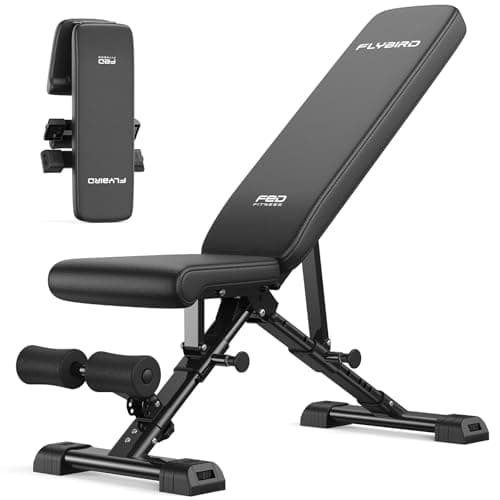
Two numbers do most of the work here. The first is the 800 lb capacity, which combines your bodyweight and the loaded bar — comfortably past what a home lifter benches, so the rating is durability headroom rather than a ceiling you’ll hit. The second is the full FID range: the WB5 goes from a 90-degree upright through flat to a genuine -30-degree decline, which is unusual at this price. Most budget benches skip decline entirely, so getting it here means one bench covers overhead-supported pressing, flat and incline barbell and dumbbell work, and decline movements without a second purchase. Our bench-angles guide explains what each position trains and why the range matters.
The backrest and pad
The WB5 uses a 30-inch extended backrest, which is long enough to support your head and back through a full press for most lifters — a real upgrade over the stubby pads on the very cheapest benches, where taller people hang off the end at the top of an incline. The pad itself is firm. That’s the right call for pressing — a firm pad keeps your shoulder blades set and doesn’t sink under load the way a plush pad does — but it’s less cushioned for long accessory sessions. If you want a plusher, wider pad you’re into more expensive territory. For how the pad, base and adjustability trade off across the category, see our how to choose a weight bench guide.
Folds flat: the feature that sells it
The reason the WB5 became the default budget bench isn’t any single spec — it’s that it folds flat. In an apartment or a shared garage, a bench that collapses and slides into a closet or behind a door between sessions solves a real problem that a heavier fixed bench doesn’t. It means you can have a proper FID bench in a space that couldn’t permanently house one. That portability is the whole pitch, and it’s why the WB5 sits alongside a small-space rack in a lot of first home gyms.
The two honest compromises
No bench at this price is perfect, and two things are worth knowing before you buy. First, like most folding benches, the WB5 has a visible seat-to-back gap— the small opening between the seat pad and the backrest that folding hinges create. It doesn’t affect pressing for most people, but it’s there, and lifters who want a single continuous pad won’t get it from a folding design. Second, the firm pad mentioned above is a genuine trade-off for anyone who does high-volume, long sessions and wants more cushion.
Neither is a dealbreaker — they’re the normal cost of a folding bench at this price, and we’d rather state them than pretend the bench is flawless. If they bother you, the step up is a sturdier, less-foldable bench from a specialist brand (our roundup covers the REP AB-3000 and the heavier FLYBIRD WB7 for exactly that lifter).
Who should buy it — and who shouldn’t
Buy it ifyou want a full FID bench that stores away, you press at home within a normal range, and you value the folding footprint and the low price. For the overwhelming majority of home lifters, that’s the right description, which is why the WB5 is our value pick and the bench the rest of the category chases.
Look elsewhere if you press very heavy and want a planted, bolted-down feel (step up to a commercial-grade bench), or if you specifically want a single continuous pad with no seat gap and a plusher surface (that means a non-folding design at a higher price). Pair whatever bench you choose with a rack that has safeties, so you can bench alone without a spotter.
Sources
- FLYBIRD WB5 adjustable bench — manufacturer product specification (capacity, adjustment positions, backrest length, folding design) as published on the retail listing.
- General weight-bench selection principles (capacity, FID range, pad firmness, stability and storage) as covered in our methodology and linked bench guides.