Grip plates: why the cut-out handles matter
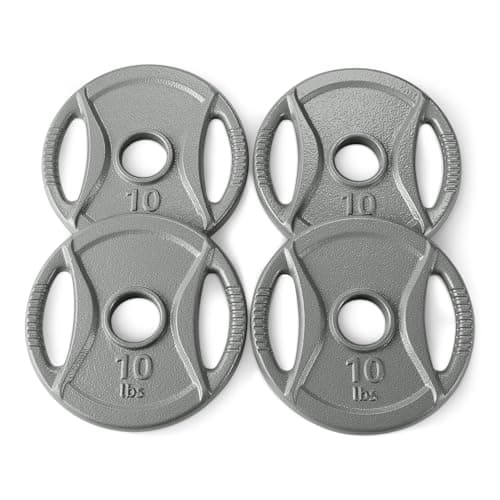
The defining feature here is the grip— the handles cut through the body of each plate. A standard flat Olympic plate is a solid disc you have to pinch by the rim or hug against your body; a grip (or handle) plate gives you two or three molded cut-outs you can actually get your fingers through. That sounds like a small thing until you’re carrying a pair of 45s across the garage or sliding plates onto a loaded bar. With handles you get a secure, full-hand hold instead of a rim pinch, which makes loading and carrying meaningfully easier and safer — fewer dropped plates on your toes, less strain on your fingers, and a cleaner grip when you’re changing weights between sets.
The trade-off with any handle plate is that the cut-outs move a little material toward the rim to keep the labeled weight correct, so a grip plate of a given weight is usually a touch wider in diameter than a slim flat plate of the same value. For a home lifter that’s rarely an issue — you’re not competing under strict plate-diameter rules — but it’s worth knowing if you like to fit a lot of small plates onto a short sleeve. If you want the full breakdown of how handle plates compare to plain discs on grip, diameter and loading, our guide on tri-grip vs standard plates walks through exactly when the handles earn their keep and when a flat plate is the simpler choice.
Clearly labeled denominations and quick loading
Because these are grip plates with the weight cast and labeled into the plate, you can read the denomination at a glance — the number is raised right there on the face, not printed on a sticker that peels off after a few sweaty months. That matters more than it sounds when you’re buying by the pair: as your collection grows into a mix of 2.5, 5, 10, 25 and 45 lbplates, being able to grab the right weight instantly keeps plate changes fast and stops you second-guessing what’s already on the bar. Cast-in numbers also don’t wear off, so a plate you buy today still reads clearly years from now.
Combined with the handles, the clear labeling makes these genuinely quick to load. You can see the weight, get a full hand through the cut-out, and slide the plate home without fumbling. For a busy home session where you’re stripping and re-loading the bar between exercises, that speed is a real quality-of-life upgrade over plain discs. It’s a modest feature list, but it’s the right feature list for the job these plates are meant to do: add specific weight, fast, without ceremony.
Iron means cheaper per pound — but not drop-safe
Here’s the honest heart of it. These plates are cast iron, and iron is why they’re cheap. Bare and cast, iron delivers the most weight for the least money, which is exactly why it anchors the budget end of the plate market. But iron carries one hard rule you must respect: you cannot drop these plates. Unlike a rubber bumper plate, which is built specifically to be dropped from lockout and absorb the impact, a bare iron plate has no give. Drop a loaded iron bar and you risk cracking or chipping the plate, damaging the bar sleeve, and gouging your floor — and cast iron can shatter on a hard landing.
This isn’t a knock on the product; it’s the nature of the material. For controlled lifts— squats you rack, presses, rows, slow deadlifts you set down under control — iron plates are ideal and will last a lifetime. The moment your training involves dropping the bar from overhead, such as Olympic lifting, snatches, cleans or missed max attempts, you want rubber bumpers instead, on a floor and bar built to take the hit. So the rule is simple: buy iron grip plates like these to add weight for controlled training, and reach for bumpers if your program involves dropping the bar. Treat the “can’t be dropped” line as a firm boundary, not a suggestion.
Pairs vs a full set: the cost-per-pound math
The whole reason to buy Amazon Basics grip plates is the by-the-pairmodel, so it’s worth being straight about where that helps and where it doesn’t. Buying pairs is the cheapest route when you already own a base of plates and just need to close a specific gap — you want two more 10s, or a pair of 25s, and you don’t want to pay for weight you already have. In that situation, paying only for the exact denomination you’re short of beats re-buying a whole set, and these plates give you about the lowest entry price to do it.
The flip side is equally honest: building a full loadout pair-by-pair costs more per pound than buying a complete set. Sets are priced for volume, so if you’re outfitting a bar from scratch and know you’ll want the standard spread of denominations, a single boxed set almost always works out cheaper per pound than assembling the same total from individual pairs. The decision comes down to what you already have. If you’re starting near zero, price a complete set first — our best budget weight plates roundup is the place to do that. If you already own a starter set and just need to top up, buying these by the pair is the smarter spend. Working out how much total weight you actually need before you buy keeps you from over- or under-buying either way; our how many plates do I need guide runs the numbers for common lifts and goals.
Basic tolerance: fine for training, not competition
Every plate has a weight tolerance— the small margin by which its true weight can differ from the number cast on the face. At this price, expect a basic finish and basic tolerance. In plain terms, a plate labeled 45 lb might weigh a little more or less than exactly 45 lb, and the paint and casting are functional rather than premium. For the overwhelming majority of home training this simply doesn’t matter: your body responds to the work, not to whether a plate is a fraction of a pound off, and progressive overload happens across sessions where any small variance washes out.
Where tolerance does matter is competition and record-keeping to the ounce — a sanctioned meet, or a lifter who needs certified, calibrated plates matched to a tight spec. Amazon Basics grip plates are not calibrated competition plates and don’t claim to be, so if that’s your requirement, you’re shopping in a different, far more expensive category. For everyone else, basic tolerance is a non-issue and part of what keeps the price low. If you want to understand exactly what the tolerance number means, how it’s measured, and when it’s worth paying for tighter accuracy, our guide on weight plate tolerance explainedcovers it in full — it’s the clearest way to decide whether “training accurate” is good enough for you, and for most home lifters it is.
Where these sit: rubber-coated grip plates and the full field
It helps to place these plates against the two things people cross-shop them with. First, rubber-coated grip plates. These do the same by-the-pair, cut-out-handle job, but with a rubber jacket over the iron core that protects your floor and bar from knocks, quiets the clang, and resists rust better than bare iron. You pay a bit more per pound for that coating, and the plates run a little thicker. Our RitFit rubber grip plates reviewcovers that alternative in detail; if you want the handle convenience with more floor protection and don’t mind spending a touch more, that’s the direct comparison to read. The important caveat: a rubber coatingis still not a bumper — it protects against everyday knocks, not against repeated drops from overhead.
Second, the full field. Bare iron grip plates like these are the value pick for adding controlled-lifting weight by the pair. If you want to see how they stack up against rubber-coated plates, bumpers, and premium options across the whole market, our best weight plates roundup lays out the field by use case, and our how to choose weight platesguide walks you through the decisions — iron vs rubber vs bumper, set vs pairs, tolerance, diameter and fitment — in the order that actually matters. Read those two together and you’ll know precisely where Amazon Basics grip plates fit for your gym: an honest, cheap way to buy the exact iron denominations you’re missing, with handles that make loading and carrying easier, as long as you never plan to drop them.
Who should buy them — and who shouldn’t
Buy Amazon Basics grip plates ifyou already own a base of plates and want to top up specific denominations by the pair, you train with controlled lifts you don’t drop, and you want the cut-out handles for easier loading at about the lowest entry price for real 2-inch Olympic plates. For that job they’re a genuinely sensible, honest pick, and they anchor the value end of the by-the-pair conversation.
Look elsewhere ifyou’re outfitting a bar from scratch — a complete set is cheaper per pound — if your training involves dropping the bar, where you need bumpers instead, or if you require calibrated competition tolerance. In each of those cases the money is better spent on a plate built for that specific need. But for the everyday problem of “I just need two more of thisweight, cheaply,” these grip plates are one of the most straightforward answers on the market.
Sources
- Amazon Basics 2" Olympic grip plates (pairs) — manufacturer product specification (sold in small sets and pairs, cut-out handle grip plates, weights cast and labeled into the plate, 2" / 50 mm Olympic fitment) as published on the retail listing.
- General weight-plate principles (iron vs rubber vs bumper, cost-per-pound for pairs vs sets, drop-safety, weight tolerance, standard denominations up to the 45 lb plate) as covered in our methodology and linked plate guides.