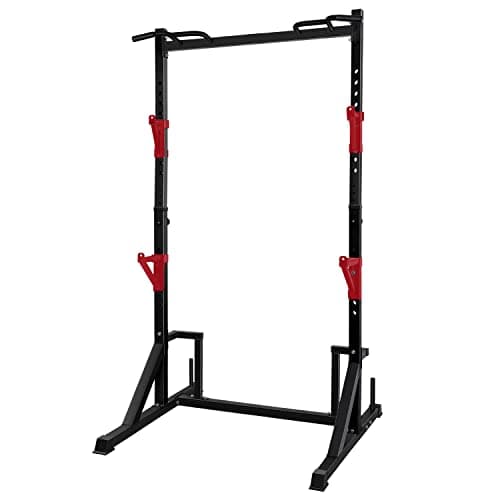
Squat/half rack, not a full cage — and why that’s the point
The first thing to be clear about is the rack style. The CANPA is an adjustable squat/half rack, not an enclosed four-post cage. That means you lift in front of the uprights rather than inside them, which is the defining difference between the two styles. Our power rack vs squat rackguide covers the trade-offs in full, but the headline is this: a half rack takes less space and less money than a full cage, at the cost of the wrap-around safety a cage gives you. For a lot of home lifters that’s the right compromise — and it’s exactly the niche the CANPA is built for.
Framed correctly, the CANPA is a low-cost step up from a bare squat stand toward a proper cage. A basic two-post stand holds the bar and little else; this rack adds adjustability, a pull-up bar and J-hooks, moving you meaningfully closer to a full setup without the price or footprint of a cage. If you’re weighing the whole category, our how to choose a squat rack guide is the right place to work out which rung of that ladder you actually need.
The pull-up bar and J-hooks: more for the money
The value story here is that you get more than a bare stand for less than a full cage. The included pull-up baris the standout: it’s a piece you’d otherwise buy and mount separately, and having it integrated into the frame means one purchase covers both your pressing/squatting station and your vertical pulling. The J-hooksthat hold the bar are included too, so you’re not immediately shopping for the basics the moment the box arrives. For a budget-conscious buyer, bundling the pull-up bar in is a genuine saving rather than a marketing bullet — it’s the single most-used accessory people add to a bare stand.
The heavy-duty capacity rating and standard 2" fitment round out the practical picture. The rating is best read as durability headroom for a home lifter rather than a target you’ll approach, and the standard fitment means the rack works with the plates, bar and collars you already own. Nothing about the loading is proprietary, which is what you want from a budget rack — no lock-in to a single ecosystem of parts.
Adjustable uprights and a compact footprint
Two practical strengths make the CANPA easy to live with. First, the adjustable uprights suit a range of lifters— you can set the J-hook and safety heights to fit different people and different lifts, which matters in a shared household gym or if you train several movements at various rack heights. Second, it’s compact enough for a spare room. Not everyone has a garage; a half rack that fits a bedroom corner or a small basement is genuinely useful, and the CANPA is sized for exactly that situation. If space is your main constraint, our best power rack for small spaces roundup puts it in context against other compact options.
Where the price shows: lighter steel — anchor it
Here’s the honest part, and it’s the most important line in this review: the CANPA uses lighter steel than commercial racks, so you should anchor it to the floor or wall if you can. Lighter-gauge tubing keeps the price down but makes for a rack that can feel less planted under heavy work or on a hard pull-up kip — a taller half rack with lighter steel is inherently less stable than a heavy, bolted-down commercial cage. Anchoring is the fix: securing the rack to a concrete floor (or bracing it to a wall) dramatically improves stability and is the single best thing you can do for safety on a budget rack. Our how to anchor a power rack guide walks through exactly how to do it and why it matters so much on lighter-gauge frames.
Read this as a condition of buying, not a dealbreaker. Plenty of home lifters run a lighter half rack safely for years by bolting it down and using sensible loads. The compromise is real, but it’s manageable — and it’s the reason a rack like this can cost what it does. Just don’t treat “heavy-duty rated” as permission to skip the anchors; on a lighter frame, anchoring is where the real-world safety comes from.
The other limit: fewer attachments
The second honest con is the ecosystem. The CANPA has fewer attachment options than the T-3 ecosystemand other premium rack families. Established rack lines have a deep catalog of compatible add-ons — dip stations, safety straps, cable systems, specialty bars — that let you keep expanding for years. A budget multifunction rack like this covers the essentials well but doesn’t plug into that kind of catalog, so if your long-term plan is to keep bolting on accessories, factor that ceiling in. For most buyers who want a solid squatting, pressing and pull-up station and little more, it’s a non-issue; for tinkerers who want to keep growing the setup, it’s a real constraint worth knowing up front.
Who should buy it — and who shouldn’t
Buy the CANPA ifyou’re space- or budget-limited, you’ve outgrown a bare squat stand, and you want a compact adjustable rack with a pull-up bar included — and you’re willing to anchor it down. On those terms it’s a smart, low-cost step toward a proper setup, and it earns a look in our best budget power rack and best squat rackthinking for exactly that reason. If you’re cross-shopping other compact budget racks, the Yoleo squat rack is a close rival worth reading alongside it.
Look elsewhere ifyou want commercial-grade steel you don’t have to anchor, the wrap-around safety of a full cage, or a deep attachment ecosystem to grow into for years. In those cases the honest move is to step up to a full cage or a heavier rack line — the CANPA is built to be the affordable middle step, not the last rack you’ll ever buy. On its own terms, that’s a genuinely useful thing to be.
The pull-up bar and half-rack safety in practice
Two things are worth thinking through before you train hard on a rack like this. The first is the pull-up bar. It’s a real bonus at this price, but on a lighter, taller half rack it’s also the movement most likely to make the frame move — an aggressive kipping pull-up puts side-to-side force on the uprights that a slow squat never does. That’s another reason anchoring matters: bolt the rack down and the pull-up bar feels planted; leave it free-standing and you’ll feel it flex on explosive reps. Strict pull-ups are far gentler on the frame than kipping, so if you can’t anchor, favor controlled reps.
The second is your safety strategywithout the wrap-around catch of a full cage. On a half rack you’re relying on the rack’s safeties or spotter arms to catch a failed lift, so set them at the right height for every exercise and don’t train to failure on a heavy bench without them positioned properly. This is the trade you accept for the smaller footprint and lower price: a half rack is safe when you use its safeties deliberately, and risky when you treat it like a full cage. For a solo lifter that discipline is the price of admission, and it’s well worth it for the space and money you save. If you’d rather have wrap-around safety that needs no thought, that’s the signal to step up to a full cage instead — but for the buyer this rack is aimed at, the deliberate-safeties habit is an easy trade to make.
Assembly and getting it stable
A budget rack’s real-world feel is decided as much by assembly as by the spec sheet, so it’s worth doing properly. The CANPA ships flat and bolts together, and the single biggest factor in how solid it feels is how tightly every joint is torqued down — a loose bolt anywhere in the frame shows up as wobble under load. Assemble it fully, snug every connection, then come back after your first few sessions and re-tighten everything once the frame has settled and the bolts have taken their initial set. If you’re anchoring it, do that as part of the same job rather than as an afterthought.
It’s also worth being deliberate about placement while you build. Set the rack on the flattest part of your floor, leave room to walk around it and load plates, and if you’re mounting it near a wall, that wall can double as a bracing point for extra stability. None of this is unique to the CANPA — it’s good practice for any lighter-gauge rack — but on a budget frame it’s the difference between a rack that feels planted and one that feels like it’s fighting you. Get the assembly and the anchoring right and this rack punches above its price; skip them and you’ll blame the steel for what is really a setup problem.
Sources
- CANPA Multifunction Power Rack — manufacturer product specification (adjustable squat/half rack; includes pull-up bar and J-hooks; heavy-duty capacity rating; 2" plate fitment) as published on the retail listing.
- General rack spec principles (half rack vs full cage, value of a bundled pull-up bar, adjustable uprights, footprint, steel gauge and the importance of anchoring, attachment ecosystems) as covered in our methodology and linked rack guides.