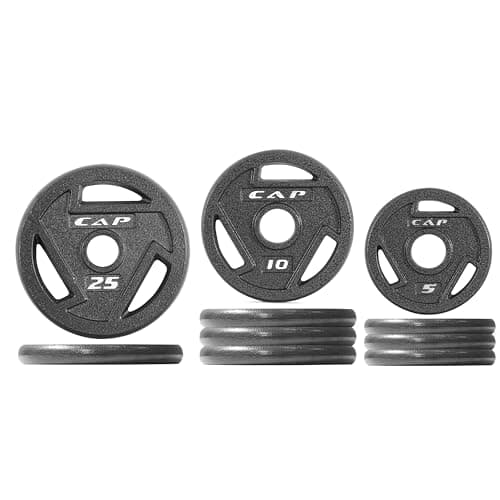
What a 110 lb starter iron set is actually for
The most useful thing to understand about this set is what job it’s built for. One hundred and ten pounds of plates, split across a pair of everything, is aimed squarely at pressing, rowing and accessory work— the lifts where you’re moving moderate loads for reps rather than grinding a one-rep max. Add the weight of a standard 45 lb Olympic bar and you have a loadable total in the low 150s, which is more than enough to run overhead presses, bench work, bent-over rows, curls, skull-crushers and the rest of the accessory catalog that fills out a program. For a beginner who is still building the strength and technique to handle real load, that’s a genuinely productive amount of iron.
Where it stops being enough is the two big lower-body lifts. On squats and deadlifts, an intermediate lifter blows past 155 lb of bar-plus-plates fast — often within the first few months of consistent training. That’s not a knock on the set; it is exactly what a 110 lb starter block is supposed to be. But it means you should buy this with clear eyes: it will carry your pressing and accessory work for a long time, and it will carry your heavy pulls only briefly. If you already know you’ll be squatting or pulling meaningful weight soon, our how many plates do I needguide is the honest place to sanity-check whether 110 lb or a larger set fits your actual numbers before you spend.
Machined cast iron and the cost-per-pound story
The reason this set can be cheap is the material. It’s machined cast iron— the plates are cast in a mold and then machined so the center hole and faces come out to spec — which is the least expensive way to make a durable metal plate. Iron’s whole appeal here is cost per pound: pound for pound, plain cast iron is dramatically cheaper than rubber-coated bumper plates, because bumpers wrap or encase the weight in dense rubber to survive being dropped. You’re paying for steel and iron, not for a rubber jacket, and for a lifter who racks or lowers the bar under control that’s money well saved. The trade-off between the two materials is the classic first decision in kitting out a plate rack, and our bumper plates vs iron platesguide walks through it in full — iron for cheap density and a compact stack, bumpers for drop-safety and floor protection.
“Machined” is worth a caveat, though, because it sets an expectation the budget price can’t always meet. Machining the faces and bore doesn’t guarantee laboratory-grade weight tolerances — cast iron plates in this price bracket are typically accurate enough for training but not certified to the tight percentages you’d get from a calibrated competition plate. For a home lifter chasing progressive overload, a plate being a fraction of a pound off either way is irrelevant; what matters is that the plates are consistent and the bore fits your bar. If you want to understand why cast and machined plates behave the way they do, the machined vs cast weight plates guide covers the manufacturing side and what it means for fit and finish.
Thin profile means more weight per sleeve
One quietly important spec is that these are thin, non-bumper plates, and that thinness pays off directly on the bar. Because each iron plate is a fraction of the width of a rubber bumper of the same weight, you can fit far more loadable pounds per sleevebefore you run out of room. On a bumper setup the sleeves fill up quickly with bulky rubber; with thin iron, the same seven-inch loadable sleeve swallows a much deeper stack of weight. For a starter set that’s a real advantage: even though 110 lb is a modest total today, the thin profile means the plates you buy now leave plenty of room to keep adding iron later without the bar running out of sleeve. You’re not locking yourself into a format that caps out early.
The thin profile also keeps the plates compact to store — a full stack of thin iron takes up noticeably less shelf or tree space than the equivalent in bumpers — and it makes loading and unloading straightforward once you know the order to stack heaviest-to-lightest. If you’re new to that, our how to load a barbell guide covers the mechanics, and the weight plate sizes explainedguide is a useful companion for understanding why the diameters and thicknesses come out the way they do. The one honest downside of thin iron is that it can be less comfortable to grip and lift off the floor than a fat, rubber-clad plate — but for a set that’s destined for a bar rather than the ground, that rarely matters.
The drop-safety limit: iron is not drop-safe
Here’s the con that deserves the most emphasis, because it’s a safety point rather than a preference. Cast iron is not drop-safe.These plates are designed to be lifted and lowered under control, not dumped from overhead or dropped from lockout. Drop a loaded iron bar and you risk cracking or chipping the plates, gouging your floor, and damaging the bar — and unlike a bumper plate, iron has no rubber to absorb the impact. That doesn’t make it a bad buy; it makes it a set with a clear operating envelope. Pair it with a rackso you can bail a failed press or squat onto safeties instead of the floor, and lower your deadlifts under control rather than letting them crash. Do that and iron lasts effectively forever; ignore it and you’ll chip a plate on the first missed rep.
This is the single biggest reason to be clear-eyed about how you train before you buy. If your plan involves Olympic lifting, CrossFit-style workouts, or any programming where dropping the bar is routine, iron is the wrong tool and you want rubber — a cushioned grip plate or a true bumper. Our RitFit grip plate review covers a rubber-encased option for lifters who need to set the bar down harder than bare iron allows. For a lifter who presses, rows and controls the descent on their pulls, though, the drop-safety limit is simply a rule to train within, not a dealbreaker.
When to size up to the 200 lb set
Because 110 lb is a starting point, the most important buying question is whether you should start bigger. This set is the smaller sibling of the CAP Elite 200 lb set, which we cover in our CAP Elite cast-iron set review, and the two are built from the same machined iron in the same 2" Olympic fitment — the only real difference is how much iron comes in the box. The honest guidance is this: if you are a genuine beginner focused on pressing and accessory work, or you want the lowest possible entry price and are happy to add plates as you progress, the 110 lb set is the right call. It gets you lifting for the least money and the thin profile means you can grow the set later.
But if you already squat or deadlift with any real weight — or you can see yourself getting there within a few months — the 200 lb set is usually the smarter spend. Buying the bigger set up front tends to work out cheaper per pound than buying the 110 and then topping it up piecemeal, and it saves you the mild hassle of matching plate finishes and diameters across two purchases. Think of the 110 as the honest minimum to start pressing, and the 200 as the set that carries a full beginner-to-intermediate program including the big lower-body lifts. If cost is the deciding factor either way, our how much do weight plates costguide puts both sets in context against the wider market, and shows why iron’s low cost per pound is the whole reason a starter set like this exists.
The honest verdict
The CAP Elite 110 lb set does one thing well: it gets real 2" Olympic iron onto a bar for about as little money as the format allows. It’s plenty for pressing, rows and accessory work, the thin profile keeps it compact and leaves room to grow, and machined cast iron gives you durable weight without the price premium of rubber. The two honest caveats are baked into what a starter set is: 110 lb plus the bar is quickly outgrown on squats and deadlifts, and iron isn’t drop-safe, so you need a rack and controlled lowering to lift within its envelope. Buy it as a deliberate first step — not a final answer — and it’s a genuinely sensible way to start loading a barbell.
Sources
- CAP Elite 110 lb Olympic Cast-Iron Plate Set — manufacturer’s published product listing (110 lb set weight, machined cast iron, 2" Olympic fitment, thin non-bumper plates) as published on the retail listing.
- General weight-plate principles (iron cost per pound vs bumpers, thin-profile loadability, machined vs cast tolerances, drop-safety limits of bare iron) as covered in our methodology and linked plate guides.