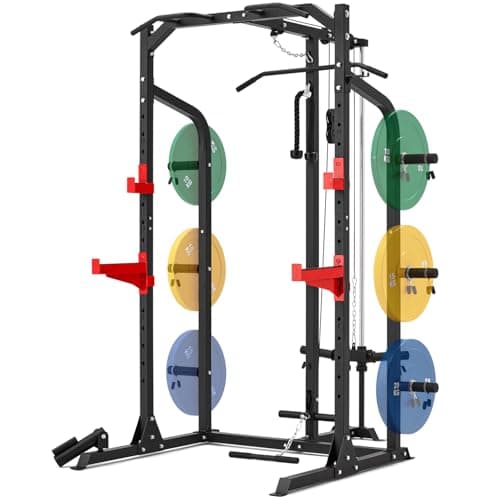
A full cage, not a stand
The foundation is the important part: this is a true four-post cage, not a two-post stand. That means the safeties surround you, so a failed squat or bench drops onto the pins and you walk away — the single biggest reason to buy a cage if you train alone. A stand relies on extended spotter arms and careful setup to do the same job. If you lift without a spotter, the cage format is worth more than any attachment on the spec sheet. Our power rack vs squat rack guide walks that trade-off in full.
The pulley system: the reason it’s our top pick
What separates the RUNFREELY from the budget field is the integrated cable pulley. A functioning cable station on a sub-$300 cage is genuinely rare — it adds lat pulldowns, cable rows, triceps and face-pulls to a rack that already squats and benches, without buying and bolting on a separate tower. Paired with the included landmine (for rows, presses and rotational work) and pull-up bar, it turns one footprint into a near-complete gym. That breadth of built-in attachments is exactly what earns it the overall spot.
Capacity and safeties: enough for any raw lifter
The cage is rated to 1,000 lb and ships with its own safety bars. A thousand pounds is far beyond what any raw home lifter racks — read it as durability headroom, not a ceiling. The safeties are the feature that actually keeps you safe day to day: set them just below your bottom position and a missed rep has somewhere to go. Our rack-sizing guidecovers measuring your ceiling and footprint so the cage — and its pull-up bar — fits your room.
Where the value shows
Two honest compromises come with the price. First, the 1,000 lb rating trails the commercial 3x3 racksbuilt for the very heaviest lifters — not a concern for a raw home lifter, but worth naming. Second, the hole spacing isn’t the fine “Westside” spacingof premium racks, which pack the holes closer together through the bench and rack zone for finer height adjustment. In practice that means slightly less precise J-hook and safety height dial-in — a small thing most lifters never notice, but a real difference from a boutique cage. If you want to understand the steel side of that gap, our steel gauge guide is the place to start.
Who should buy it — and who shouldn’t
Buy it ifyou want the most complete rack for the money — a full cage that squats, benches, pulls and does cable work out of the box, without a separate list of attachments. It’s the natural center of a first serious home gym, and it pairs cleanly with a good Olympic bar and a set of plates.
Look elsewhere ifyou’re a very heavy lifter who wants commercial 3x3 steel and fine Westside hole spacing — that’s a different tier of rack and price. And if floor space is your hard constraint, a folding wall-mounted rackgives you serious steel that folds flat instead of a full cage’s permanent footprint.
Sources
- RUNFREELY power rack with pulley system — manufacturer product specification (rated capacity, included pulley, safeties, landmine, pull-up bar, cage type, plate fitment) as published on the retail listing.
- General rack-spec principles (cage vs stand safety, steel gauge, hole spacing, attachment value) as covered in our methodology and linked spec guides.