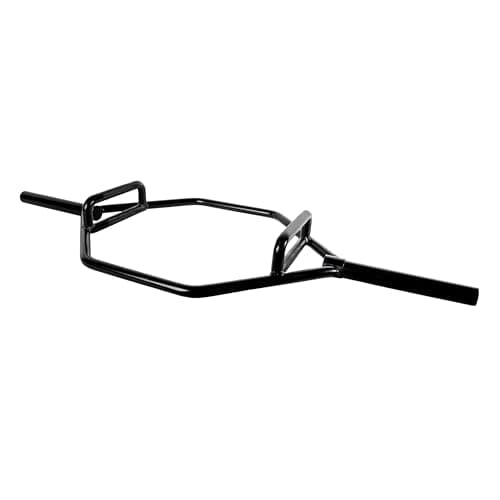
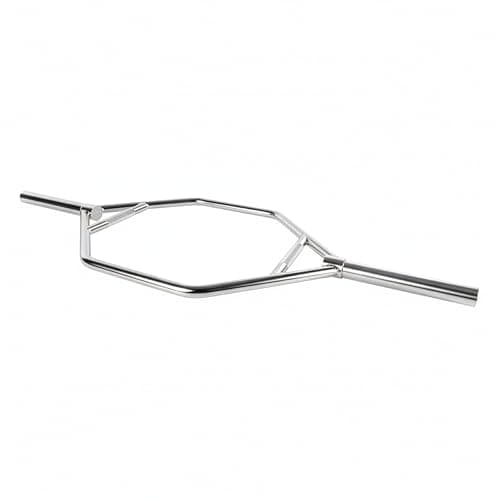
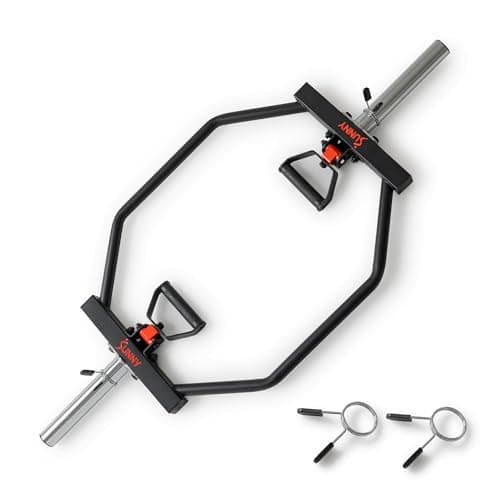
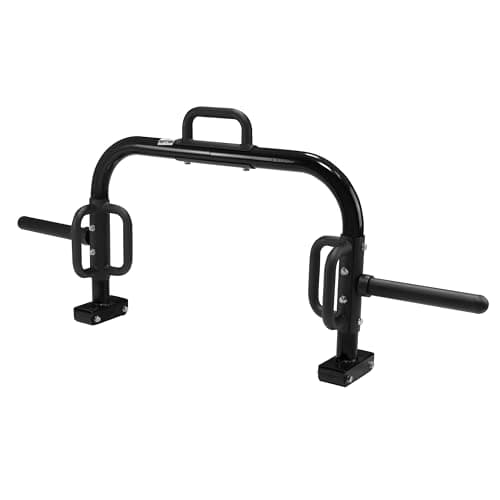
The specs, side by side
Every figure below comes from the manufacturer’s own published listing for the exact model we link to. Where a maker doesn’t publish a number, the cell says so rather than carrying an estimate — that is the whole method, and it matters most on cheap specialty bars, where unpublished specs are common.
Who each bar is for
- CAP Deluxe Open Trap Bar — for the lifter who genuinely wants to walk: farmer’s walks, walking lunges, carries for distance. The only buyable open frame here. Accept the budget welds and finish as the price of the format.
- CAP Olympic Trap Bar (32 mm combo grip)— for the lifter whose “carry” is really a loaded static hold or a heavy shrug, and who wants the grip itself to be the training stimulus. The 32 mm handles turn a hold into forearm work.
- CAP Olympic Trap Bar (chrome, flush neutral)— for the lifter who wants the hardest-wearing finish on a bar that will be set down on concrete repeatedly, and who doesn’t need a raised handle.
- Sunny Health & Fitness Hex Trap Bar— for the beginner doing moderate holds, where the 11-inch loadable sleeves (the longest here) and rotating handles matter more than the 400 lb ceiling.
How to choose a trap bar for carries
Open frame or nothing, if you plan to move
This is the entire decision, and it is binary. If your plan involves stepping — a farmer’s walk down the driveway, a walking lunge, a carry for distance — you need an open frame and no amount of extra capacity or nicer chrome substitutes for it. If your plan is to pick the bar up and stand there— loaded holds for time, heavy shrugs, static carries at the end of a session — a closed hex bar does that perfectly well, and you should buy on build quality instead. Be honest with yourself about which one you’ll actually do, because the closed bars here are better-specified at every price.
Grip diameter is the dial you set deliberately
A carry is a grip event long before it is a leg event: your hands give out first, every time. That makes handle diameterthe spec you should choose on purpose rather than by accident. The CAP combo bar’s 32 mm handles are noticeably fatter than a standard grip, which means your forearms fail sooner — brilliant if grip strength isthe goal, frustrating if you’re trying to cover distance with meaningful weight. A standard handle lets your hands last longer so your legs and trunk do more of the work. Neither is better; they train different things. If grip is your weak link, the fat bar is the cheaper fix than buying dedicated grip tools.
Sleeve length caps the load before capacity does
Carries are often loaded with whatever plates are already in the gym, and on a short-sleeved bar that runs out fast. The Sunny bar publishes 11 inches of loadable sleeve and both CAP Olympic bars publish 9 inches— and a thick rubber bumper plate eats that space far quicker than thin iron does. This is the quiet reason a 400 lb capacity rating is rarely the thing that stops you. Our trap bar loadable sleeve length guide has the arithmetic, and bumper plate thickness explains why rubber fills a sleeve so much faster than cast iron.
Capacity matters less here than on a deadlift roundup
On the main trap-bar roundup we rank capacity heavily, because a trap-bar deadlift is where people load the bar to its limit. A carry is different: the weight you can hold and walk with is normally well below the weight you can pull once off the floor. That is why the Sunny bar’s 400 lb rating — the lowest here, and a real mark against it for deadlifting — is much less of a problem for carries, and why we haven’t pushed it to the bottom of this list. Don’t pay for 1,000 lb of rated steel to do 185 lb carries unless you also want the bar for heavy pulls.
What a trap bar beats, and where dumbbells still win
A loaded trap bar gives you one handle on each side at a fixed width, which keeps your hands out of your thighs and lets you load far past the heaviest dumbbell most home gyms own. That is its real advantage for carries. Dumbbells or kettlebells still win on two counts: they let you carry one-sided for anti-lateral-flexion work, and they let you walk through doorways. If your space is a garage with a tight turn in it, an open trap bar loaded with 45s is a wide, awkward object — measure your walking lane before you buy. Our how to use a trap bar guide covers carry setup, and is a trap bar worth it puts the whole purchase in context.