These two get confused constantly, and it is Rogue’s naming that does it: the Ohio Bar and the Ohio Power Bar are one word apart, come out of the same factory in Columbus, and are built for opposite jobs. The short version, from Rogue’s own published numbers: the Ohio Bar is a 28.5 mm multipurpose barbell with 190,000 PSI steel, dual knurl marks and no center knurl— a bar meant to do everything from squats to snatches. The Ohio Power Bar is a 29 mm dedicated powerlifting bar with 205,000 PSI steel, single powerlifting marks and a center knurl— a bar meant to do three lifts extremely well and nothing else.
So “which is better” has a clean answer for once, and it has nothing to do with price: if you only squat, bench and deadlift, buy the Power Bar; if you do anything overhead or explosive, buy the Ohio Bar. Neither sells on Amazon — both are brand-direct through Rogue — so further down this page we name the closest Amazon-available equivalent for each, judged on the same specs, with live prices as of October 7, 2026.
The published specs, side by side
Every figure below is Rogue’s own published specification for the bar named, taken from its product pages. Where the two differ, the difference is deliberate rather than incidental — this is one company making two bars on purpose.
The center knurl is the difference that matters
Of everything in that table, this is the one you will actually notice every session. The Ohio Power Bar has a center knurl— a knurled band in the middle of the shaft, in what Rogue describes as a deep, coarse pattern. Its job is to grip your shirt across your back so the bar does not slide down during a heavy squat. Under a maximal attempt that is genuinely valuable, and it is why essentially every dedicated power bar has one.
It is also why you may not want one. That same band scrapes your neck on a high-bar squat, and it does nothing whatsoever for a clean, a snatch or an overhead press — lifts where the bar never touches your back. The Ohio Bar leaves it off entirely, which is the correct choice for a bar that has to do everything. If you have never used a center-knurled bar, read center knurl explained before you spend: it is the single most common regret in bar buying, in both directions.
28.5mm vs 29mm, and what the half-millimeter buys
Rogue positions the Ohio Bar’s 28.5 mmshaft explicitly as the middle ground — it sits between the 28 mm Olympic standard and the 29 mm powerlifting standard. The Power Bar takes the full 29 mm. Thicker steel is stiffer steel, so the Power Bar flexes less under a heavy squat or deadlift and feels more planted and more predictable at the bottom of a grind. That stiffness is an advantage on maximal attempts and a liability on the Olympic lifts, where a little whip helps the bar leave the floor progressively.
The thinner shaft has its own advantage, and it is about hands rather than physics: 28.5 mm is easier to wrap your fingers fully around, which helps grip on a heavy pull and makes high-rep work less punishing. Our 28mm vs 29mm guide walks the trade-off, and barbell whip explained covers why stiffness is a feature in one lift family and a bug in the other.
Tensile strength: a real difference you will never feel
205,000 PSI against 190,000 PSI looks like a decisive win for the Power Bar, and it is worth being straight about what it means. Tensile strength describes how much stress the steel takes before it permanently deforms. Both of these figures are far inside the range where a bar springs back to straight after years of heavy loading rather than taking a bend — so neither bar is going to fail, and you will not be able to feel the 15,000 PSI as a separate property.
Read the higher number as part of the Power Bar’s brief rather than as a selling point on its own: a bar designed for maximal attempts is specified with more headroom. If you want to know how much weight a published figure actually implies, our barbell tensile strength guide does the arithmetic, and are expensive barbells worth it puts flagship pricing in context.
Which one to buy
Buy the Ohio Power Bar if your training is the three powerlifts and nothing else; if you squat low-bar and want the bar locked to your back; if you compete raw or want to train on competition-shaped equipment. Accept the center knurl and the stiffness as the point of the bar.
Buy the Ohio Bar if you clean, snatch, press overhead, do CrossFit-style work, do high-rep anything, or simply do not know yet what you will specialize in. It is the better first serious bar for almost everyone, because a multipurpose bar never stops you doing something, while a power bar does. If you own one bar, this is usually the one. See what barbell should I buy for the wider decision and Olympic vs powerlifting barbell for the bar families these two bracket.
The Amazon-available equivalents
Neither Ohio bar is sold on Amazon, so there is nothing honest to link for them directly. What we can do is name the bars in our registry that match each one on the specs that define it — diameter, knurl marks, center knurl and sleeve type — at a fraction of flagship money. Prices are live from the Amazon listings, as of October 7, 2026.
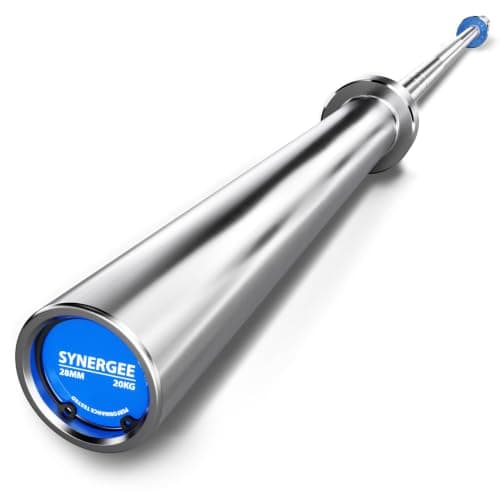
Synergee Regional 20 kg Barbell (Hard Chrome)
A hard-chrome 20 kg all-rounder rated to 1,500 lb — the sensible middle bar for a lifter who does a bit of everything and doesn't want to overthink it.
#ad · Price as of October 7, 2026 · Affiliate disclosure
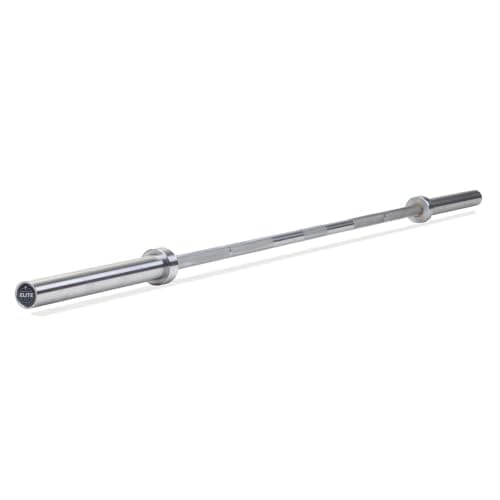
Titan Fitness Elite Series Power Barbell
A 29mm, 2,000 lb-rated power bar with brass bushings and aggressive mountain knurl — a genuine power-bar spec sheet at roughly a third of a boutique bar's price.
The Synergee Regionalis the closer analogue of the two: a 28.5 mm hard-chrome shaft on bushings with dual knurl marks and no center knurl — the same design decisions as the Ohio Bar, in a cheaper package with a hard-wearing finish. The Titan Elite Series Power Barbellstands in for the Power Bar: a 29 mm shaft with an aggressive knurl anda center knurl, on brass bushings, rated to 2,000 lb. Neither is a Rogue bar and we will not pretend otherwise — what they are is the same spec decisions, which is the part that changes how a bar feels. Both fields are ranked in full in best Olympic barbell and best powerlifting barbell, and if bench press specifically is your priority, best barbell for bench press re-ranks the power bars for pressing.
The short version
Same name, same factory, opposite jobs. The Ohio Baris 28.5 mm, 190,000 PSI, dual marks, no center knurl, bronze bushings, 16.40″ loadable sleeve — a do-everything bar. The Ohio Power Baris 29 mm, 205,000 PSI, single power marks, center knurl, bronze bushings with a snap ring, 16.875″ loadable sleeve — a squat, bench and deadlift bar. Pick on the lifts you actually do. And if you want something you can add to a cart today, the two bars above make the same choices for a lot less money.