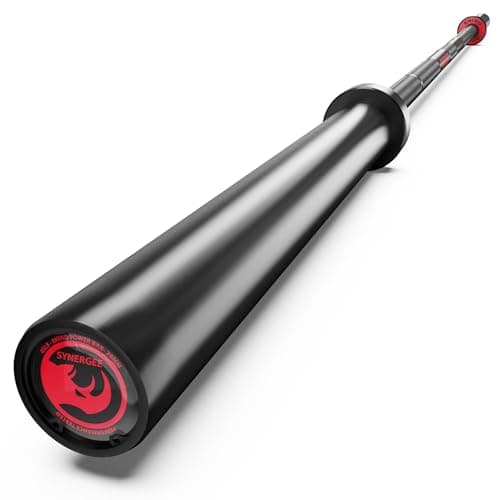
The spec sheet, and what each line buys you
The three specs that make it a power bar
29 mm, and why one millimeter matters
The whole Olympic-versus-power split comes down to this. Olympic bars settled on 28 mm because a thinner shaft whips, and a clean or a snatch uses that whip. Power bars settled on 29 mm because a squat, bench and deadlift want a deadbar. Because bending resistance rises with the fourth power of diameter, the step from 28 mm to 29 mm is worth roughly 15% more resistance to bending — not the 4% the raw numbers suggest. Our shaft diameter guide and barbell whip guide cover that properly, and 28mm vs 29mm is the direct comparison.
The center knurl, which is the giveaway
A center knurl is the single clearest signal that a bar was designed for squatting. In a low-bar position the bar rests on your rear delts over a shirt, and a smooth center section creeps downward set by set; the knurl is the only thing holding it where you set it. It is also a genuine trade-off — it will scrape your neck on a high-bar squat and ride on your throat in a front rack. Full treatment in center knurl explained.
The volcano knurl
Worth knowing the difference, because this is the spec people react to most. A mountain knurl cuts sharp pyramid points that bite hard and shred hands. A volcanoknurl cuts the pattern so each point has a flattened crater top — the grip comes from many small edges rather than a few sharp spikes, which holds nearly as well and hurts less. Synergee describes the Rhino’s as aggressive but not sharp, and for a bar whose job is a near-max deadlift that is the right place to land. See aggressive vs passive knurling and barbell knurling explained.
Where it sits against the rest of the power bars
Three bars in our registry are dedicated power bars. The honest summary of the Rhino is that it is the value pick rather than the best one:
- Titan Fitness Elite Series — 29 mm hard chrome, 2,000 lb, brass bushings, aggressive mountain knurl with a center knurl. The best-overall power bar on our ranking, and it costs more.
- P86B — a published 205,000 PSIand 2,000 lb, with the most aggressive knurl of the three. The spec-sheet winner on tensile.
- Synergee Rhino— 190,000 PSI and 1,500 lb, and the cheapest of the three by a clear margin, with the best corrosion resistance of the three thanks to the Cerakote.
It is also worth saying what the Rhino is not: it is not a Texas Power Bar or an Ohio Power Bar, which are brand-direct purchases at a different price tier and are not sold on Amazon at all. Our Ohio Power Bar vs Texas Power Bar page covers those on their own published specs and names the buyable bars that match them.
The three honest trade-offs
1. The knurl is punishing on volume
This is the real cost of buying a dedicated power bar, and it is not a defect. An aggressive volcano knurl is what you want on a max deadlift and what you do not want on five sets of ten bench press or any high-rep pressing. If most of your training is moderate-weight volume work, a milder bar is the more comfortable purchase — the 28 mm Titan Performance Series is the honest compromise.
2. 1,500 lb, not 2,000 lb
Both numbers are far beyond any raw home lifter — a 200 lb lifter squatting 400 lb loads 400 lb on the bar. What the rating really signals is how the bar was built, and on that scale the Rhino sits one tier below the two 2,000 lb bars. Barbell weight capacity explained covers what a rating does and does not promise.
3. Cerakote chips
Cerakote is a baked polymer-ceramic barrier and it is excellent at keeping moisture off steel — which is why this bar ranks on best barbell for a garage gym. It is a coating rather than the steel itself, though, so dragging plates on and off will eventually chip it, and a chip is a bare spot that needs watching. The sleeves are black phosphate, which is a conversion coating rather than a barrier and wants a light oiling in a damp space. See barbell finishes explained and how to prevent barbell rust.
Who should buy it
Buy it ifsquats, bench and deadlifts are essentially all you do, you want the 29 mm-and-center-knurl specification without paying boutique money, and your gym is a garage or basement where a Cerakote shaft earns its keep. For that lifter it is the best value in the category.
Look elsewhere ifyou clean, snatch or do high-rep conditioning work — a stiff, aggressively knurled bar fights all three, and an Olympic baris the right tool. Also look elsewhere if you want the highest published numbers in the category, in which case the Titan Elite and the P86B both publish 2,000 lb, or if you want one bar to do everything, where the 28 mm dual-marked all-rounders win — what barbell should I buy walks that decision end to end, and Olympic vs powerlifting barbell is the fork this bar sits on one side of.
Sources
- Synergee Rhino powerlifting barbell — manufacturer product specification (29 mm shaft, 190,000 PSI tensile, 1,500 lb capacity, aggressive volcano knurl, center knurl, one set of powerlifting marks, Cerakote shaft with black phosphate sleeves, 45 lb bar weight, 86.36 in overall length, 16.40 in loadable sleeves, bushings) as published on the Amazon retail listing and on the Living.Fit retailer product page, checked 2026-10-21. Figures sourced only from a retailer listing are labeled as such in the table above.
- IPF and general power-bar design principles (29 mm shaft standard, center knurl purpose, volcano vs mountain knurl geometry, bushings vs bearings) as reflected across manufacturer bar specifications and our methodology.
- Comparative figures for the Titan Fitness Elite Series and P86B power bars as published on their own retail listings and recorded in our power bar roundup.