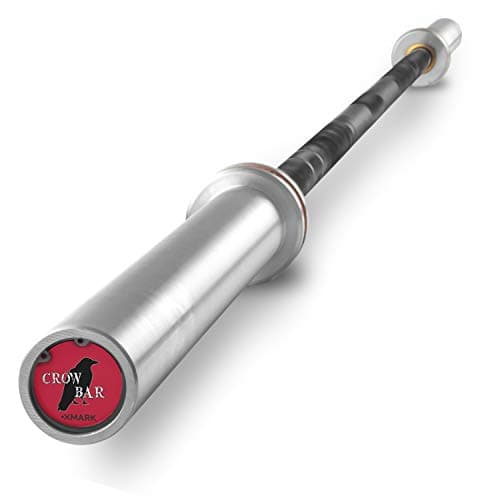
The published spec sheet
XMark publishes a fuller sheet on its own site than it does on Amazon, and this is the version we are reviewing. Every figure here is XMark’s.
What stands out: the sleeve length
The headline number everyone reads is the tensile figure, but the spec on this bar that will actually change your training is the 16.25 in loadable sleeve.
Most bars at this price publish 15 in to 15.5 in. The CAP bars we track on the combo sets publish 15.2 in to 15.3 in. An extra inch of sleeve does not sound like much until you are loading bumper plates, which are far thicker than iron: one more inch per side is roughly one more bumper, and on a heavy deadlift with a collar on the end that is the difference between fitting the load and not. If you own or plan to own bumpers, this is a genuine, under-advertised advantage — see loadable sleeve length explained for why it runs out faster than people expect.
The flip side of a long sleeve on an 86.5 in bar is a 51.5 in shaft, which is normal but at the short end of the 7 ft range. That is still well inside the inside-width of any power rackwe rank, so rackability is not an issue — but it is worth knowing if you have a wide rack and expected a wide shaft.
185,000 tensile, in context
Tensile strengthis the force the steel takes before permanent deformation, and it is the number most reliably correlated with a bar surviving a decade of abuse. Here is where the Crowbar’s published figure sits against the bars in our registry that publish one.
Two honest observations about that table. First, the Crowbar’s figure is genuinely competitive with dedicated power bars, and roughly three and a half times the figure on the budget bars that ship in weight sets. Second, and less comfortably, XMark does not state the unit. The number is almost certainly PSI — it is the convention in the category and the value is in the right range — but we are not going to write “PSI” into a spec table on XMark’s behalf when XMark did not write it.
The practical reading: at 185,000 and 1,500 lb, this bar will outlast the lifter in a home gym. Almost nobody reading this will load 1,500 lb. What the figure buys you is margin — a bar that does not take a set when you drop it across the J-hooks or load it to 500 for a rack pull.
The four places XMark contradicts itself
This is the part of the review that matters, and it is the reason the Crowbar does not score higher. XMark publishes a better spec sheet than most of its competitors and then undermines it across its own channels.
- Shaft finish.XMark’s own product page gives the shaft finish as Cerakote (spelled “Cerokote” in the spec table). XMark’s Amazon listing for the Black Diamond set that includes this bar describes a “hard black manganese phosphate coating.” A third-party retail listing says hard chrome. Those are three genuinely different finishes with three genuinely different maintenance requirements — see barbell finishes explained. You will not know which one is in the box until you open it.
- Steel.The same XMark page calls the material “solid, heat-treated alloy steel” in the specification table and “45# carbon steel” in the feature list. Alloy steel and carbon steel are not the same material.
- Shaft diameter.XMark’s own page and the standalone Amazon listing both say 28 mm. XMark’s Amazon listing for the Black Diamond set says the Crowbar has a “28.5 mm grip shaft.” We have gone with 28 mm because two of XMark’s three statements say so, including the maker’s own spec table — but it is a half-millimeter of uncertainty on the dimension you hold.
- Bar weight.The spec sheet says 43 lb. The Amazon title calls it a “20 kg Training Bar,” and 20 kg is 44.1 lb. A pound either way is irrelevant to your training and highly relevant if you are tracking total load honestly or ever intend to compete. Weigh it when it arrives.
None of these are reasons not to buy the bar. All of them are reasons to treat the marketing copy as marketing copy. The figures we would bet on are the ones repeated consistently across channels: 28 mm, 185,000, 1,500 lb, 16.25 in sleeves, brass bushings, center knurl, dual marks.
Who the knurl is for
XMark describes a medium-depth knurl with a center knurl and dual IWF and IPF marks. That combination is a deliberate statement about who the bar is for, and it is worth unpacking because it is the main reason to choose or reject it.
A medium knurl is the right choice for a bar you do everything on. It holds a chalked hand on a heavy pull without shredding your palms across a set of ten, and it will not scrape the inside of your elbows on cleans the way an aggressive knurl does. It is also, unavoidably, a compromise: if your grip is the limiting factor on a maximal deadlift, you will want more bite than this, and the bars that give it to you are single-purpose.
The center knurl is the other compromise, and the one people complain about. It exists to stop the bar creeping down your back under a maximal squat, which is why competition power bars have one. It also scrapes your neck in a high-bar squat position and catches your shirt on cleans. On a dedicated power bar that is a fair trade. On a bar sold for Olympic lifts it is a slightly odd choice, and it is the single most likely thing to annoy you about this bar day to day.
The dual IWF and IPF marks are a genuine plus, and rarer than you would think at this price. IWF marks index snatch-width hands; IPF marks index bench-press-width hands. Having both means you can find the same grip twice without thinking, whichever lift you are doing. Bars with a single set of marks force you to count knurl rings on the other lift.
Where it sits against the bars we already rank
The Crowbar lands in an awkward and useful gap. It is specified like a power bar and shaped like an all-purpose bar.
- Against the Titan Performance Series (our best Olympic barbellpick): the Crowbar publishes a tensile figure and a 1,500 lb capacity where Titan publishes 700 lb and no tensile figure at all, and the Crowbar’s sleeve is longer. The Titan is cheaper and has no center knurl, which some lifters will prefer. Our Titan review has the detail.
- Against the Synergee Rhino (reviewed here): the Rhino publishes a slightly higher 190,000 PSI on a 29 mm shaft with an aggressive volcano knurl. That is the better bar for a powerlifter and the worse bar for cleans. Same published capacity.
- Against the P86B: 205,000 PSI and 2,000 lb on a 29 mm shaft with an aggressive knurl — strictly stronger numbers, strictly narrower purpose.
- Against XMark’s own Lumberjack(also in our registry): the Lumberjack is the older, cheaper 28 mm chrome bar with no published tensile figure. The Crowbar is the straightforward upgrade within the brand.
If you are still deciding what class of bar you want rather than which model, Olympic vs powerlifting barbell and what barbell should I buy are the two pages to read first.
Living with it: finish care and the honest caveats
Whatever the shaft finish turns out to be, the sleeve finish is published consistently as hard chrome, micro-grooved— which is durable and the micro-groove is a real detail, giving the plate a little tooth so it does not slide on a loose collar.
For the shaft, assume the worst case of the three published finishes and treat it accordingly: wipe it down after chalked sessions, brush the knurl, and keep it off a damp concrete floor. Our how to clean a barbell routine takes thirty seconds and how to prevent barbell rustcovers storage. If it really is Cerakote, be aware it chips when you drag plates across it — see Cerakote vs stainless steel.
Two more honest caveats. The snap-ring sleeve retentionis the cheaper of the two standard designs — snap ring vs bolt explains what that means for serviceability, and the short answer is that a snap ring is harder to put back if a sleeve ever needs attention. And the warranty duration is not published anywhere we could find: XMark states that a warranty covering defects in materials and workmanship exists, but not how long it runs. For a $200-bracket bar that is a real gap — barbell warranty explained covers what to look for.
The verdict
The Crowbar is the best-specified multipurpose bar we track for the money, and the worst-documented one relative to how good its specification is. 185,000 tensile, 1,500 lb, 28 mm, 16.25 in sleeves, brass bushings and dual marks is a genuinely strong sheet, and the long sleeve is a real advantage nobody advertises. Buy it if you want one bar for squats, presses, pulls and cleans, and you are comfortable with a center knurl.
Do not buy it if you want a dedicated power bar — the 28 mm shaft and medium knurl are the wrong tools and the powerlifting pickscost similar money. Do not buy it if you need to know exactly what finish you are getting before you spend. And weigh it when it arrives, because XMark cannot decide whether it is 43 lb or 20 kg.
One last option worth knowing about: XMark sells this bar bundled with plates as the Black Diamond set, which is the only combo set on our best barbell and weight set ranking built around a bar worth keeping. If you need plates too, that is the cleaner purchase — with the warning that the set does not include collars.
Sources
- Availability, current price and the exact listing title — resolved live through the Amazon Creators API (
searchItems and getItems) on November 4, 2026. The listing returned “In Stock” with a live price and the title matches the brand and model. - Full published specification (43 lb, 86.5 in overall, 51.5 in shaft, 28 mm grip, 16.25 in loadable sleeve, 2 in sleeve diameter, 185,000 tensile, 1,500 lb capacity, Cerakote shaft, hard chrome micro-grooved sleeves, brass bushing, snap-ring retention, medium knurl with center knurl, dual IWF/IPF marks) — XMark’s own product page, checked November 4, 2026 at xmarkfitness.com. The unit on the tensile figure is not stated on that page; the material is given as “solid, heat-treated alloy steel” in the spec table and “45# carbon steel” in the features, and the warranty is stated to exist with no duration.
- The conflicting 28.5 mm shaft diameter and “hard black manganese phosphate coating” are XMark’s own copy on its Amazon listing for the Black Diamond 185 lb set (ASIN B07YVN1QF3), retrieved in the same Creators API call on November 4, 2026.
- Comparative tensile, capacity and shaft figures for the Titan Performance Series, Synergee Rhino, P86B, XMark Lumberjack and the CAP combo-set bars are the published specifications recorded in our own product registry, each sourced on the roundup and review pages linked above.
- We have not loaded, dropped, measured or weighed this bar. Every figure on this page is a published manufacturer number or a direct comparison between published numbers, and every contradiction between XMark’s own sources is reported rather than resolved silently.