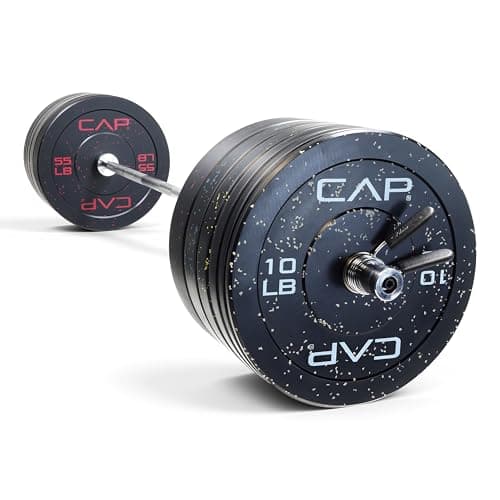
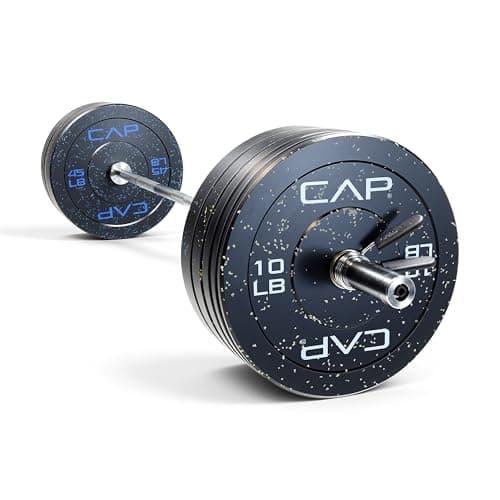
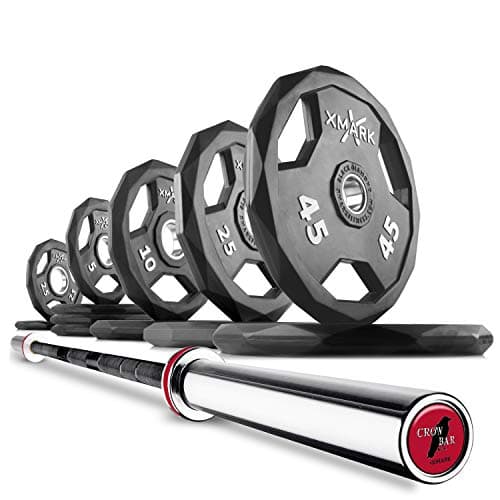
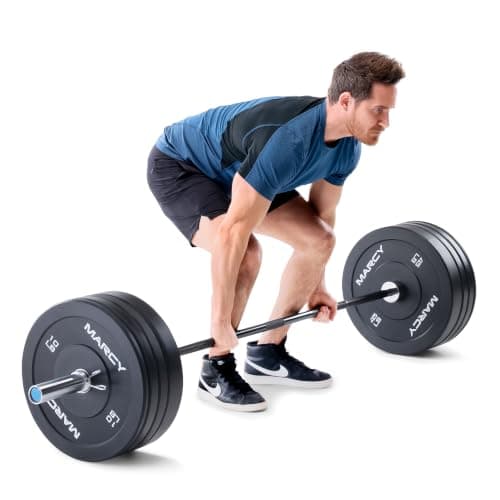
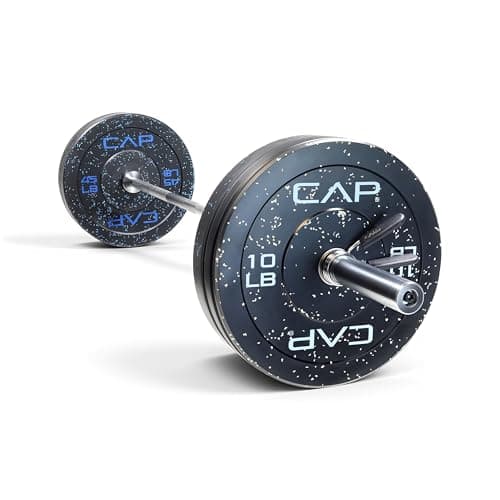
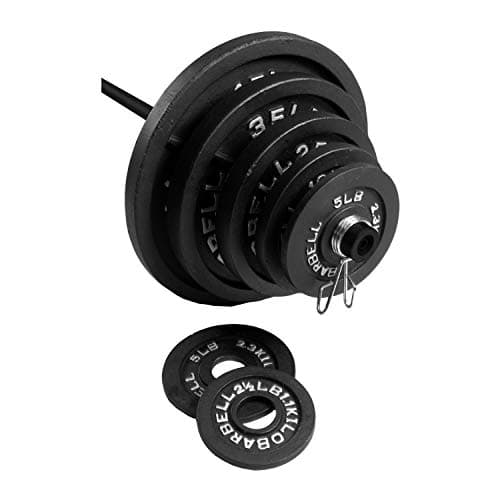
Step one: work out what is actually in the box
Combo sets are advertised by total system weight, and the total includes the bar. A “250 lb set” with a 45 lb bar contains 205 lb of plate. That is not a scam — it is the convention across the whole category — but it makes cross-shopping on the headline number useless, because a 300 lb set from one brand and a 300 lb set from another can differ by 45 lb of actual plate depending on whether the bar was counted.
Here is the real content of every set on this page, counted off the makers’ own listed plate breakdowns.
Two columns in that table decide most purchases, and neither is the one people shop on.
Why the smallest jump matters more than the biggest number
A bumper set built from pairs of 10, 25 and 45 looks generous. In practice its smallest possible increase is 20 lb, because plates come in pairs and the bar is loaded symmetrically. If you are squatting 185 and the next available load is 205, you have a 20 lb jump in front of you on a lift where 10 lb would already be a hard week.
That is the single most common complaint about combo sets, and it is entirely predictable from the listing if you read the plate breakdown. Only two sets on this page solve it in the box: the CAP 300 lb cast iron set, which ships four 5 lb plates and a pair of 2.5s, and the XMark Black Diamond set, which ships the same. Every other set here needs change plates bought separately — which is a real cost to add to the sticker price, and it is why the cheapest set is rarely the cheapest finished gym.
If you want the arithmetic on that: a pair of 5 lb and a pair of 2.5 lb plates is a small add-on purchase, and fractional plates go smaller still if your press has stalled. Our how many plates do I need guide works through the loadout properly.
The bar in the box: what 54,000 PSI actually means
Four of these six sets ship a CAP bar with a published tensile strength of 54,000 PSI and, on the speckled sets, a published capacity of 500 lb. For context, the bars we rank on best Olympic barbellpublish 110,000 to 190,000 PSI and 700 to 1,500 lb. So the honest framing is this: the bar in a combo set is a beginner’s bar, and it is the component you will outgrow first.
What that means in practice is less dramatic than the numbers suggest. Tensile strengthdescribes how much force the steel takes before permanent deformation; a 54,000 PSI bar is not going to bend under a 225 lb squat, and the vast majority of home lifters never load a bar past 315. What a low-tensile bar does do is take a permanent set if you drop it badly across the J-hooks or load it to the published ceiling repeatedly — and 500 lb is a ceiling a strong deadlifter genuinely reaches. See how to tell if a barbell is bent for what that looks like.
The other thing to notice is the 30 mm grip diameterCAP publishes on all four of its bars here. That is thicker than the 28 mm of an Olympic bar or the 29 mm of a power bar, and it makes the bar feel chunky in the hand and harder to hook-grip. It is not a defect, it is a budget-bar characteristic — shaft diameter explained covers what you feel at each size.
Only one set here breaks that pattern. The XMark Black Diamond is built around the Crowbar, which publishes 185,000 PSI and a 1,500 lbcapacity — genuinely a keeper bar. We review it separately in our XMark Crowbar review, including the inconsistencies in XMark’s own published specs.
Bumper or iron: a room decision, not a quality one
This is the fork that should settle itself in about ten seconds, so do not agonize over it.
Short version: if you deadlift to the floor and let go, buy bumpers. If you lower everything under control or deadlift onto a platform, iron is cheaper per pound and takes less sleeve. Our bumper plates vs iron plates guide goes deeper, and do I need bumper plates is the short version of the decision.
One thing people miss: bumper plates are far thicker than iron, so a 15 in loadable sleevefills up much faster with them. The CAP sets here publish 15.2 in of sleeve, which is normal but worth knowing if your plan is to load 400 lb of bumpers one day.
Does a combo set actually save money?
Usually yes, on plates specifically, and that is the honest reason to buy one. Plates are heavy, which means shipping dominates their cost, and a single palletized set ships far cheaper per pound than three separate plate purchases. The savings come from freight, not from the plates themselves being different.
Where the savings disappear is the bar. If you were always going to buy a real power bar, then a combo set hands you a second bar you did not want and you have effectively paid for a spare. In that case the right move is a plates-only set — our best bumper plates and best weight platesrankings cover those — plus the bar you actually want.
A rough decision rule:
- First barbell gym, under $500 total. Buy the combo set. The bar is fine for the loads you will be using for the next two years.
- You already own a bar. Buy plates only. Do not pay for a second bar.
- You know you want a 29 mm power bar or a competition bar. Buy plates only, then buy the bar on its own merits.
- You are buying for a second location or a garage you share. The combo set is the easier logistics, and a spare bar is genuinely useful.
What a set does not include, and what it costs you
Three line items that are not in any of these boxes and are not optional.
- Something to put the bar on.A set of plates and a bar is not a gym; you cannot squat out of a set. A rack or a pair of stands is the other half of the purchase — see best budget power rack and best home gym rack for the format decision.
- Collars you will actually use.Every set here except the XMark includes spring clips, which work but are fiddly and loosen over time. Proper lock-jaw-style collars are a cheap upgrade — best barbell collars ranks them by mechanism. On the XMark set collars are not included at all, so budget for them.
- A floor. Bumpers protect the plate, not the slab. Iron needs real protection. Either way, if you are deadlifting in a garage the mat or platform is part of the cost.
Where we would spend the money
If you are starting from nothing and the budget is fixed, the ranking above is also our spending order. Buy the CAP 300 lb cast iron set if you squat and bench more than you deadlift, because it gives you the most plate and the only usable small increments. Buy the CAP 260 lb speckled set if you deadlift to the floor, because bumpers in a garage are not negotiable. Step up to the 370 lb setonly if you already know you will need 400 lb on the bar, in which case it is clearly the best value per pound here.
Buy the XMark Black Diamond setonly if you want the Crowbar specifically — it is the one bar in this category we would keep long-term, and the set is a convenient way to get it with plates attached, but you are paying roughly double per pound of plate for the privilege.
And if the whole thing feels like too much money at once, that is a legitimate reaction. How much does a home strength setup cost lays out the whole bill, and how much do weight plates cost tracks the live spread on plates bought separately.
Sources
- Availability, current price and the exact listing title for all six sets — resolved live through the Amazon Creators API (
searchItems and getItems) on November 4, 2026. All six returned a live price; the XMark set was the only one not showing open “In Stock” availability. - Plate breakdowns, bar dimensions, published tensile figures, loadable sleeve lengths, grip diameters, collar inclusion and warranty terms — quoted from each maker’s own Amazon listing copy as returned by the same API call on that date. CAP publishes the most complete sheets in the category (54,000 PSI, 2185 mm bar length, 15.2–15.3 in loadable sleeve, 30 mm grip); Marcy publishes none of it, which is stated as a con on that pick rather than filled in from another model.
- XMark Crowbar specification (185,000 PSI tensile, 1,500 lb capacity, 28.5 mm grip shaft, center knurl, hard black manganese phosphate coating) — XMark’s own copy on the Black Diamond set listing, same API call. XMark’s standalone Crowbar listing states 28 mm rather than 28.5 mm; both figures are the maker’s and we report the conflict rather than picking one. Full detail in our XMark Crowbar review.
- Comparative tensile and capacity figures for standalone bars are the published specifications of the bars in our own registry, listed with sources on best Olympic barbell and best powerlifting barbell.
- We have not assembled, loaded or dropped any of these sets. Every number on this page is a published manufacturer figure or arithmetic performed on one, and the gaps are marked as gaps.