Buy the 7 ft bar unless your room physically will not take one.That is the honest answer, and it is not about quality — it is about the fact that every power rack, every squat stand and every bench on the market was designed around one measurement, and the 7 ft bar is the bar that measurement describes. A standard men’s Olympic bar is about 2,200 mm (86 in) overall with roughly 1,310 mm (51.6 in) between the sleeves. That sleeve-to-sleeve span is the number the rack cares about, and it is the number this whole decision turns on.
The 6 ft bar is a real answer to a real problem, though, and the problem is space. CAP publishes 45.75 in of shafton its 6 ft Olympic bar — almost six inches less span than the standard. In a garage where the bar has to pass between a car door and a wall, those six inches, and the 14 in off the overall length, are the difference between a workable gym and a constant irritation. Prices on the bars below are live as of October 28, 2026.
The numbers, side by side
Everything that matters is in this table. The 7 ft column is the standard every rack is built around; the 6 ft column is CAP’s published spec for the bar we track, which is the only short bar in this price range that publishes a shaft length at all.
Read the second row first. 51.6 in against 45.75 inis the whole argument. A full-length bar rests in the J-hooks with several inches of shaft outside each upright, which is why it seats cleanly even if your rack is a little wider than average. A 6 ft bar has that margin cut to almost nothing, and a 5 ft bar has none — its shaft is shorter than the inside width of any normal cage, so there is nowhere for it to sit.
The measurement that decides it
Before you buy a short bar, do this once with a tape measure:
- Measure your rack’s inside width— the clear span between the two uprights, not the outside footprint. Our how wide should a power rack be guide explains why those two numbers differ by more than people expect.
- Add the J-hook intrusion. Each J-cup sits inside the upright and eats into that span. Measure from the inner face of one cup to the inner face of the other.
- Compare that against the bar’s distance between sleeves.The shaft has to be comfortably longer — you want the sleeves clearly outside the cups, not balanced on the lip of them.
If the bar’s shaft is shorter than or barely equal to that cup-to-cup figure, the bar does not rack. There is no technique that fixes it, and a sleeve resting on the edge of a J-cup is a genuinely dangerous setup for a loaded squat.
One rack format sidesteps the whole problem: an adjustable-width squat stand. The YOLEO stand we rank adjusts from 35 in to 67 in between the posts and its maker states plainly that it fits both 6 ft and 7 ft bars. If you already know you want a short bar, buy the rack that narrows to meet it rather than hoping a fixed cage will.
What you give up with a 6 ft bar
Three things, and they are worth knowing before the box arrives.
- Capacity.CAP rates its 6 ft bar at 500 lb. Full-length bars at the same money are commonly rated 700 lb, and the power bars we rankgo to 1,500 lb. 500 lb is plenty for most lifters and a genuine ceiling for a strong deadlifter. See barbell weight capacity explained for what those ratings do and do not mean.
- Loadable sleeve.11 in against roughly 16 in on a standard bar. With thin bumpers that is survivable; with thick cast-iron plates you run out of sleeve before you run out of rating, and collars need somewhere to go too. Barbell loadable sleeve length works through the arithmetic.
- Bar weight you have to track.A 6 ft bar is not 20 kg. CAP’s is 28 lb, so every working weight you write down is 16 lb off the familiar 44 lb baseline. Trivial once you know it, and a persistent source of confusion if you do not. See do all barbells weigh 20 kg.
What you do notgive up is plate compatibility. A 6 ft Olympic bar has the same 2 in sleeves as a 7 ft one, so your plates, bumpers and collars carry over. The thing to watch for is the 1 in “standard” bar, which is also sold in 6 ft lengths, looks similar in a photo and takes entirely different plates — olympic vs standard barbell covers the difference, and it is a more expensive mistake than picking the wrong length.
When the 6 ft bar is genuinely the right call
Four situations, all about the room rather than the lifting:
- You cannot swing an 86 in bar.A single-car garage with a car in it, a basement with a support post, a spare bedroom — if loading plates means the bar end is in a wall, the short bar solves a daily problem.
- You train off stands, not in a cage. Adjustable-width stands narrow to meet a short bar, and a bench press out of low stands never needs the full span.
- It is a second bar. A short bar is a good hip-thrust and floor-press bar to keep loaded in a corner while the main bar lives in the rack.
- You move it often.72 in and 28 lb is noticeably easier to carry up stairs or store in a closet than 86 in and 44 lb.
And one situation where people reach for a short bar and should not: storage alone. If your only complaint is that a 7 ft bar is awkward to put away, a vertical bar holder costs far less than a second barbell and keeps the full-length bar you actually want.
The bars, at both lengths
One short bar worth buying and two full-length bars to compare it against. Prices live as of October 28, 2026.
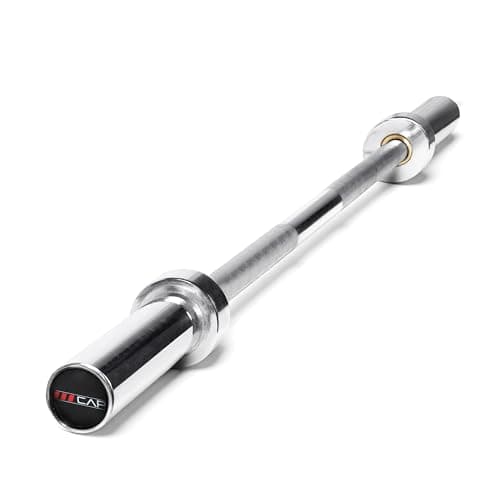
CAP 6 ft Olympic Barbell (28 lb, Chrome)
A 72 in Olympic bar with a published 45.75 in shaft - short enough to swing in a tight garage, long enough to still rack in most narrow home racks, which is the combination the 5 ft bars miss.
#ad · Price as of October 28, 2026 · Affiliate disclosure
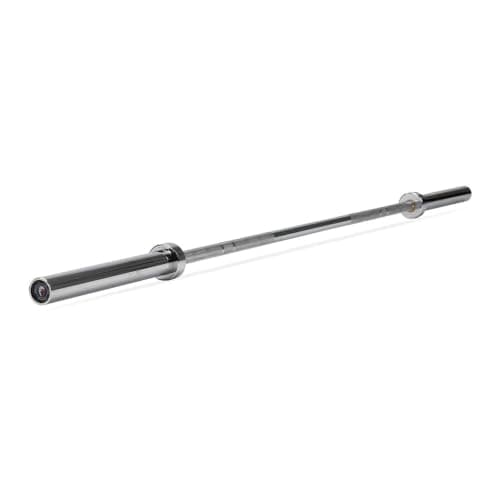
Titan Fitness Performance Series Olympic Bar
A 28mm, 700 lb-rated Olympic bar with bronze bushings and a medium volcanic knurl — the most bar you can put under mixed training at this price.
#ad · Price as of October 28, 2026 · Affiliate disclosure
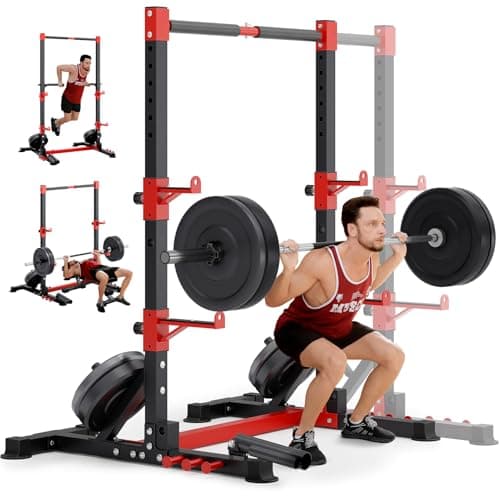
YOLEO Squat Rack with Pull-Up Bar
An adjustable-width squat stand with extended safety arms and a pull-up bar — the best-value way to squat and press heavy without a full cage's footprint.
#ad · Price as of October 28, 2026 · Affiliate disclosure
The CAP 6 ft bar earns its place here on one thing: it publishes its shaft length, which almost no short bar does, so you can actually check it against your rack before you buy. The Titan Performance Seriesis the full-length counterweight — 28 mm, 700 lb rated, bronze bushings, and the bar we would tell almost everyone to buy instead. And the YOLEO standis the hedge: at 35–67 in of adjustable width it is the one rack in our registry whose maker says it takes either length, which makes it the sensible base if you are building around a short bar on purpose. If you are still deciding what kind of bar to squat with rather than how long it should be, types of squat bars is the other half of this decision.
The short version
Measure the gap between your J-hooks. If a full-length bar fits the room, buy the 7 ft bar— more capacity, more sleeve, 20 kg so the math is familiar, and it will rack anywhere you ever move it. If the room genuinely will not take one, the 6 ft bar is a real tool rather than a compromise toy: same plates, same 2 in sleeves, 500 lb of capacity, and the only short bar we track that tells you its shaft length so you can check it fits. The 5 ft bar is for benching off stands and floor work, not for a rack.
Sources
- Standard Olympic bar dimensions (~2,200 mm overall, ~1,310 mm between sleeves, 20 kg) are the figures this site uses throughout and are set out in barbell dimensions and length.
- CAP 6 ft Olympic bar published specification — 72 in overall, 45.75 in shaft length, 11 in loadable sleeve, 28 mm grip diameter, 2 in sleeves, 28 lb bar weight, 500 lb capacity, rotating sleeves — as published on CAP’s retail listings for the bar, checked October 28, 2026. CAP publishes no tensile-strength figure for this bar, which is why none is quoted. Availability and current price resolved live through the Amazon Creators API the same day (“In Stock”).
- 5 ft column figures are the specification published on CAP’s 5 ft Olympic bar retail listings (60 in overall, 37 in shaft, 9.75 in sleeve, 500 lb), checked October 28, 2026. They are shown as typical rather than universal because 5 ft bars vary more between makers than 6 ft and 7 ft bars do.
- YOLEO squat stand adjustable width (35–67 in) and the maker’s statement that it fits both 6 ft and 7 ft bars are from its product listing, recorded in this site’s product registry and covered in the YOLEO squat rack review.