Yes — a cheap power rack can be entirely safe, and whether a particular one is comes down to five published specs. The honest problem at the bottom of this market is not thin steel; it is silence. Of the nine racks we track, only three publish a capacity rating at all, and the pattern holds across the category: the cheaper the rack, the less the listing tells you. So this guide is a check you can run in a couple of minutes on any budget rack — and the good news is that some cheap racks pass it comfortably. The VEVOR cage publishes a 1,000 lb rating at the budget end, which is more disclosure than many racks at twice the money. Live prices as of October 21, 2026.
One thing to establish first, because it reframes the whole question. The failure mode that actually hurts people is not a rack bending under a squat. It is a rack tipping over— from a pull-up, from a band anchored to one upright, or from a loaded bar re-racked hard onto a single J-hook. That is a geometry and anchoring question, which means the single highest-value safety step on a cheap rack costs about fifteen dollars in concrete anchors. See how to anchor a power rack.
The five-spec check
Open the listing and look for these five, in this order. Three or more and the rack is a known quantity. Zero and you are buying a photograph, whatever the price.
Two of those rows have guides of their own worth reading before you spend: 11-gauge vs 14-gauge steel for what the gauge actually changes, and Westside hole spacing for why better racks drill the bench zone more finely than the rest of the upright.
What a cheap rack actually gives up
Stiffness, not strength
This is the distinction that matters and the one most arguments miss. A 14-gauge upright is not in danger at home-gym loads — but a thinner wall flexes more when you re-rack a heavy bar and ringslouder when a bar lands on the safeties. That feels alarming and reads as “unsafe”, when what you are feeling is deflection well inside the material’s limits. 11-gauge tube is stiffer, quieter and more reassuring, which is a real thing to pay for — just not a safety cliff.
Hole spacing, which is a genuine safety spec
This one is not cosmetic. If the holes are spaced widely, your safety bars land either too high (clipping your bottom position) or too low (useless on a failed rep). Precise safety placement is the entire mechanism by which a rack protects you when you lift alone, so coarse spacing is one of the few places a cheap rack genuinely costs you safety rather than feel. Our rack safety checklist covers how to set and test them.
Hardware and assembly
Budget racks ship with budget fasteners and vaguer instructions, and a rack assembled with under-torqued bolts behaves worse than the same rack assembled properly. This is fixable for free: follow the sequence, torque everything, and re-check every bolt after your first few sessions and then every few months. How to assemble a power rack walks it, and it is the step that turns a cheap rack from rickety into solid.
What it does not give up
Worth saying plainly: at the loads a home lifter handles, a cheap rack is not giving up the ability to hold your squat. A heavy home squat including the bar is rarely above 500 lb, and a cheap cage publishing 1,000 lb was rated with the load applied gently to steel that then has to survive your dynamic bail. There is margin. What you are buying with money is stiffness, precision and disclosure— not permission to lift heavy.
The one format that is never a bargain
A wall-mounted folding rack bought on price. Every other format carries its load to the floor through its own frame, so a cheap version is merely a less stiff version. A wall-mounted rack carries its load into your wall, which means the fasteners, the upright section and the structure behind the drywall are the load path. That is the one case where saving money compromises the mechanism rather than the feel. If the folding format is what your room needs — and for a shared garage it often is — buy one that publishes its upright size and gauge, like the 11-gauge 2×3″ Titan T-3, and mount it into real structure. Read folding vs freestanding first.
The cheap racks that publish enough to pass
These three are at the budget end and still give you numbers to check. Prices live as of October 21, 2026.
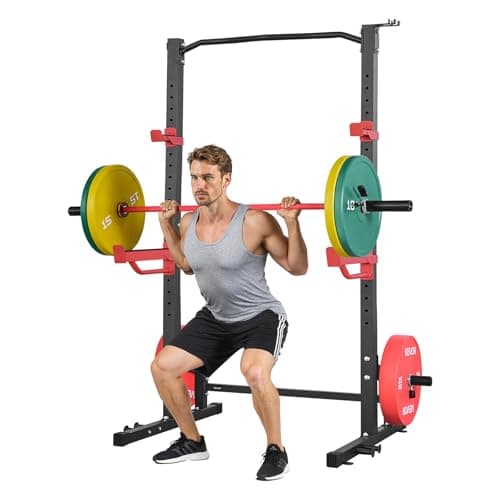
VEVOR Power Cage (1,000 lb)
A 1,000 lb-rated four-post cage with band pegs, adjustable J-hooks and safeties for around $160 — the cheapest honest full cage on this list.
#ad · Price as of October 21, 2026 · Affiliate disclosure
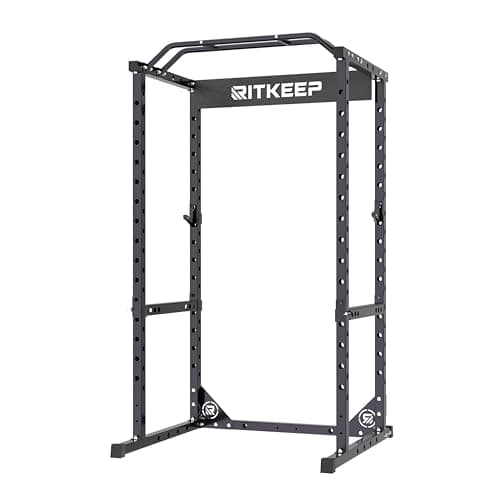
RitKeep RMAX2250 Power Rack
A 1,200 lb-rated four-post cage on a 44x45-inch footprint that ships with J-hooks, safety spotter arms and a multi-grip pull-up bar — a full cage sized for a small room.
#ad · Price as of October 21, 2026 · Affiliate disclosure
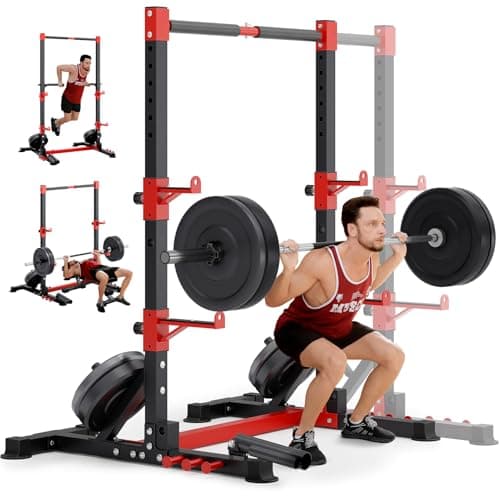
YOLEO Squat Rack with Pull-Up Bar
An adjustable-width squat stand with extended safety arms and a pull-up bar — the best-value way to squat and press heavy without a full cage's footprint.
#ad · Price as of October 21, 2026 · Affiliate disclosure
The VEVOR cageis the honest budget answer: a full four-post cage with a published 1,000 lb rating, four band pegs, J-hooks and safeties. The RitKeep RMAX2250is the most transparent rack we track at any price — 1,200 lb, 2×2″ uprights and a full 44.3″ × 45″ × 81.7″ footprint, so you can confirm it fits before buying. The YOLEO standis the format answer when a cage will not fit: adjustable 35″–67″ width with safety arms, and no anchoring required because there is far less rack to tip. Full rankings in best budget power rack and best home gym rack.
Making any rack safer, for almost nothing
- Anchor it, or load plate storage on the rear uprights — mass and attachment both defeat tipping.
- Set and test the safeties with an empty bar before every new heavy session. The right height is just below your bottom position, not wherever the pins happen to sit.
- Re-torque every boltafter the first few sessions. More “wobbly rack” complaints are loose hardware than bad steel.
- Never hang bands off a single upright on a free-standing rack— that is lateral load pulling at the one thing holding the rack up.
- Check the floor. A rack on an uneven slab rocks on two feet, and no rating fixes that. Shims cost nothing.
If you are still weighing the rack against a squat stand or deciding how much cage you need, is a power rack worth it and what size power rack do I needtake it from there — and power rack vs squat rack covers the format fork.
The short version
Cheap racks are mostly safe and often under-documented, and those are different problems. Demand a published rating, a stated upright size and gauge, full-length safety bars, bolt holes and reasonable hole spacing. Buy the one that tells you the most, assemble it properly, anchor it, and test the safeties with an empty bar. A cheap rack treated that way is safer than an expensive rack standing loose on a smooth floor with its safeties set by eye.