The published figures on the racks we track run from 1,000 lb to 1,200 lb — and only three of nine racks publish a figure at all. The RitKeep RMAX2250 publishes 1,200 lb; the RUNFREELY and VEVOR cages both publish 1,000 lb. The other six publish nothing, which is the first honest answer to this question: in this category, most makers do not tell you. The second honest answer is that for a home gym a 1,000 lb static rating is already far more capacity than your heaviest squat will ever ask for — so the rating is rarely the thing that should decide your purchase.
What the number actually describes is a static vertical load: weight at rest on the J-hooks or safeties, applied gradually. It is not a tested-to-failure figure, it is not certified by anyone, and it says nothing about the one event you most want a rack to survive — a failed rep dropping a loaded bar onto the safety bars. Understanding that distinction is worth more than memorizing any number.
What the racks we track actually publish
Every figure below is from the maker’s own listing. “Not published” is exactly that — a silence, not an estimate on our part.
Note the CANPA row. “Heavy-duty rated” is marketing language, not a specification, and we record it as unpublished for exactly that reason. If a listing gives you an adjective where a number belongs, treat it as an absence.
Static rating vs what actually happens in your garage
The static number
A rating is measured with the load at rest. Put 500 lb on the J-hooks of a 1,000 lb-rated rack and you are at half of a figure that was arrived at gently. That is reassuring and it is also the easy case: a rack holding a racked bar is barely working.
The dynamic case the rating ignores
Now fail a rep. The bar drops a few inches and lands on the safeties, and for a fraction of a second the load on that steel is a multiple of the bar weight. Racks are designed for this — bailing is the whole reason to own a cage — but the capacity rating is not the spec that tells you how gracefully it will go. What does: whether the safeties are full-length bars seated through both uprights or short pin-style arms cantilevered from one. Full-length bars spread the impact across the frame. Read spotter arms vs safety straps for the comparison, and the safety checklist for how to set them.
And the failure mode that actually injures people
It is not the steel yielding. It is the rack tipping— usually from a pull-up, a band anchored to one upright, or a bar re-racked hard onto one J-hook. An unanchored rack with a narrow base is the one to worry about, which is why anchoringbuys more real safety than any upgrade from 1,000 to 1,200 lb ever will, and why band pegs deserve a thought before you load them.
The four specs worth more than the rating
When you cannot get a capacity figure — which is two thirds of the time — these are what to read instead, in order.
Two guides go deeper on the first two rows: 11-gauge vs 14-gauge steel and 2×2 vs 3×3 uprights, plus Westside hole spacing for why the bench zone is drilled more finely on better racks.
The racks that publish a real number
If a published rating matters to you — and it is a reasonable thing to insist on, because it indicates a maker willing to be held to a figure — these are the three that give you one. Prices live as of October 21, 2026.
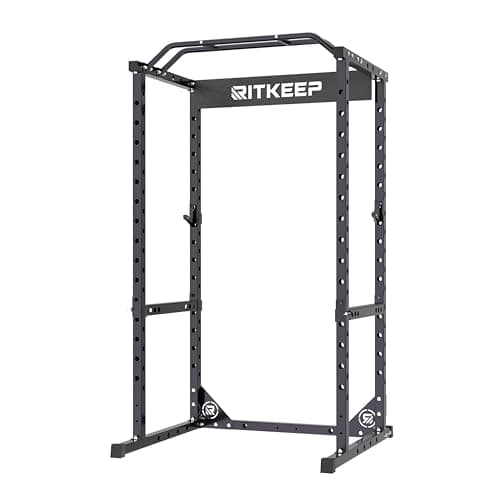
RitKeep RMAX2250 Power Rack
A 1,200 lb-rated four-post cage on a 44x45-inch footprint that ships with J-hooks, safety spotter arms and a multi-grip pull-up bar — a full cage sized for a small room.
#ad · Price as of October 21, 2026 · Affiliate disclosure
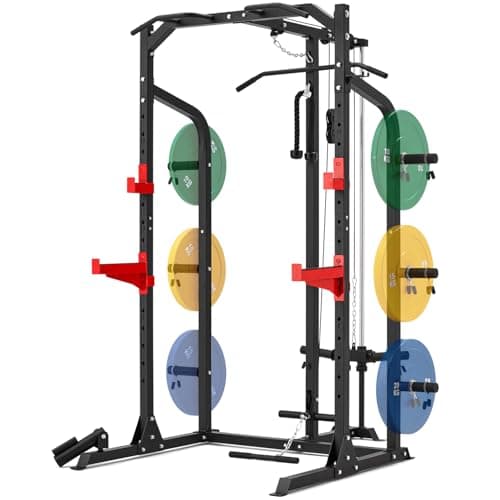
RUNFREELY Power Rack with Pulley System
A 1,000 lb-rated full cage that ships with a pulley system, safety bars and a landmine — the most complete rack on this list for the money.
#ad · Price as of October 21, 2026 · Affiliate disclosure
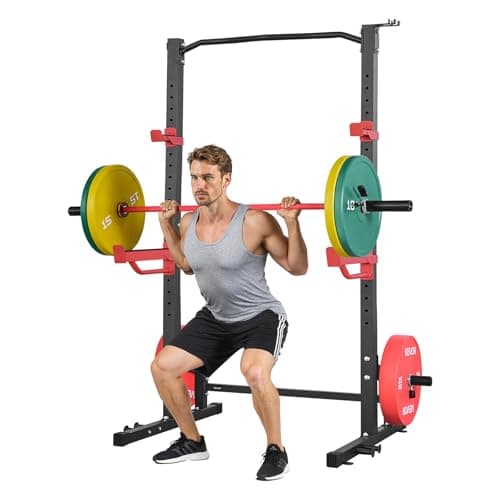
VEVOR Power Cage (1,000 lb)
A 1,000 lb-rated four-post cage with band pegs, adjustable J-hooks and safeties for around $160 — the cheapest honest full cage on this list.
#ad · Price as of October 21, 2026 · Affiliate disclosure
The RitKeep RMAX2250is the most transparent rack we track: 1,200 lb, 2×2″ uprights and a complete footprint of 44.3″ × 45″ × 81.7″, so you can check it against your ceiling before buying. RUNFREELYpublishes 1,000 lb alongside a pulley, safeties, a landmine and a pull-up bar. The VEVOR cagepublishes the same 1,000 lb at the bottom of the market, which is rarer than it should be — most cheap cages publish nothing. The full rankings are in best home gym rack and best power rack.
How much capacity do you actually need?
Work it out rather than guessing. Take your target squat or bench, add the bar, and that is the static load your J-hooks will see — for most home lifters somewhere between 200 and 500 lb. Then give yourself a wide margin for the dynamic case and for the fact that you are trusting an uncertified number: anything published at 1,000 lb or aboveis comfortable, and a published figure at all is a better sign than a large unpublished one. If you are chasing a number far beyond that, you are optimizing the spec that is least likely to be your limit — is a power rack worth it and what size power rack do I need cover the decisions that will actually change your training.
And if you are shopping the bottom of the market, where ratings are scarcest, read are cheap power racks safenext — it runs the five-spec check that tells you whether a cheap rack is a bargain or a gamble.