Yes — bumper plates work perfectly well for bench press, and there is no safety reason to avoid them. A press does not care what the plates are made of. The bar sits in your hands, the plates are just mass on the ends, and rubber and steel are identical in that role. If you already own bumpers, bench with them and do not give it another thought.
The real question hiding behind this one is about sleeve space and cost per pound. Rubber is far less dense than steel, so it takes much more material to reach the same number — which means a 45 lb bumper is dramatically wider than a 45 lb iron plate. On a bench press that matters for exactly one reason: you can run out of room on the bar before you run out of strength. Whether that is a real problem for you is arithmetic, not opinion, and this page shows you how to do it.
Does it affect the lift? No
Worth stating plainly, because a lot of forum advice implies otherwise. Nothing about a bench press interacts with plate material. The bar does not rotate, so sleeve spin is irrelevant. You are not dropping it, so bounce is irrelevant — and bounce is the single property bumpers exist for. The plates do not touch you. The bar’s behaviour under load is a function of the shaft, not the plates. The only material-dependent thing a bencher ever notices is that rubber plates are quieter when you load and unload them, which is a small genuine plus in a shared house.
There is one geometric consequence worth knowing: bumper plates are made to a uniform large diameterregardless of weight, while iron plates get smaller as they get lighter. That changes the height the bar sits at when it rests on the floor — relevant for deadlifts, irrelevant on a bench, where the bar lives in J-hooks. Our weight plate diameterguide covers where uniform diameter does and doesn’t matter.
The one real catch: sleeve space
Here is the arithmetic. A full-size Olympic bar typically offers around 15 to 16 inches of loadable sleeve per side— the usable stretch before the collar shoulder stops the plates. Standard-thickness bumpers are wide enough that a heavy load starts to fill that; thin cast iron barely touches it. For most home benchers this never becomes a problem. It becomes a problem in three situations, and they are worth checking against your own setup before you decide you need a second set of plates.
Do the check yourself: look up the published loadable sleeve length for your bar, work out how many plates per side your target bench weight needs, and see whether they fit. Our loadable sleeve length guide walks the calculation and bumper plate thickness explains why the small bumpers are the sneaky space thieves — a 10 lb bumper is not much thinner than a 45, because rubber plates need minimum thickness to survive being dropped at all.
What to look for when you're choosing between them
If you are actually buying plates rather than just wondering whether to bench with the ones you own, the decision comes down to one question and two secondary specs.
The question: do you drop the bar?Olympic lifting, or deadlifting to the floor without a rack, means you need bumpers — iron plates are not drop-safe at any price, and dropping a loaded bar on iron damages the plates, the bar and your floor. If you rack every lift and lower under control, iron is the correct, cheaper, more compact answer. That single question settles it for most people; our do I need bumper plates guide is the long version.
Then: the hub. On a bumper, look for a published steel insertrather than a molded rubber collar — the insert holds the 2-inch opening true, where a rubber collar wears oval and starts to wobble on the sleeve. And: the hole. On iron, look for a machined 2-inch centre hole, which seats cleanly on an Olympic sleeve instead of rattling. Our how to choose weight plates guide covers the full checklist, and why does my barbell rattle covers what a sloppy hole feels like.
The two sets to look at
One of each, from our own registry, so you can see the trade in concrete terms. Prices are live from the Amazon listings, as of October 5, 2026.
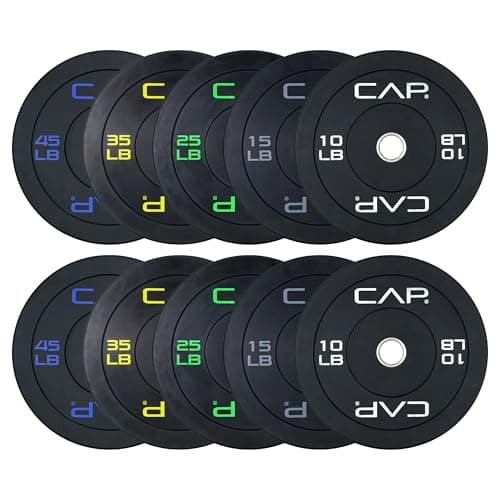
CAP 260 lb Olympic Bumper Plate Set
A 260 lb virgin-rubber bumper set with steel inserts — the value pick for a complete plate loadout that survives being dropped from the top of a deadlift.
#ad · Price as of October 5, 2026 · Affiliate disclosure
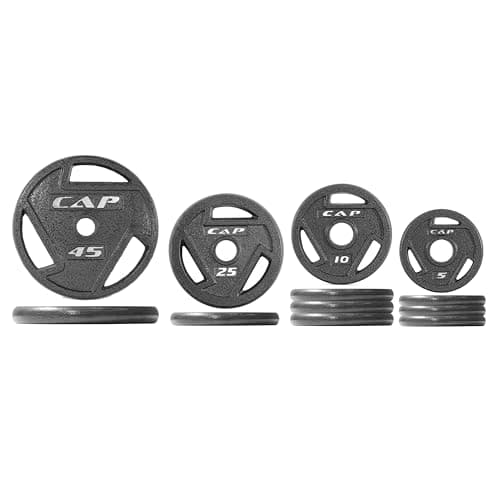
CAP Elite 200 lb Olympic Cast-Iron Plate Set
A 200 lb cast-iron set with machined 2" Olympic holes and a baked-enamel finish — the thin-plate default for a lifter who loads iron in a rack and sets the bar down under control.
The CAP bumper set publishes a virgin-rubber body with steel inserts and low bounce — a complete drop-safe loadout in one purchase, and perfectly good for benching. The CAP cast-iron set publishes machined 2-inch holes and a documented plate breakdown, and its thin profile fits far more weight per sleeve — which is the whole argument for iron if you never drop. Both fields are ranked in full in best bumper plates and best weight plates.
Mixing them is allowed, and often smart
You do not have to pick a side. Loading bumpers inboard— closest to the shoulder of the sleeve — and thin iron outboard of them, then collaring it, is a normal way to reach a weight that would not fit in bumpers alone. The one rule: once there is any iron on the bar, the bar is no longer drop-safe, no matter how many bumpers are also on it. Lower it under control or rack it. Our how to load a barbell guide covers the order and the collars, and collars and clips covers what actually holds a mixed load in place.
The short version
Bench with whatever plates you own — a press cannot tell the difference, and there is no safety issue. If you are buying, let the drop test decide: bumpers if the bar hits the floor, thin iron if it never does, because iron fits more weight per sleeve for less money. And if you are hitting the end of the sleeve with bumpers, check the published loadable length and your plates-per-side before buying a second set — mixing bumpers inboard with iron outboard usually solves it for free.