Liquid chalk and block chalk are the same compound — magnesium carbonate — delivered two different ways, and the format decision is not about grip. Block chalk puts more mineral on your hands faster and costs roughly a tenth as much per ounce. Liquid chalk puts a thinner, longer-lasting film on your hands, leaves nothing airborne, and is tolerated in buildings where a chalk block would get you a conversation with the front desk. If you own the floor you lift on, buy the block. If you lift anywhere else, buy the liquid. If you do both, own both — it is under thirty dollars for the pair at the prices we see, which is why this page ends in a recommendation to stop choosing.
This page settles the format argument only. If you have already decided which form you want and just need to know which tub to buy, go straight to our best gym chalk ranking, where five chalks are ranked on form and cost per ounce with live prices on each.
The 30-second answer
Read that table once and you have the whole decision. Everything below is the reasoning, the places the obvious answer is wrong, and three products that cover both columns.
They are the same mineral, and that matters
Lifting chalk is magnesium carbonate(MgCO₃) — not the calcium carbonate in classroom blackboard chalk. It works by absorbing moisture off your skin, which is why it is close to a complete fix for a bar rolling out of damp hands and close to useless for dry fingers that are simply opening under load. Climbing chalk, gymnastics chalk and lifting chalk are all the same compound; the differences are grain size and packaging.
Liquid chalk is that same powder plus a volatile carrier, almost always an alcohol, sometimes with a resin-type binder. You pump it out as a lotion, spread it, and the carrier flashes off in fifteen or twenty seconds leaving a bonded layer of magnesium carbonate behind. That is the entire difference in chemistry. Nobody has invented a grippier mineral; what they have done is change how it arrives and how long it stays.
One genuine exception is worth flagging, because it is the only case where the two forms are chemically different in a way you will feel: pine rosin. Rosin is tacky rather than drying, and it appears in a handful of premium liquid formulas — Spider Chalk publishes lab-grade magnesium carbonate plus pine rosin in the Black Widow formula, which is one of the only published formulas in the whole category. If your problem is a bar rotating in your fingers on a mixed-grip pull rather than sweat, rosin is a real ingredient to look for and plain block chalk will not replicate it.
Grip: block wins, and not by as much as people think
On a single maximal attempt with dry hands, block chalk is the better tool. You can load as much mineral onto your palms as you want, in as long as it takes to rub a block, and you can add more between attempts without waiting. For a one-rep-max deadlift in a garage, that is the right answer.
Across a session, the gap narrows and sometimes reverses. Loose chalk migrates: it comes off on your shirt when you chalk up, on the bar when you set your grip, on your legs on the way down. By your third set you have less on your hands than you think, which is why people re-chalk constantly. A dried liquid film does not do that — it is bonded to your skin and survives several sets before it needs refreshing. Lifters who switch to liquid often report using it once at the start of a session and not thinking about it again, which is a real convenience even if peak grip is slightly lower.
The honest summary: block for peak, liquid for duration. And the thing that actually matters more than either, if your hands keep failing, is the surface you are gripping. A worn, slick, mildly knurled bar fights you with or without chalk. Our aggressive vs passive knurling guide covers what you are holding, and barbell knurling explained covers why it is shaped the way it is.
Mess is what actually decides this for most people
If you ask lifters why they bought liquid chalk, almost nobody says grip. They say one of three things: the gym bans the block, their partner banned the block, or they were tired of chalk prints on the car seat.
Block chalk produces visible airborne dust every single time you use it. In a dedicated garage with a rubber floor, that is a non-issue — it settles, you sweep it, nobody cares. In a finished basement with carpet nearby, a spare bedroom, or a room that is also a laundry room, it is a weekly argument. Liquid chalk produces no dust at all, which is the whole reason it exists commercially and the reason it spread so fast through shared gyms.
There is a third format that solves this without going liquid: a chalk ball, which is fine chalk inside a permeable cotton sock. The sock meters the chalk and holds most of what would otherwise end up in the air, and a refillable one lasts indefinitely. If your objection to block chalk is purely mess and you do not need the portability of a bottle, the ball is the cheaper fix. We rank one on the chalk roundup.
What liquid chalk does to your skin
This is the trade that gets under-reported, and it is the main reason we do not tell people to use liquid for everything.
Block chalk absorbs moisture that is already on your hands. Liquid chalk does that and delivers an alcohol carrier that strips skin oil as it evaporates. Used a few times a week that is unremarkable. Used every session by someone who already has heavy calluses from pulling, it leaves palms noticeably dry, and dry calluses tear and crack far more readily than supple ones. If you have ever lost a week of deadlifts to a torn callus, you know what that costs.
None of that is an argument against liquid chalk; it is an argument for pairing it with basic hand maintenance. File the calluses down before they get tall, and keep a balm in the bag. The lifters who complain loudest about liquid chalk ruining their hands are usually the ones using it daily and doing neither.
Cost: do the arithmetic once
Chalk is a commodity mineral that costs cents to mine, so the price spread across formats is almost entirely packaging. Buying a bulk block means buying the mineral. Buying liquid means buying the mineral, an alcohol carrier, a bottle and a pump — and the carrier is most of the volume you are paying to ship.
At the prices resolved for our chalk roundup, the arithmetic was stark: bulk block chalk landed near eleven cents an ounce, branded 2 oz blocks landed above a dollar an ouncefor the identical compound, and liquid is the most expensive form in the category per unit of chalk actually delivered to your hands. Prices move, so treat those as the shape of the thing rather than a quote — the picks below show today’s live numbers, checked November 11, 2026.
The practical conclusion is not “buy the cheap one.” It is that the cheap one is so cheap that owning both is the rational move. A multi-year bulk block plus a small travel bottle is a single sub-thirty-dollar purchase that covers every room you will ever lift in, and it is the recommendation we would give a friend without hesitating.
Gym rules, and the one place we will not guess
Commercial gym chalk bans are about dust and floor residue, so liquid chalk is tolerated in the overwhelming majority of buildings that forbid the block. That is the practical reality. It is not a guarantee: plenty of chains write the rule as “no chalk” with no qualifier, and a front-desk employee reading that sentence is not going to litigate chemistry with you. Ask once and you will know for the life of your membership.
Competition is the part where we will not tell you a rule we cannot quote. Loose magnesium carbonate is permitted in sanctioned powerlifting, usually with conditions about where you may apply it and a requirement to wipe equipment down afterwards. The chalk provisions in federation rulebooks were written around loose chalk and do not all address liquid explicitly, and we could not pull current primary rule text to settle it. So: if you are competing, read your federation’s current technical rulebook and ask the meet director, and do not let a gear site — ours included — be the source of a decision that could cost you a lift.
What each one leaves on your barbell
Chalk is not free for the bar. Magnesium carbonate packs into the knurl, and packed chalk holds moisture against steel. On a raw steel or black oxide shaftthat is the single most common cause of rust in a home gym — not humidity alone, but chalk plus humidity sitting in the diamonds for a week.
Block chalk is much worse for this than liquid. Loose chalk goes everywhere, including deep into the knurl pattern, every time you set your hands. Liquid chalk bonds to your palms instead, so far less of it transfers. If you chalk heavily with blocks on a raw bar and never brush it, you will find orange spots in the knurl inside a season.
The fix is thirty seconds with a nylon brush, not a product — how to clean a barbell has the routine and how to prevent barbell rust covers storage. If you know you will not do it, that is a legitimate argument for a stainless or Cerakote shaft next time you buy, and a legitimate argument for keeping liquid as your default.
Three chalks that cover both columns
One bulk block for the room you own, one published-formula liquid for everywhere else, and the cheapest honest way to find out whether you like liquid at all. Prices live as of November 11, 2026.
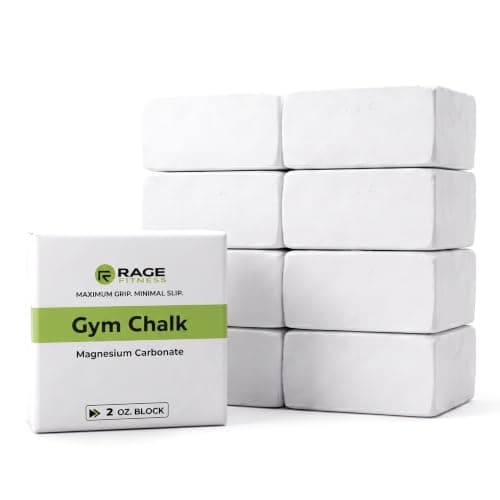
Rage Fitness Gym Chalk, 8 x 1 lb Blocks
Eight pounds of pure magnesium carbonate in 1 lb blocks - the cheapest chalk per ounce we found, and more than a home gym gets through in a year.
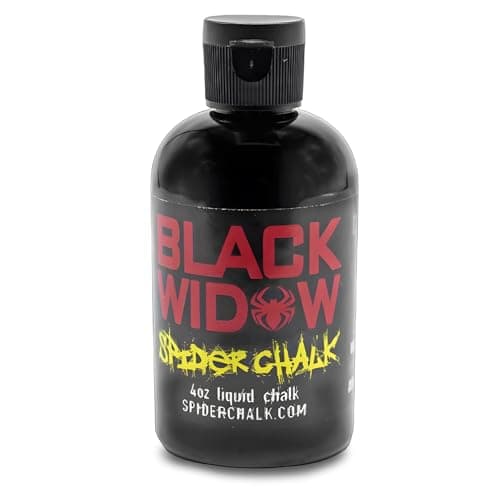
Spider Chalk Black Widow Liquid Chalk
The liquid chalk with rosin in it - lab-grade magnesium carbonate plus pine rosin, which is the formula to reach for on a deadlift bar that keeps sliding.
#ad · Price as of November 11, 2026 · Affiliate disclosure
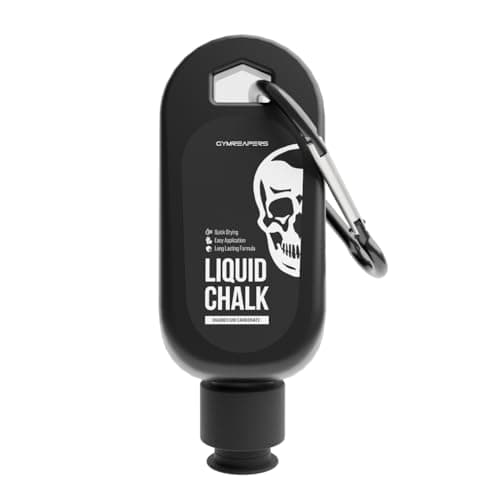
Gymreapers Liquid Chalk (50 mL)
A 50 mL bottle of liquid chalk at roughly the price of a sandwich - the cheapest honest way to find out whether you prefer liquid to a block.
#ad · Price as of November 11, 2026 · Affiliate disclosure
The Rage Fitness 8 x 1 lb packis eight pounds of pure magnesium carbonate — realistically a multi-year supply for one lifter, and the lowest per-ounce figure in our lineup by roughly a factor of ten. Its honest con is that eight pounds is far more chalk than most people need, so think of it as a one-time purchase that ends the question rather than a consumable.
The Spider Chalk Black Widowis the liquid we rank first because it is one of the only products in the category whose maker publishes what is in it: lab-grade magnesium carbonate plus pine rosin. The rosin is why it feels tackier than plain chalk. Its con is that the Amazon listing does not state a bottle size, which makes per-ounce arithmetic impossible — we say so rather than inventing a figure.
The Gymreapers 50 mL liquid is the low-commitment option: a pocket bottle for the cost of a couple of coffees, which is the right way to find out whether you actually prefer the format before standardizing on it. Its con is that Gymreapers publishes no detailed composition at all, so you are buying on format and price rather than on a stated formula.
So which should you buy?
- You lift in your own garage or basement, mostly heavy. Bulk block. It is the heaviest coat, the cheapest per ounce, and the mess is your own problem to sweep.
- You lift at a commercial gym. Liquid, and ask whether chalk of any kind is permitted before the first set.
- You lift at home in a shared, finished room. A chalk ball first, liquid second. Loose block chalk in a carpeted house is a fight you will lose.
- You travel or compete.Liquid in the bag regardless, plus whatever your federation’s rulebook actually permits on the platform.
- Your hands are already cracking. Block over liquid, and deal with the calluses. The alcohol carrier will make a bad situation worse.
- Your grip fails on load, not sweat. Neither. Lifting straps are the tool for fingers that open at 90% of a max, and a hook grip is the free version.
Sources
- Composition, form, quantity and published formula claims for the three picks above — the makers’ own Amazon listings, with availability and current price resolved live through the Amazon Creators API (
getItems). Where a maker publishes nothing (bottle size on the Black Widow listing, detailed composition on the Gymreapers liquid), the picks above say so rather than estimating. - Spider Chalk Black Widow published formula (“100% pure, laboratory-grade magnesium carbonate mixed with pine rosin and proprietary bonding agents”) and manufacturing location, from the maker’s product documentation as reproduced in Rogue Fitness’s product guide, checked October 28, 2026 at support.roguefitness.com.
- Liquid chalk composition — magnesium carbonate suspended in an alcohol carrier, sometimes with a resin-type binder — per the general published description of the product category. We did not test, assay or measure any chalk, and we do not claim to have.
- Competition legality: we could not retrieve current primary rule text on liquid chalk from a federation rulebook, so this page deliberately declines to state one. Check your federation’s current technical rulebook and your meet director.