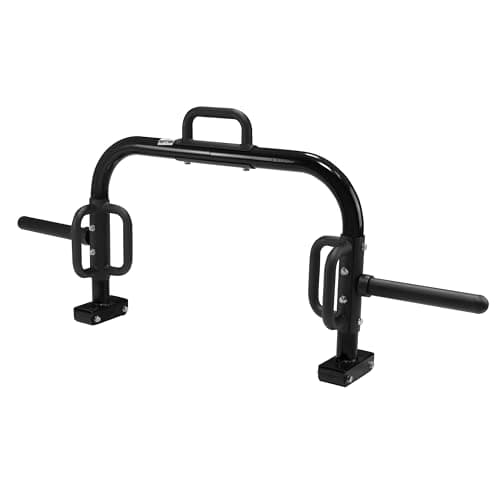
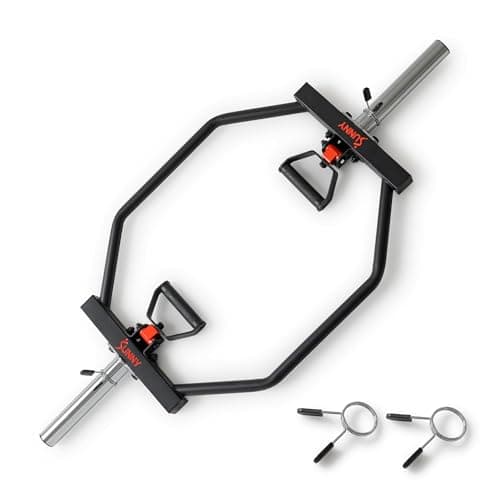
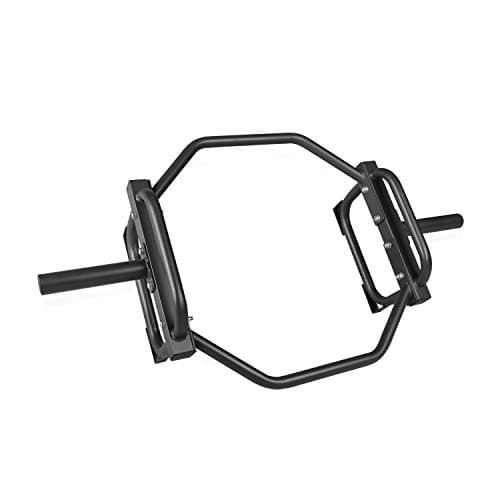
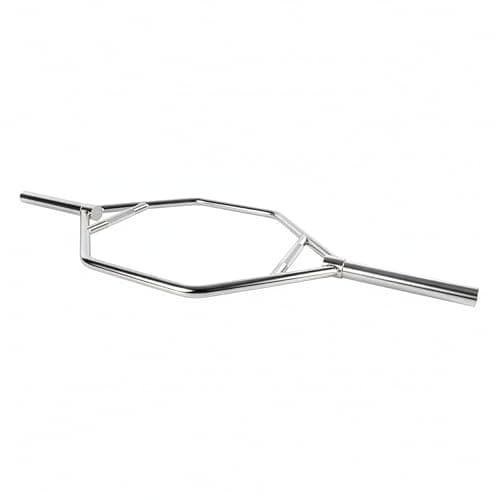
The four published specs, side by side
Every figure below is from the maker’s own listing. Where a maker does not publish a number we say so rather than estimating it — and in this category the blanks are as informative as the figures.
Notice the bottom row. Not one of these four publishes a bar weight, which means your true working total is a guess until you put the empty bar on a bathroom scale. That is the single biggest honesty gap in the budget end of this category, and it is worth doing on day one — how heavy is a trap bar covers the usual range and why the number varies so much.
Handle height is the decision, not the price
All four of these bars cost within about $25 of each other, so the money is not really what you are choosing between. The handles are.
- Flush handles (CAP chrome) sit in line with the sleeves, so the bar behaves like a conventional deadlift with your hands at your sides. The longest range of motion of the four, and the hardest.
- Elevated handles(CAP Trap & Shrug) raise the start position by a couple of inches. That is a genuinely shorter pull — excellent for shrugs, rack pulls and anyone whose hip mobility makes a floor pull ugly, and a real reduction in difficulty if you were hoping to compare numbers with a barbell.
- High and low pairs (CAP Deluxe Open) give you both by flipping the bar over, which is the most flexible arrangement and the reason most mid-price hex bars offer it.
- Swivel handles (Sunny) rotate to whatever angle your wrists want, which is a comfort feature rather than a height one.
Trap bar high vs low handles works through what the height change does to the lift, and open vs closed trap bar covers the frame fork.
Where the cheap bars actually bind
Loadable sleeve length, not capacity
This is the ceiling almost nobody checks. A 9″ loadable sleeve holds roughly four bumper plates per side before you run out of room for a collar — comfortably past 400 lb, but it is the sleeve, not the 750 lb rating, that stops you. Trap bar loadable sleeve length does the arithmetic properly.
Capacity, when you are strong
The 400 lb Sunny rating is the lowest here and it is a real number, not a conservative one — a trap bar deadlift is usually the heaviest pull a lifter owns, and 400 lb including the bar arrives faster than people expect. If you are already pulling over 350 lb, buy the 750 lb CAP and stop thinking about it. For what a rating does and does not cover, see how much weight can a trap bar hold.
Finish and welds
The visible budget tell. Chrome on the CAP chrome bar wears better than painted black at the points where plates load, and the Deluxe Open’s welds are explicitly budget-tier. Neither is a safety issue at these loads; both are why the bar looks older than it is after two years in a garage.
When to spend more instead
Three cases where the budget bar is false economy. First, if you want one bar that does everything — the thick-combo CAP on our main trap bar roundupis 1,000 lb rated with 32 mm dual-height knurled handles, and it is the only bar we track that covers every pull without compromise. Second, if loaded carries are the reason you want a trap bar, the open format is the feature and best trap bar for farmers carries ranks for exactly that. Third, if you are not sure a trap bar earns its floor space at all, read is a trap bar worth it before spending anything.