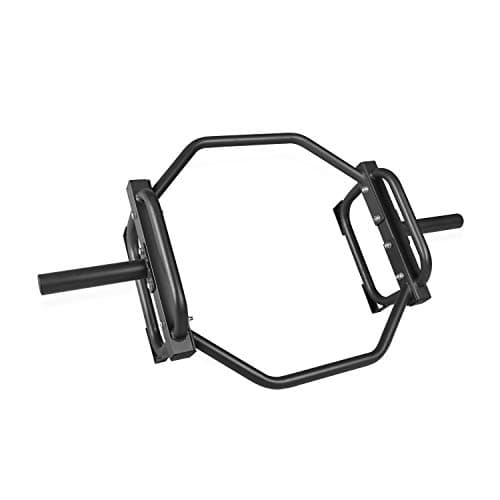
What the elevated grip actually does
Picture a standard closed hex bar: you step inside, and the handles sit roughly in line with the loaded sleeves, so the bar hangs at about mid-shin and you pull it through a full deadlift range. Now raise those handles a few inches. Two things change at once. The starting height goes up, so there is less distance to travel, and your starting position gets more upright, because you do not have to fold as far down to reach the handles.
For the lifts this bar is named after, both changes are advantages. A shrugis a short, heavy movement at the top of the range — starting lower just means more wasted travel before the part you care about. A rack pull deliberately shortens the deadlift to overload the top half. A loaded hold never moves at all. In each case a raised handle gets you to the working position with less setup and less lower-back demand. It is also genuinely easier on anyone with limited hip or ankle mobility, which is the quiet reason elevated-grip bars sell well.
The flip side is the one to understand before buying: on a full-range trap-bar deadlift, a raised handle means you are not training the bottom of the lift. That is not automatically bad — plenty of programs use elevated pulls on purpose — but if you want the deadlift itself, a flush-handle bar gives you the whole movement. Our trap bar high vs low handles guide covers the trade in detail, and the CAP chrome trap bar is the flush-handle bar in the same family if that is what you are after.
The 500 lb rating, read honestly
Capacity is where this bar sits lowest in the field, and it deserves a straight answer rather than a shrug. 500 lbis the published rating. For context, the other trap bars we cover publish 1,000 lb, 750 lb and 400 lb. So this is not the cheapest option by accident — the rating is part of the price.
Whether that matters depends entirely on the lift. For shrugs, 500 lb is a ceiling almost nobody reaches: a heavy shrug for a strong lifter is well inside it, and that figure includes the bar. For rack pulls and loaded holds, which are the other things an elevated bar is good for, you can get closer — rack pulls are one of the few movements where people genuinely load past their deadlift. And for a maximal trap-bar deadlift, you should simply buy a different bar; 500 lb is not enough headroom for a lifter who is progressing hard. Our capacity explained guide covers what a rating does and does not promise, which is worth reading on any budget bar.
What CAP doesn't publish, and why it matters here
Two missing numbers have practical consequences on this bar specifically.
The first is bar weight. A trap bar is heavy, and its own weight counts toward your working total from the first rep — so not knowing it means your logged shrug weight is a guess. CAP does not publish a figure for this model. The fix is unglamorous and takes one minute: weigh the bare bar on a bathroom scale and write the number on it with a marker. Our how heavy is a trap bar guide explains why these bars vary so much and why you cannot assume a standard.
The second is loadable sleeve length, which on a cheap hex bar is the spec that usually stops you before capacity does. If the sleeves are short, thick rubber bumper plates fill them fast and you cannot physically fit the weight you wanted. CAP publishes 9 inches per sleeve on its OBIS-series trap bars, but notfor this model, and we are not going to carry that figure across to a different product line. If you load with bumpers rather than thin iron, ask the seller or check the listing Q&A before ordering. Our trap bar loadable sleeve length guide has the arithmetic and bumper plate thickness explains why rubber fills a sleeve so much faster than cast iron.
A 2-inch Olympic fitment, which is the easy part
The good news on compatibility: this is a true 2-inch Olympicbar, the same sleeve diameter as almost every full-size barbell and plate set sold today. Your existing plates slide straight on and standard collars hold them — no adapter, no oddball size. If you are not certain which fitment your plates are, our 2-inch vs 1-inch weight plates guide shows how to tell, and best barbell collars covers what to hold them on with.
The closed frame: no carries
Like most cheap hex bars, this one is a closed frame. You step into the middle and the bar surrounds you on all sides, which is fine for every lift above — shrugs, rack pulls, holds, deadlifts — and rules out one thing entirely: walking carries. There is no open end to step through, so the front of the frame sits in front of your shins and blocks a normal stride. If farmer’s walks are something you want, you need an open walk-in frame, and our best trap bar for farmer’s carries page covers the one that is still buyable. Our open vs closed trap bar guide explains what the open end buys you.
Who should buy it
Buy this bar if shrugs, rack pulls or loaded holdsare the reason you want a hex bar, if you want the cheapest honest route into the format, or if limited mobility makes a flush-handle bar awkward to set up from. On those terms it is a good buy and the price is hard to argue with — it does one job well for roughly what a single plate costs.
Skip it if you want a full-range trap-bar deadlift (buy a flush or dual-height bar), if you are progressing toward heavy pullsand will outgrow a 500 lb rating, or if you want loaded carries (buy an open frame). And if you want one bar that covers all of it, the CAP combo-grip bar in our best trap barroundup rates 1,000 lb with two handle heights knurled at both positions — three times the price, and a different class of tool. Our how to choose a trap bar checklist and how much does a trap bar cost put this bar in the context of the whole category, including why the price gap exists.
Sources
- CAP Olympic Trap and Shrug Bar, Elevated Grip, Black — published listing title and specification (500 lb capacity, elevated grip, 2" Olympic fitment, black finish) and live availability, resolved via the Amazon Creators API on 7 October 2026. Bar weight and loadable sleeve length are not published for this model and are reported as such rather than estimated.
- Comparison figures for the other trap bars named (1,000 lb and 750 lb CAP OBIS-series bars, 400 lb Sunny hex bar, and the 9" OBIS loadable sleeve figure) are the manufacturers’ own published specifications as recorded in our product registry and cited on each bar’s own review page.
- General specialty-bar principles (elevated vs flush handle height and range of motion, open vs closed frames and loaded carries, folding bar weight into your loading math, and reading a capacity rating) as covered in our methodology and the guides linked above.