The three dimensions, and why they are the whole review
The IPF Technical Rulebook specifies a competition bench as not less than 1.22 m (48″) long, 29–32 cm (about 11.5–12.5″) wide, and 42–45 cm (16.5–17.7″) high measured floor to the top of the uncompressed pad. Those are not arbitrary numbers. Each one exists because of something that happens to a lifter when it is wrong.
For context on how unusual that is: of the six fixed flat benches in our registry, the PROIRONgets the width right (11.8″) and misses the height at 19″ overall; the TITAN Seriesgets the height right at 17″ and overshoots the width at 14″, which is about 35.6 cm and not competition-legal; the REP FB-3000is inside on width at 12″ and sits at or just over the height ceiling depending on which of REP’s two published figures you read; and FLYBIRD publishes neither for its folding flat bench. See bench pad thickness and width and bench angles explained for the full treatment.
The single post, which matters more than it sounds
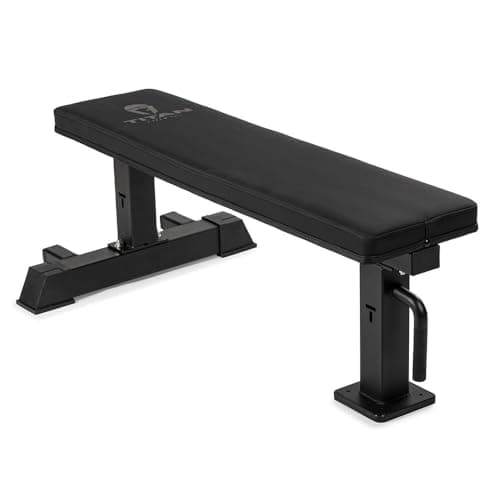
Most flat benches carry their load on a frame with a leg or a cross-member somewhere in the middle. This one uses a single postat each end, so the floor under the middle of the bench is completely clear. That is not a styling decision — it is about where your feet go.
A competition-style bench press setup has your feet planted and driving, often pulled back under your hips. A center leg sits exactly there and forces you to splay your stance around it, which costs you the straight-line drive from floor to shoulders. On a single-post bench you put your feet where your body wants them. If you have ever found yourself fighting a bench’s frame for foot space, that is the spec you were missing.
The steel, the mass and the rating
Titan publishes 11-gauge steel in 2×3″ and 3×3″ tube, a 1,000 lb capacity and a 56 lb bench weight. Each of those is worth reading correctly:
- 11-gauge is the real number to look for. It is the same wall thickness used on serious power racks, and it is the difference between a bench that feels inert and one that flexes perceptibly when you drive. Our 11-gauge vs 14-gauge guide covers what the gauge changes.
- The 1,000 lb rating has to cover you as well as the bar.A 200 lb lifter pressing 315 lb puts about 515 lb through the frame, so this is roughly double the headroom a strong home presser needs — which is the right amount, not an excessive amount. How much weight can a bench hold does that arithmetic properly.
- 56 lb is the number that decides how it behaves.Heavy enough to stay planted when you unrack and drive; light enough, with the rear wheels, to move in and out of a rack without turning it into a job. For comparison, the cheapest bench we rank is 18 lb and the TITAN Series is 76 lb.
The three honest trade-offs
1. The pad is firm, deliberately
2.5″ of dense foam is not a plush surface, and if you like sinking into a bench you will not like this one. The reason to want it firm is consistency: thick soft foam compresses more under a heavy load, which quietly raises your press height between a warm-up and a top set. Titan’s own TITAN Series doubles the thickness to 4″ if you want the other end of that trade.
2. The 48″ pad has no margin
It lands exactlyon the 1.22 m competition minimum. That satisfies the rule and leaves nothing spare, so a very tall lifter will find their head near the end of the pad. If you are over about 6′3″, the 50″ pad on the TITAN Series is the more comfortable platform — at the cost of a 14″ width that is no longer competition-legal. Our bench for tall lifters page ranks on published backrest and pad length.
3. The price
It is roughly four times the cheapest bench in our registry. What the money buys is the dimensional correctness, the 11-gauge frame and the mass — not features. If your pressing is dumbbell work and accessories, you do not need any of that, and best budget weight bench is the honest page for you.
What it does not do
Two things, both inherent to the format rather than to this bench. It does not adjust— no incline, no decline, no seated pressing with back support. If you want those, you are shopping the adjustable bench category instead, and accepting a seat-to-back gap in exchange. And it has no safeties of its own, which no flat bench does: a failed bench press is the most dangerous miss in lifting, so press inside a power rack with the safety bars set just below your chest or with a spotter. Bench press without a spotter covers the setups that work and the one to avoid.
Who should buy it
Buy it ifthe bench press is a lift you care about getting right — if you want your feet flat on the floor, your shoulder blades pinned behind a legal-width pad, and a frame that does not move while you drive. It is also the obvious pick if you train for a raw meet and want your training setup to match the platform.
Look elsewhere ifyou want incline pressing (go adjustable), if you are very tall and would rather have pad length than legal width (the TITAN Series), if you want a plush surface (also the TITAN Series), or if your bench will mostly hold dumbbells and your hips — in which case the budget end of the category is genuinely fine, and best bench for hip thrusts ranks for that job specifically.