Skip to content
Knurl Knock

01

The Best Bench for Hip Thrusts (2026)

A hip thrust loads a bench sideways, not downward - so the specs that matter are mass, pad width and height, in that order. That inverts the usual bench ranking, and the widest pad on this site wins.

By Stephen V., Strength-gear enthusiastLast updated October 17, 2026How we pick
Affiliate disclosure: Knurl Knock earns a commission when you buy through our links, at no extra cost to you. We accept no free products and no sponsored placements — we only earn if you buy, never for recommending. How this works.

The best bench for hip thrusts is the Titan Fitness TITAN Series single post flat bench — 76 lb of 3×3″ 11-gauge steel, a 14″ wide, 4″ thick pad, and a 17″ height. Every one of those numbers is the wrong answer for a competition bench press and the right answer for a hip thrust: the mass stops the bench sliding backwards under horizontal force, the extra pad width supports your whole upper back instead of a narrow strip, and 17 inches is the height that gives most lifters a full hip arc without the shoulders riding up.

If 76 lb is more bench than your room wants to move, Titan’s Elite Seriesis the same 17″ height and single-post frame at 56 lb with a 12″ pad. The REP FB-3000is the lightest bench we would recommend for this lift at 40–45 lb, and it has the grippiest pad cover of the four. The PROIRONis the budget answer and is included with an honest caveat: at 19″ overall it is the tallest bench here, which shortens the top of the movement. Live prices as of October 21, 2026.

The reason this page exists as a separate ranking: a hip thrust is the only common barbell lift that loads a bench horizontally. Everything else you do on a bench pushes it into the floor, which is why bench rankings are normally about load rating and pad geometry for pressing. A hip thrust instead puts your upper back against the pad edge and drives away from it, so the bench wants to slide backwards on every rep. Mass and friction are what stop it, and neither appears on a bench press spec sheet. That is why our best flat bench ranking and this one disagree.

02

The picks, ranked

Best benches for hip thrusts - ranked on mass, pad width and height

#ProductBest forScorePrice
1
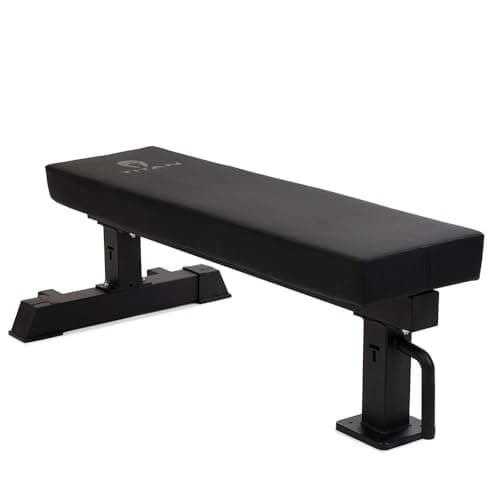
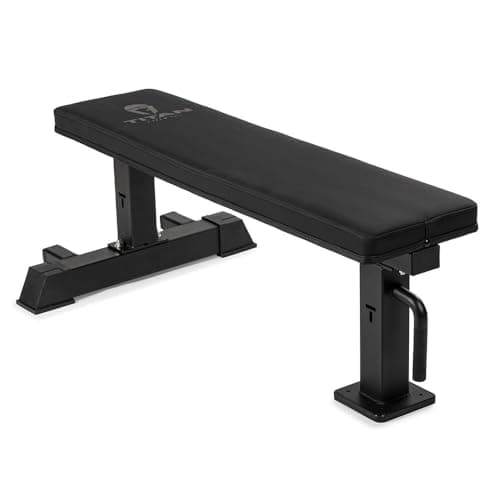
Titan Fitness TITAN Series Single Post Flat Bench

A 76 lb, 1,200 lb-rated bench on 3x3-inch 11-gauge steel with a 50-inch pad — the most planted flat bench on this list, as long as you don't need a competition-legal pad width.

Best for heavy pressing8.7
$299.99 · View on Amazon

#ad · Price as of October 21, 2026 · Affiliate disclosure

2
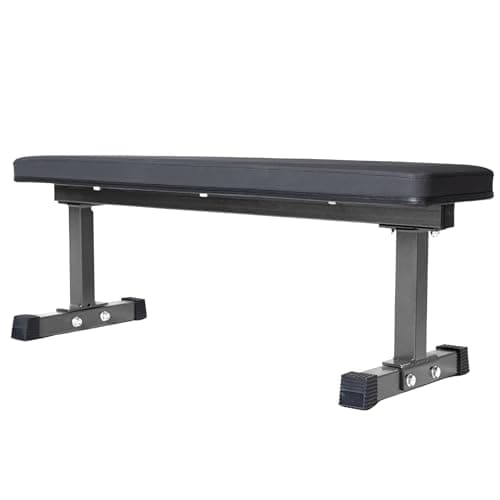
Titan Fitness Elite Series Single Post Flat Bench

The only bench here that lands all three competition dimensions at once — 17 inches tall, a 12-inch pad, 48 inches long — on 11-gauge steel, with a single post that leaves the floor under your feet completely clear.

Best overall9.0
$189.97 · View on Amazon

#ad · Price as of October 21, 2026 · Affiliate disclosure

3
REP Fitness FB-3000 Flat Weight Bench

11-gauge steel, a 12-inch grippy pad built on a plywood substrate rather than particle board, and a real strength brand behind it — the sensible middle of this list.

Best from a strength brand8.6
$149.99 · View on Amazon

#ad · Price as of October 21, 2026 · Affiliate disclosure

4
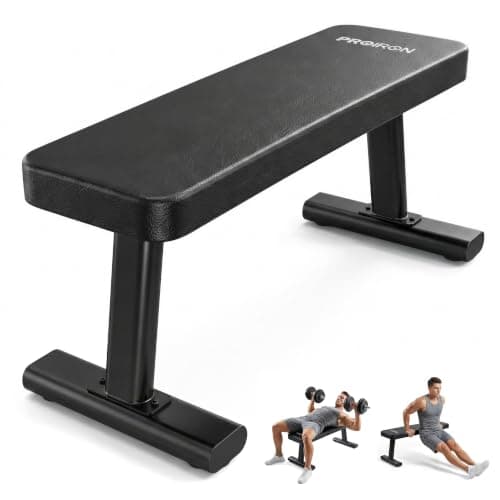
PROIRON Flat Weight Bench (1,200 lb)

A 1,200 lb static rating, an 11.8-inch pad inside the competition width band, and legs splayed 8 degrees outward on adjustable feet — a lot of considered geometry for budget money.

Best budget7.8
$79.99 · View on Amazon

#ad · Price as of October 21, 2026 · Affiliate disclosure

03

Every pick, reviewed

Titan Fitness TITAN Series Single Post Flat Bench
01
Best for heavy pressing

Titan Fitness TITAN Series Single Post Flat Bench

Titan Fitness

8.7

A 76 lb, 1,200 lb-rated bench on 3x3-inch 11-gauge steel with a 50-inch pad — the most planted flat bench on this list, as long as you don't need a competition-legal pad width.

Capacity
1,200 lb
Height
17"
Pad
50" x 14", 4" thick
Frame
3x3" 11-ga steel
Bench weight
76 lb
Extras
Rear wheels, knurled handle

What we like

  • 1,200 lb on 3x3-inch 11-gauge tube is the heaviest-rated frame here
  • 76 lb of bench simply does not move when you unrack and drive
  • 50" pad supports tall lifters head to hips with room left over
  • The 4" HeftyGrip pad is the most comfortable surface on the list for long sessions

Trade-offs

  • The 14" pad is about 35.6 cm — wider than the IPF's 32 cm ceiling, so it is not competition-legal and it can crowd your shoulder blades
  • 4" of foam compresses more under a heavy load than a 2.5" pad, which quietly changes your press height
  • The most expensive bench here by a wide margin
  • 76 lb is a real lift to reposition, even with the rear wheels
Value
7
Stability
10
Pad
9
Geometry
7
$299.99 · View on Amazon

#ad · Price as of October 21, 2026 · Affiliate disclosure

Titan Fitness Elite Series Single Post Flat Bench
02
Best overall

Titan Fitness Elite Series Single Post Flat Bench

Titan Fitness

9.0

The only bench here that lands all three competition dimensions at once — 17 inches tall, a 12-inch pad, 48 inches long — on 11-gauge steel, with a single post that leaves the floor under your feet completely clear.

Capacity
1,000 lb
Height
17" (IPF range)
Pad
48" x 12", 2.5" thick
Frame
11-ga, 2x3" + 3x3" tube
Bench weight
56 lb
Extras
Rear wheels, knurled handle

What we like

  • 17" pad height sits inside the IPF's 42-45 cm window, so your feet reach the floor the way they do on a competition bench
  • 12" pad is in the legal 29-32 cm band — wide enough to support you, narrow enough to let your shoulder blades pin back
  • Single-post design means there is no center leg between your feet when you drive
  • 56 lb of 11-gauge steel, with rear wheels and upright storage so the weight isn't a burden

Trade-offs

  • The 48" pad lands exactly on the 1.22 m minimum with no margin — fine for the rule, tight for very tall lifters
  • 2.5" pad is firm and thin by design; if you want a plush surface the TITAN Series doubles it
  • Roughly four times the price of the cheapest bench here
Value
8
Stability
9
Pad
8
Geometry
10
$189.97 · View on Amazon

#ad · Price as of October 21, 2026 · Affiliate disclosure

REP Fitness FB-3000 Flat Weight Bench
03
Best from a strength brand

REP Fitness FB-3000 Flat Weight Bench

REP Fitness

8.6

11-gauge steel, a 12-inch grippy pad built on a plywood substrate rather than particle board, and a real strength brand behind it — the sensible middle of this list.

Capacity
700-750 lb (see trade-offs)
Height
17.5-18" to top of pad
Pad
12" wide, 2.5" thick
Frame
11-gauge steel
Bench weight
40-45 lb
Pad build
Plywood base, dense foam

What we like

  • 11-gauge steel and a plywood pad substrate — REP specifies it is not particle board, which is what sags first on cheap benches
  • 12" pad width sits inside the competition band, and the grippy cover keeps your back set when you sweat
  • 40-45 lb is light enough to slide in and out of a rack without a fuss
  • A Denver-based strength company you can actually reach for a replacement pad

Trade-offs

  • Lowest load rating here — and REP's own spec table says 700 lb where the Amazon listing says 750 lb
  • Those two sources also disagree on height (18" vs 17.5"), pad width (11.8" vs 12") and bench weight (40 lb vs 45 lb); either figure puts the height at or just over the IPF's 45 cm ceiling
  • At about 47" the pad is fractionally under the 1.22 m competition minimum
Value
9
Stability
8
Pad
9
Geometry
8
$149.99 · View on Amazon

#ad · Price as of October 21, 2026 · Affiliate disclosure

PROIRON Flat Weight Bench (1,200 lb)
04
Best budget

PROIRON Flat Weight Bench (1,200 lb)

PROIRON

7.8

A 1,200 lb static rating, an 11.8-inch pad inside the competition width band, and legs splayed 8 degrees outward on adjustable feet — a lot of considered geometry for budget money.

Capacity
1,200 lb static
Overall
42.5" x 18" x 19"
Pad
42.5" x 11.8", 2" thick
Frame
Reinforced ladder steel
Feet
8-degree splay, adjustable
Upholstery
High-density PVC

What we like

  • 1,200 lb static rating for budget money — on paper it matches the priciest bench here
  • 11.8" pad width is inside the 29-32 cm competition band, which the priciest bench on this list misses
  • Legs splay 8 degrees outward and the feet adjust, so it levels on an uneven garage slab

Trade-offs

  • 19" overall height is well above the IPF's 45 cm ceiling — shorter lifters will lose the floor and with it their leg drive
  • The 42.5" pad is about 5.5" short of the competition minimum; taller lifters will hang off one end
  • 2" pad is thin, and PVC is less grippy than the textured vinyl on the Titan and REP benches
  • PROIRON publishes no bench weight, and a light bench is a bench that moves
Value
10
Stability
7
Pad
6
Geometry
6
$79.99 · View on Amazon

#ad · Price as of October 21, 2026 · Affiliate disclosure

04

How to choose

The three specs a hip thrust actually loads

Benches for hip thrusts, on their published figures

TITAN SeriesElite SeriesREP FB-3000PROIRON
Bench weight76 lb56 lb40-45 lbNot published
Pad width14"12"12"11.8"
Height to pad17"17"17.5-18"19" overall
Pad thickness4"2.5"2.5"2"
Frame3x3" 11-ga2x3" + 3x3" 11-ga11-gaLadder steel
Centre leg in the way?No - single postNo - single postNoNo

1. Mass, because the force is sideways

At the top of a heavy hip thrust a substantial part of your drive is horizontal. The bench resists that with its own weight and the friction of its feet — nothing else. This is why the heaviest bench wins a ranking it would lose anywhere else, and why an 18 lb folding bench, which is perfectly good for dumbbell work, creeps backwards across a smooth slab here.

2. Pad width, where wider is genuinely better

On a bench press a narrow pad is a feature: 12″ lets your shoulder blades pin back behind the surface. A hip thrust asks the opposite — your upper back rests acrossthe pad while your shoulders pivot, and a narrow pad concentrates that on a strip. The TITAN Series’ 14″ pad is about 35.6 cm, wider than the IPF’s 32 cm ceiling and therefore not competition-legal, and for this movement that is an advantage rather than a flaw. More in bench pad thickness and width.

3. Height, which sets the arc

Bench height determines where your shoulders pivot and therefore how far your hips travel. Around 16–17 inches suits most adult lifters: low enough that you reach full hip extension, high enough that your shoulders are supported at the top. At 19 inches you tend to finish the rep with the shoulders riding up the pad and the hips short of lockout — which is why the PROIRON ranks fourth here despite having the best published rating in its price class. Shorter lifters feel this most.

You also need a pad, and it should be square

This is the part people skip and then give up on the lift over. A loaded bar directly on the hip crease is genuinely painful at useful weights, and the cushion is not optional once the bar is heavy. The specific thing to know: a round sleeve pad wants to roll under a hip thrust, which is both annoying and a reason the bar wanders mid-set. A square-profile pad cannot roll, and in our barbell pad rankingit is the square POWER GUIDANCE pad that takes the hip-thrust slot for exactly that reason. The round Gymreapers pad is the only one in the category whose maker publishes a foam thickness — 1.3 inches of neoprene — if you prefer the sleeve format. Are barbell pads worth it covers the full case, including why the same pad is a bad idea on a squat.

Setting the bench up so it stays put

  • Put the bench on rubber. A horse-stall mat under the feet is the single most effective anti-slide measure there is, and it costs less than the difference between any two benches on this page.
  • Brace it against a wall or a rack upright if you can. Free, and it removes the problem entirely rather than resisting it.
  • Sit with your shoulder blades at the pad edge, not on top of the pad — the edge is the pivot. A bench that is too tall makes this impossible, which is the practical form of the height spec above.
  • Use the bench lengthways, not across. Loading a bench sideways puts your weight outside the frame rails on most benches and is how benches tip.
  • Weigh anything light down.A plate laid flat on the far foot of a sub-20 lb bench is a free 45 lb of ballast.

What about an adjustable bench?

It works, with two caveats. An adjustable bench set flat is usable for hip thrusts, but the folding ones are the lightest benches in any gym and the seat-to-back gap sits right where your shoulder blades want to be — bench seat gap explained covers that. If you own one already, put it on rubber and brace it; if you are buying specifically for this lift, a flat bench is both cheaper and heavier. Flat vs adjustable bench and best budget weight bench cover the broader decision, and the Titan Elite Series review covers the runner-up here in full.
05

Common questions

What is the best bench for hip thrusts?

The Titan Fitness TITAN Series single post flat bench, on three published figures: 76 lb of bench weight so it does not slide under horizontal drive, a 14 in pad that supports your whole upper back, and a 17 in pad height that gives most lifters a full hip arc. Its 14 in pad is wider than the IPF's competition ceiling, which makes it a worse bench press bench and a better hip thrust one. The Titan Elite Series is the same height and frame at 56 lb, and the REP FB-3000 is the lightest we would recommend for this lift.

What height bench is best for hip thrusts?

Around 16-17 inches to the top of the pad for most adult lifters. That height lets your shoulder blades sit at the pad edge while your hips travel through a full arc to lockout. Benches at 19 inches - which is common at the budget end, including two in our registry - tend to leave you finishing the rep with your shoulders riding up the pad and your hips short of extension. Shorter lifters notice it most, and there is no way to adjust it out.

Will a hip thrust bench slide?

Any bench will if it is light and standing on a smooth slab, because a hip thrust is the one common barbell lift that loads a bench horizontally rather than vertically. Three things stop it: bench mass (76 lb of steel simply does not move), a rubber mat under the feet, and bracing the bench against a wall or a rack upright. If your bench weighs under about 20 lb, use all three - or lay a plate flat across the far foot as ballast.

Do I need a barbell pad for hip thrusts?

Yes, at any useful weight - this is the one lift where a pad is not a comfort accessory. A loaded bar resting directly on the hip crease is painful enough to be the reason most people stop doing hip thrusts. Buy a square-profile pad rather than a round sleeve: a round pad rolls under the bar mid-set, which is both distracting and a reason the bar wanders. Our barbell pad roundup ranks the square POWER GUIDANCE pad for exactly this job.

Can you use an adjustable bench for hip thrusts?

Yes, set flat, with two warnings. Folding adjustable benches are the lightest benches in a home gym, so they slide more than a fixed flat bench of the same price; and the seat-to-back gap on most of them sits where your shoulder blades want to pivot, which some lifters find uncomfortable and others never notice. If you already own one, put it on a rubber mat and brace it against something solid. If you are buying for this lift, flat is cheaper and heavier.

Is a wider bench pad better for hip thrusts?

Yes, and that is the opposite of the advice for bench pressing. On a bench press a 12 in pad lets your shoulder blades retract behind the surface, which is why the competition band is 29-32 cm. On a hip thrust your upper back lies across the pad and pivots on its edge, so a narrow pad concentrates that contact on a strip. A 14 in pad is not competition-legal for pressing and is more comfortable here - one of the few cases where the illegal spec is the useful one.

Read next

Mass first, then the pad

A heavy bench on a rubber mat with a square pad on the bar turns the hip thrust from a wrestling match into a lift.