Yes — you can use bumper plates on bare concrete, and being dropped is exactly what they are built for. A decent set of bumpers will survive a garage slab for years. But concrete is the hardest surface you are likely to own, and that has three consequences worth understanding before you start dropping heavy singles: more bounce, more shock through the bar, and, on an older slab, the possibility of surface spalling at the exact spot you drop every rep.
Here is the part that surprises people, and it is the single most useful thing on this page: the component most at risk from dropping on concrete is the barbell, not the plates and not the floor. Rubber spreads the impact over a wide area, so the slab is usually fine and the plates are doing their job. The bar, meanwhile, takes the shock back up through its sleeves — which is where the bushings or bearings live, and the most expensive thing in the equation. That is why the answer to “can I drop on concrete?” is yes, and the better question is “should I put something down first?”
What actually happens on a hard floor
Bounce goes up, and so does unpredictability
A floor returns energy. A padded gym floor absorbs a lot of a drop; concrete absorbs very little, so more of it comes back as the bar leaving the ground and going somewhere you did not plan. On singles that is mostly a nuisance; on a set of cleans where you are catching the next rep it is a real hazard, because the bar can be moving when you expect it to be still. This is why low bounce is a more valuable spec on concrete than anywhere else. Our bumper plate bounce guide explains what makes one compound livelier than another.
Shock goes into the sleeves
Every drop sends a shock wave up through the plates into the sleeve and the collar assembly. On a soft surface much of that is absorbed before it gets there; on concrete it is not. Over hundreds of drops this is what loosens a sleeve, develops rattle, and shortens the life of the rotating assembly — and it is why a platform is a bar upgrade disguised as a floor upgrade. See why does my barbell rattle for what that wear sounds like and snap ring vs bolt for which sleeve designs are easier to service when it happens.
Spalling, not cracking
A healthy slab is very unlikely to crackfrom dropped bumpers — the load is spread too wide. What does happen on older, thinner or already-damaged concrete is spalling: surface chipping and dusting in the one spot you always drop. A pre-existing crack can also widen. If your garage floor is thin, old or already cracked, the calculation is easy: a platform costs a fraction of concrete repair.
Bare concrete vs the alternatives
If you take one thing from that table: the cheapest row is not the best row, and the gap is mostly about the bar. Mats under the drop zone are the minimum worthwhile intervention and they are genuinely cheap. A plywood-and-rubber platform adds a flat, consistent surface that also stops the bar rolling on a sloped garage slab — and most garage slabs slope toward the door.
What to look for in plates you'll drop on concrete
Two published specs matter more than anything else here, and both appear on good listings.
A low-bounce rubber compound.This is the spec concrete makes important. A plate marketed on low bounce is telling you its compound converts more of the impact to heat and less to return energy — which means the bar stays near the floor instead of coming back up at you. On a padded floor you would barely notice; on a slab you will.
A steel hub insert. Under repeated hard impact, the hub is where a cheap bumper fails: a molded rubber collar wears oval and the plate starts to wobble on the sleeve, which then accelerates sleeve wear too. A pressed-in steel insert holds the 2-inch opening true. Both sets below publish one.
One thing worth knowing before you shop: light bumpers are the ones that fail. A 10 or 15 lb bumper has much less rubber absorbing the same impact, and because every bumper needs a minimum thickness simply to survive being dropped at all, a light plate is not far off the thickness of a heavy one but has far less material doing the work. The usual failure is the rubber separating from the insert. The practical response is not to buy different plates — it is to avoid dropping the bar when it is loaded only with light bumpers. Our bumper plate thickness guide covers why that minimum thickness exists.
Two sets built for this
Both publish the two specs above — low-bounce rubber and a steel insert. Prices are live from the Amazon listings, as of October 5, 2026.
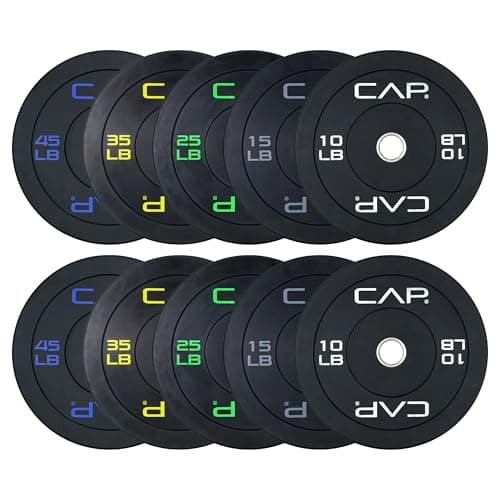
CAP 260 lb Olympic Bumper Plate Set
A 260 lb virgin-rubber bumper set with steel inserts — the value pick for a complete plate loadout that survives being dropped from the top of a deadlift.
#ad · Price as of October 5, 2026 · Affiliate disclosure
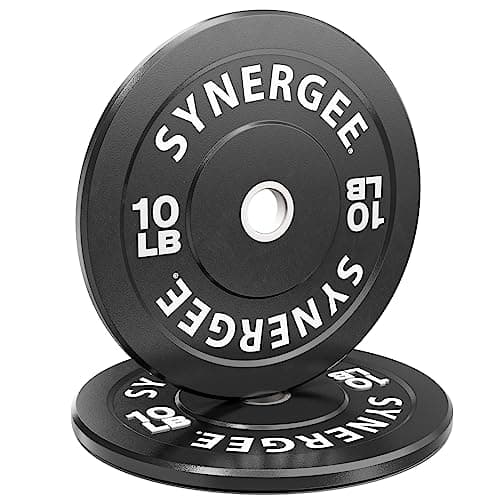
Synergee Bumper Plates (Pairs)
Durable low-bounce bumpers sold by the pair — the pick when you want to buy exactly the weights you're missing rather than a whole set.
#ad · Price as of October 5, 2026 · Affiliate disclosure
The CAP set is the value route to a complete drop-safe loadout in one purchase — virgin rubber, steel inserts, and low bounce that its own listing calls quiet enough for a garage platform. The Synergee plates are sold by the pair and published on genuinely low bounce, which makes them the better pick if you are topping up an existing set or you drop onto a slab in a shared space. The full field is ranked in best bumper plates.
If the concrete is outdoors
A driveway or patio adds weather to the equation, and that changes which plates make sense — rubber bumpers are the right answer there too, but for a different reason: the plate body is rubber rather than a coating over steel, so there is no bare metal face for rain to find. Our best weight plates for outdoor use page ranks that case specifically, and the same warning applies twice as hard: bring the barbell indoors.
The short version
Drop bumpers on concrete without worrying about the plates or a healthy slab. Do worry about the bar, because a hard floor sends the shock straight back into its sleeves, and that is the expensive part. Put mats or a platform under the drop zone — the cheapest meaningful upgrade in a garage gym. Buy plates on low bounce and a steel hub insert. And do not drop the bar loaded only with light bumpers, on any surface.