The published specs, side by side
Every figure below is from the maker’s own listing. Where a maker publishes nothing we say so, and in this category the gaps are telling — two of the five will not commit to a capacity at all.
Two rows carry the decision. A free-standing pair has no width limit at all — you place the two uprights wherever the bar needs them, which is genuine flexibility and also the thing that makes them easy to knock out of alignment. A connected frame fixes the width but stays square forever. Neither is better; they fail differently, and the rest of this page is about which failure you can live with.
Connected frame, or a free-standing pair?
A pair, if the range matters more than the rigidity
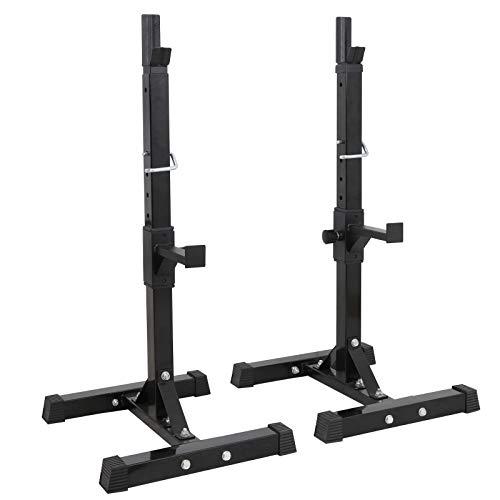
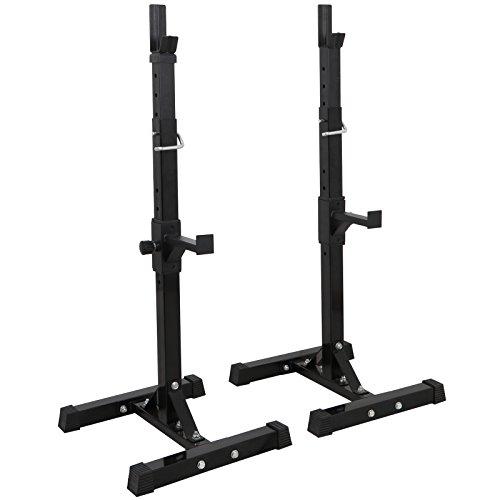
Two separate uprights will take any bar length, set to any width, and store in a corner in a way no frame does. The costs are real: two things to level on an uneven garage slab, two things to re-square after you knock one with a loaded bar, and no cross-member tying them together, so a badly-centered rack-out can tip one. Treat the spacing as part of your setup routine rather than something you do once.
A frame, if you want to set it and forget it
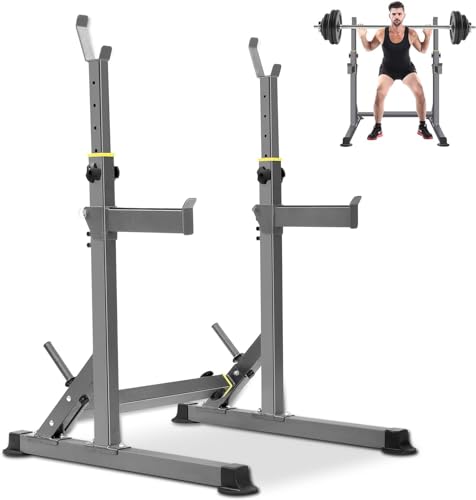
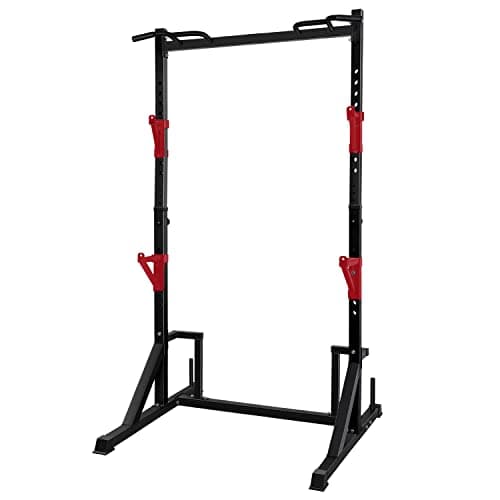
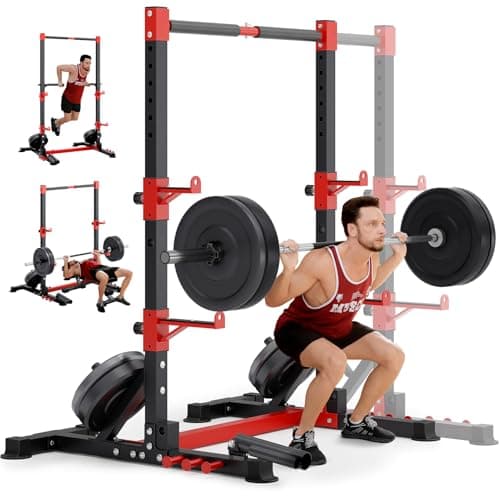
The YOLEO and CANPA are connected frames with adjustment built in, which is the best of both when the published range is wide enough — and the YOLEO’s 35–67 inch span is wide enough for anything a home lifter will own. A frame also gives you somewhere to mount a pull-up bar, which a bare pair cannot do. Best squat rack with a pull-up bar is the list if that is the deciding feature.
What an adjustable stand gives up against a cage
Be clear-eyed about this, because it is the real trade. A two-post stand catches a failed rep in one direction only. Fail a squat forward, or fail a bench press onto your chest, and spotter arms that reach one way are not a cage’s safeties. Only one of the five stands here ships with safety arms at all. If you train alone and heavy, read spotter arms vs safety straps and power rack vs squat rack before you decide, and know that best squat rack under $200found that a full four-post cage still clears that price — so a cage is not automatically the expensive option.
What you get in exchange is floor space and portability. A stand lives against a wall between sessions, which is why a room that has another job usually ends up with uprights rather than a cage. If the room is the binding constraint, best power rack for small spaces covers the folding alternatives, and power rack vs half rack covers the structural middle ground.
Setting the range you actually need
- Squat rack-out height sits a couple of inches below your standing shoulder height, so you un-rack by standing up rather than by calf-raising. For most adults that lands somewhere in the high 40s to high 50s in inches.
- Bench press heightneeds the bar roughly 18–22 inches off the floor with the bench in place — far lower than people expect, and the single most common reason a stand turns out to be useless for pressing.
- Rack pulls want the lowest setting the stand offers, usually knee-height or below.
- Check the increment, not just the span.A 40–66 inch range in coarse steps can still miss your exact bench height by an inch and a half. None of these makers publishes the hole spacing — westside hole spacing, explained covers why the gap between holes matters most on bench.
And load the base or bolt it down if you do pull-ups on a frame that offers them. How to anchor a power rack covers both the bolted and the renter-friendly versions. For the wider rack field see best squat rack, best power cage and best home gym rack; on cost, how much does a power rack cost tracks the live spread.