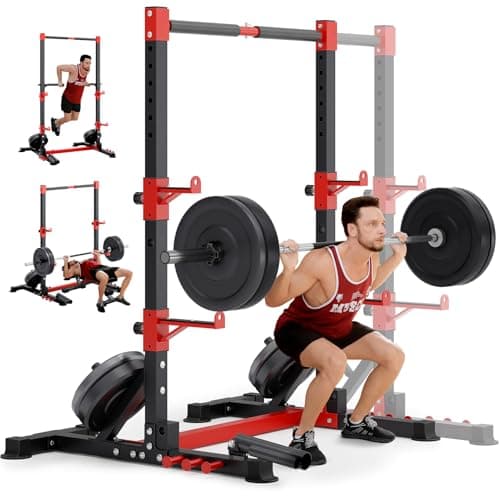
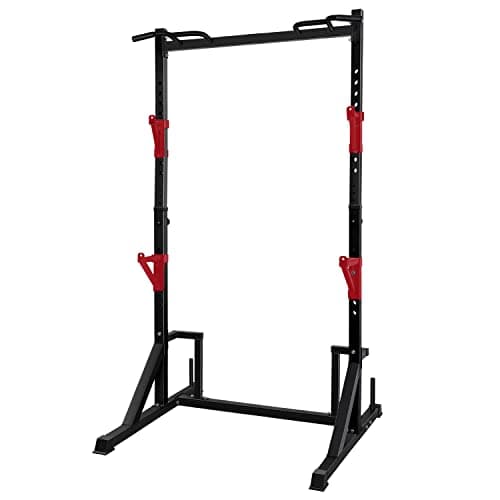
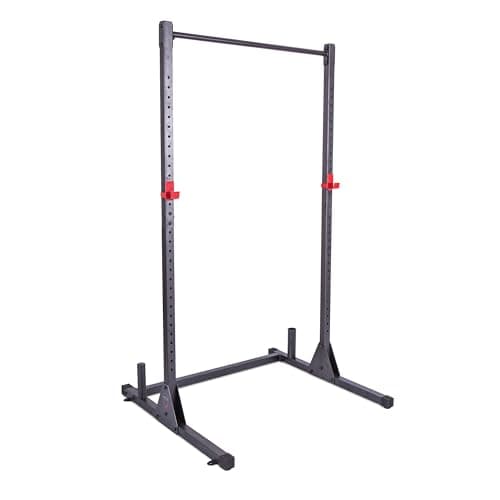
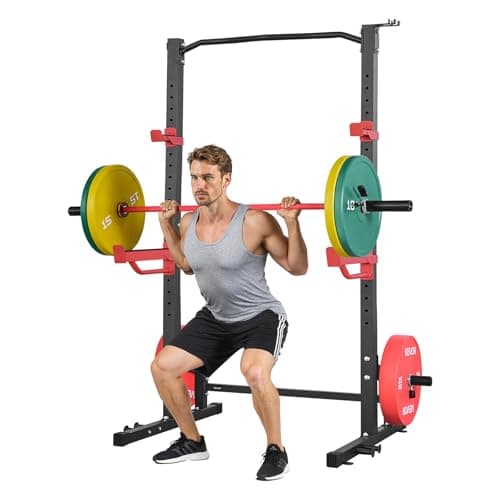
The published specs, side by side
Every figure below is from the maker’s own listing. This is a category that publishes very little, and the blanks below are the honest state of it.
Two rows carry most of the decision. Only the VEVOR publishes a number, and only the YOLEO publishes that it fits a short bar. If you own a 6 ft bar, that second row is not a detail — a standard cage is built around a 7 ft bar and a short bar may not span the J-hooks at all. See 6 ft vs 7 ft barbell for the measurements and how wide should a power rack be for the rack side of it.
Cage, half rack or stand?
Cage, if you train alone
Four uprights mean the safeties sit on both sides of the lift, so a failed squat lands on steel whichever way it goes and a failed bench cannot pin you. That is the single strongest safety argument in home lifting, and under this cap it costs you a fixed footprint and (on the VEVOR) no pull-up bar. Power rack vs squat rack and power rack safety checklist are the two pages to read next.
Stand, if the room has to stay a room
A two-post stand takes roughly half the floor of a cage, adjusts to the width of the space, and in the YOLEO’s case moves between a 6 ft and a 7 ft bar. You give up the rear safeties, so you are relying on spotter arms that only reach one way — spotter arms vs safety straps explains the difference, and best power rack for small spaces is the list if floor area is the binding constraint.
Half rack, if you want the middle
An adjustable half rack gives you a pull-up bar and more front stability than a stand without a cage’s full depth. It is the least distinctive of the three formats and usually the right compromise for a garage bay. Power rack vs half rack covers the structural difference, and what is a half rack the basics.
What $200 does not buy
Four things, named plainly. No cable pulley or LAT pulldown— the cheapest rack we track with cables included is roughly half again this cap, and best power rack with cable pulley is that list. No published footprint or heighton any pick here, which is the spec that most often stops a purchase — measure your ceiling first and read power rack ceiling height. No 11-gauge steel; see 11-gauge vs 14-gauge steel for what the gauge actually changes. And no westside hole spacing, so your bench and safety heights come in coarser increments than they would on a commercial rack — westside hole spacing, explained covers why that matters most for bench.
If you can stretch past the cap, the next real step is a $270–$310 cage — see best power cage for the four-post ranking, best power rack for every format, and Rogue power rack alternatives if you arrived here after pricing a commercial rack. On the spread, how much does a power rack cost tracks the live numbers, and best budget power rack is the no-cap budget ranking.
The two things to do on day one
First, anchor or weight it if you do pull-ups. A sub-$200 rack is light enough to lift at the front when you kip or when you unrack a heavy squat unevenly — how to anchor a power rack covers bolting and the plate-loaded alternative, and can you do pull-ups on a power rack is the honest answer for this price band. Second, re-torque every bolt after your first few sessions. Budget hardware settles, and the fix takes five minutes with the wrench that came in the box. How to assemble a power rack has the order that saves the most swearing.