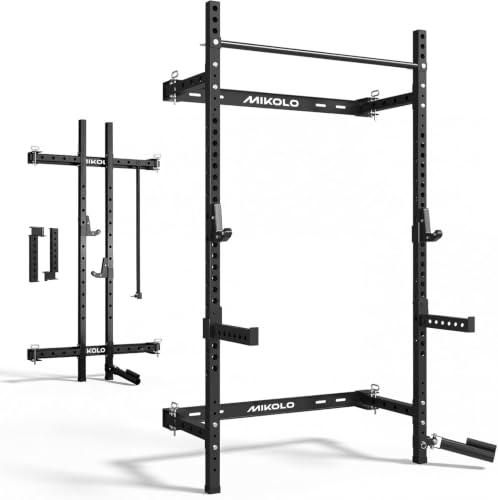
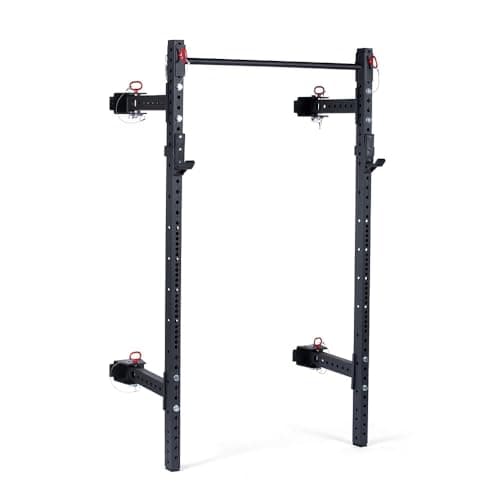
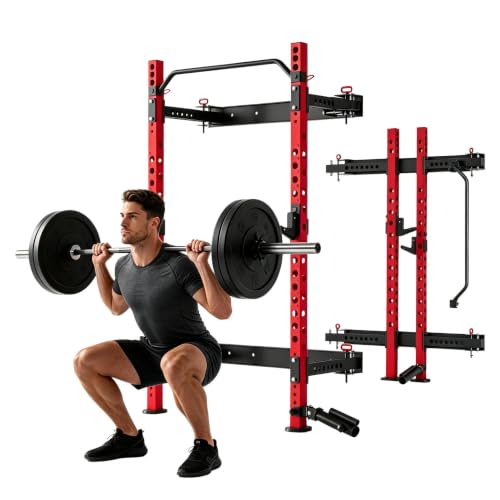
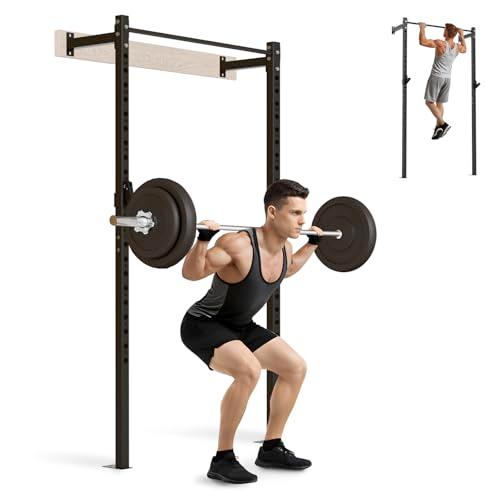
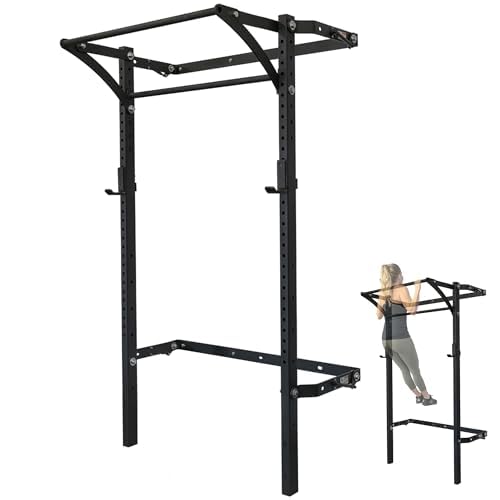
The published specs, side by side
Every figure below is from the maker’s own listing. The two most useful columns are not the capacities — they are safety catches and folded depth.
Read the safety-catch row before the price. Only one rack on this page states that safety catches are included, and that is the difference between a rack you can fail a squat in alone and a rack that simply holds the bar. The rest rely on J-cups, which hold a bar at rest and catch nothing. If you train alone and heavy, that row should probably decide your purchase — spotter arms vs safety straps covers what actually catches a failed rep.
And note the folded depth row: only the Titan publishes one. That is the single number that decides whether your car still fits in the garage, and four of five makers leave you to find out after you have drilled into your studs.
The mounting is the real purchase
You need solid studs, and you need to find them properly
Every rack here transfers your entire working load into a wall. That means timber studs or solid masonry, located with a proper detector and confirmed, not guessed. A wall mount lagged into drywall alone will pull out, and it will do it under load. If your wall is uncertain, this is the wrong class of rack and a freestanding one from best power rack is the honest answer.
It is a semi-permanent install
You are drilling into the structure of a building you may not own. Renters should check their lease before buying anything on this page; the holes are not small. That permanence is also why brand longevity matters more here than on a freestanding rack — you cannot easily swap the whole thing out when a J-cup cracks. How to anchor a power rack covers the hardware side, and folding vs freestanding power rack weighs the whole trade.
Check your ceiling for the pull-up bar
Every rack here includes a pull-up bar, and a wall mount puts it closer to the wall than a cage does — which means your head, not the bar, is what hits the ceiling. Measure before you mount, and read power rack ceiling height.
What the money buys in this class
- At the bottom, around a tenth of the top price, you get uprights, J-hooks and a pull-up bar. No safeties, no published tube size. That is a real tool for pressing and squatting to conservative weights, and not a rack to max out in alone.
- In the middle, you buy inclusionsrather than steel: safety catches, a landmine, an adjustable pull-up bar. The Mikolo and MU both ship a landmine in the box, which is a genuinely useful attachment on its own — see best landmine attachment for what one costs and what to check if yours did not come with it.
- At the top, you buy steel and brand. The Titan is the only rack here on 11-gauge 2×3 tubing, and the PRx is the only one from a company that will still be selling parts for it in five years. 11-gauge vs 14-gauge steel explains what the gauge changes.
When a wall mount is the wrong buy
Three cases, plainly. If you rent and cannot drill, nothing on this page works — see best adjustable squat rack for free-standing uprights that store in a corner. If you train alone at genuinely heavy weights, the missing rear uprights are a real safety gap and a four-post cage is the right answer; one still clears $200 on best squat rack under $200. And if your walls are masonry you would rather not drill, the install cost and risk can exceed the price difference to a freestanding rack.
For the wider field see best power rack, best home gym rack and best power rack for small spaces, which mixes formats rather than restricting to wall mounts. On cost, how much does a power rack cost tracks the live spread.