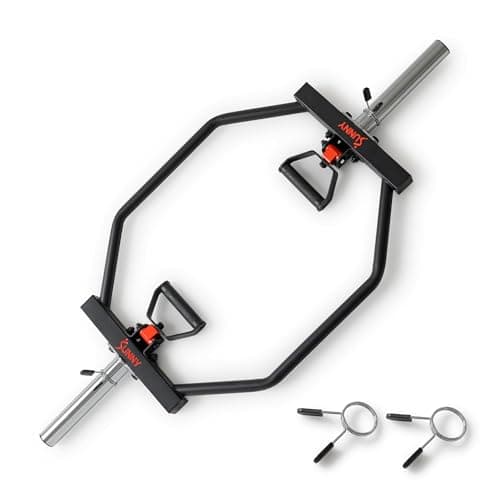
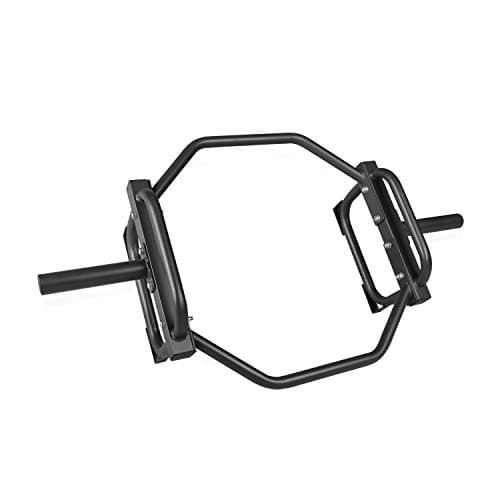
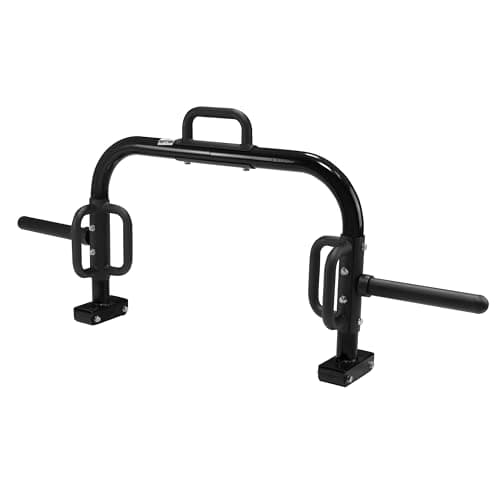
The published specs, side by side
Every figure below is from the maker’s own listing, including the bar that misses the cap so you can see exactly what the extra two dollars buys.
Read the bottom two rows together. Not one trap bar at this price publishes a bar weight, so your true working total is a guess until you put the empty bar on a bathroom scale — do that on day one. How heavy is a trap bar covers the usual range and why it varies so widely. And only one of the three does loaded carries, which is the clearest reason to pick one bar over another down here.
What the cap actually costs you
Capacity, if you are already strong
A trap bar deadlift is usually the heaviest pull a home lifter owns, because the mechanics are kinder than a straight-bar pull. The 400 lb Sunny rating and the 500 lb CAP rating are real numbers, not conservative ones, and they include the bar. If you are already pulling over about 350 lb, the sub-$100 bars are the wrong purchase and you should look at the 750 lb and 1,000 lb bars on best trap bar. How much weight can a trap bar hold covers what a rating does and does not cover.
Handle height, which is a real decision not a spec sheet line
All three bars here have a single handle arrangement, and the arrangement changes the lift more than the price does. Elevated handlesraise the start position a couple of inches, which genuinely shortens the pull — excellent for shrugs and rack pulls, and a real reduction in difficulty if you were hoping to compare numbers against a barbell. High and low pairs give you both heights by flipping the bar over. Swivel handles rotate to whatever angle your wrists want, which is comfort rather than height. Trap bar high vs low handles works through what the height change does, and open vs closed trap bar covers the frame fork.
Finish, which is cosmetic until it is not
Below $100 you get painted or plain black steel, and the Deluxe Open’s welds are explicitly budget-tier. Neither is a safety issue at these loads. What they are is why the bar looks older than it is after two winters in a garage, and chrome — the one thing the over-cap bar adds — wears visibly better where plates load. How to prevent barbell rust applies just as much to a hex frame as to a barbell.
The good news about this price band
A trap bar is unusually hard to cheapen. It is a welded steel frame with two sleeves — no bearings, no bushings, no finish doing structural work, no moving parts. Compared with a budget barbell, where the money buys tensile strength, knurl quality and sleeve spin you can feel, a sub-$100 trap bar gives up remarkably little. What it gives up is capacity and handle options, and both are published numbers you can check before spending anything. That is why the usual budget anxiety lands differently here than it does on racks, and why is a trap bar worth it answers yes more often at this price than at any other.
Before you order
- Check loadable sleeve length, not capacity.A 9″ sleeve holds roughly four bumper plates a side before you run out of room for a collar — comfortably past 400 lb, but it is the sleeve that stops you, not the rating. Trap bar loadable sleeve length does the arithmetic.
- Confirm your plates are 2″ Olympic.All three bars here take them; 1″ standard plates will not fit and adapters on a trap bar are a bad idea. See 2 inch vs 1 inch weight plates.
- Plan where it lives. A closed hex frame does not stand upright in a corner and the Deluxe Open lies flat, so you load it off the floor rather than from an upright position. Measure the space before you buy.
- Decide whether a trap bar is even the right specialty bar. Best specialty barbell ranks trap bars against safety-squat bars, which is the comparison most people should make first.